Showing posts with label Paper Frigate. Show all posts

Tuesday, November 1, 2016

Dea Ex Machina

Review: The Goddess of Sumer by Jenna Smith (aka Jennifer Seaver)


The premise is von Daniken-esque, ridiculous; star-gods bootstrapping hapless Sumerian humans until one of the gods is trapped in an ancient statue. The characters are expectable, even stereotypical. The bad guy is, literally, Satan (or Sadin).

And I enjoyed every word of this novel, from the dream-sequence beginning to the happy-ever-after ending. Even while my inner voice kept saying you know what happens next, I had to keep reading. And that’s the power of good story-telling, you care what happens to the characters. 

You don’t have to believe—it is fiction, after all. A good tale-spinner makes you want to know how it all turns out.

Jenna Smith’s tale opens on a nightmare. Jessica is being drawn to a glowing green female figure, even as she is chased by a growling beast. In her dream, she trips and hurts her ankle; when she wakes, her ankle is swollen. That’s our clue that her dream is something more than REM sleep.

When Jessica learns that her beloved uncle Derek has been hospitalized, she rushes home to be with him, despite the presence of an old flame, Randy, on her uncle’s ranch. Her uncle manages to tell her that there is an important box in the attic, and Jessica finds it contains a glowing green head from a woman’s statue.

Her uncle’s young friend Lance explains that the head is from a statue in which Sadin entrapped a Sumerian goddess, called Tiamat by some people, Horus by others. Lance has been chosen to be the next Guardian of the head, but Jessica’s uncle Derek has been Guardian for decades. Sadin’s powers, shattered by the goddess even as he trapped her in the stone, have had thousands of years to recover, Lance tells her. What’s more, the evil-doers have located the latest Guardian, poisoning Derek in their attempt to reach the goddess-head.

The statue heals Jessica’s injuries, and possessing it allows her to heal her uncle, and later, Lance. It seems the head also grants something like immortality, because the group meets with a “ancient Daoist,” Zhang Sen-Feng. Zhang is still going strong after spending hundreds of years as a Guardian. He also has the power to “cloud men’s minds,” which helps the group steal the body of the statue and escape the evil one’s henchmen.

Yes, it sounds trite and clichéd
. And yes, every time the story knits itself into a corner, a new power of the goddess or her Guardians is revealed. Somehow, they squeak through, chasing across the planet to finish at a temple of Horus where the body and head of the statue can be joined to free the goddess at last.

It’s still a good story, thrillingly told (if hokey), with enough deftness of phrase and turn of events to draw the reader along. I enjoyed every page, and was almost sorry to come to the end.

Wednesday, October 5, 2016

Grist for Google+, Fuel for Facebook, Talking-Points for Twitter

Review: The Complete Monty Python's Flying Circus: All the Words Volume 1 and Volume 2


Whether you post your opinions at a site that allows comments, or read social media posts, sooner or later you may be puzzled by references to the legendary walking tree of Dahomey1, or  E. Henry Thripshaw's Disease2.


Maybe it's simply a snide aside about "Mrs. Betty Teal and her lover in Boulton." Actually, it probably wouldn't be them; Mrs. Teal paid the requested £15, so the name of her lover in Boulton was kept secret. But it might be one of the other hapless victims of BLACKMAIL, a Pythonesque parody of a Candid Camera-style game-show.
PRESENTER: Hello, sir, hello, yes. No sir, no. I'm sure you didn't. No, it's all right sir, we don't morally censure, we just want the money... Yes, and here's the address to send it to:
(caption read in voice over)
BLACKMAIL
BEHIND THE HOT WATER PIPES
THIRD WASHROOM ALONG
VICTORIA STATION

Perhaps you see a plea for the words to "The Lumberjack Song", but by the time you've fired up your VCR, fast-forwarded through the wrong 18 episodes to find it, transcribed the words and got back to your computer, six other people have already answered.

Dear Sir, I wish to complain in the strongest possible terms about the song which you have just broadcast, about the lumberjack who wears women's clothes. Many of my best friends are lumberjacks and only a few of them are transvestites. Yours faithfully,
Brigadier Sir Charles Arthur Strong (Mrs).
P.S. I have never kissed the editor of the Radio Times.


Help is here in the two volumes of The Complete Monty Python's Flying Circus: All The Words. Here is the complete dialog of the "Parrot Sketch", the entire menu recitation that sets off the Vikings in the "Spam Sketch", the five Bruces of the "Philosophy Department of the University of Woolahmooloo".

Fourth Bruce: No. Right, well, gentlemen, I'll just remind you of the faculty rules. Rule one—no pooftahs. Rule two—no member of the faculty is to mistreat the Abbos in any way whatsoever if there's anyone watching. Rule three—no pooftahs. Rule four—I don't want to catch anyone not drinking in their room after lights out. Rule five—no pooftahs. Rule six—there is no... rule six. Rule seven—no pooftahs.

Both books include a complete cross-referenced index; items from the other volume appear in italics in the index of each book. What isn't in these volumes is the brilliant cartoonery and illustration of Terry Gilliam, nor the bizarre credits that sometimes reflected the insanity that went before. (Some of Gilliam's graphics are described, where they are essential to the story or critical to the joke.) An insert of photos from the well-known episodes is also included in each volume.
Cardinal Ximenez: Nobody expects the Spanish Inquisition!

I've been enjoying these volumes for years, and find them essential to my reputation as a Python-quoter. I recommend them for any Flying Circus debater who wishes to reach the next level.


Liner Notes:

  1. Nicholas Parsons, for whom the Pythons named the walking oak, is a long-time (long-running?) British game-show host and radio personality, seen in the US on The Benny Hill Show. To my astonishment, the 92-year-old Parsons still lives near London.
  2. I actually purchased an E. Henry Thripshaw's Disease t-shirt, and wore it often in the 1980s. Alas, it no longer fits.
  3. My favorite bit is The Poet Ewan McTeagle, with its allusions to pompously-hammy Shakespeare sonnet readers and the real Scottish doggerel poet William McGonnagall.

Saturday, July 30, 2016

Fickle Kitties and Chameleon DJs

Review: The Art of Getting Bent by Mark Sahm


This is not a book for a grammar-Nazi or frustrated proof-reader. If you can't read e.e. cummings without wincing and pulling out a mental blue pencil, leave this book on the shelf. 

With frequently-awkward phrasing (verging on the comical), sometimes-dicey word choices (weary for wary, poignant instead of pertinent), the novel reveals an author who struggles with the tense of verbs and number-agreement of pronouns. The result provides an unpleasant jar against your sense of ...

...Are they all gone?

Okay, now that the blue-haired librarians have left the room, I'll let you in on a little secret: This is a great story! Mark Sahm started out to create The Art of Getting Bent as a graphic novel. It shows. The action is kick-ass and relevant, the pacing is perfect, and the narrative style is reminiscent of John Brunner's Stand on Zanzibar, or perhaps John Dos Passos' Manhattan Transfer.

Yes, on nearly every page there is a grammar-wince lying in wait for your inner school-marm. Sure, some of the name choices (Taco Hell, StarPhücks coffee, an antagonist named Tagonist, for phücks' sake!) make it hard to stay immersed in the text. But the story! The story carries you along.

The main character of Sahm's story is a demi-lizard named Serico, living in a post-apocalyptic city. The world has been devastated by a disease called CXD, a horror of fatal infection against which man has found only two defenses. If one is wealthy enough, one can become a Cypure, living inside a powered suit of brilliant color that prevents contact with the contagion. Cypures have thus become an identifiable elite in this Manhattan-like place, Vitellius City, the Big Egg.

Far more numerous are those whose resources were more limited. These people chose instead to have their DNA inextricably spliced with that of an animal, because that makes their bodies immune to CXD. The Tag-B drug that accomplishes this merging also gives each Splice some of the characteristics of the animal—hence, Serico, whose chameleon eyes and skin reveal the lizard DNA he received.

Serico, we learn early, has a demon riding him. He works as a DJ in a Splice club, but he can only perform well when he's half-way along on a bender. For Serico, the art of his music requires that he master the art of getting bent just enough to let his brilliance loose. Amy, an owl-child martial arts master, has her own demons, born when her father died of CXD. She uses her anger to keep her survival skills honed. It doesn't pay to get bent out of shape—but Amy's found a way to make the martial art of getting bent just far enough pay off for her.

They're innocently heading for a confrontation with two entities who could lay waste to all their art: a jug of jungle rum with the label "Jugo del Diablo," and the convicted creator of the CXD plague, Tiberius Tagonist. Then there's Dr. Def Mechlin, a shadowy character whose presence spans the story from 1979 to 2020, the present day.

In the cold streets of Vitellius City in 2020, Cypures are being murdered. Their lifeless bodies are mangled and torn, and from each one, the power-pack is stolen (a Federal offense in itself). Is Tagonist killing the Cypures, trying to complete the job he started in 2005? Or is Mechlin the source of the Big Egg's current troubles? Without planning it, Serico and Amy will become embroiled in this struggle, as a result of practicing their art.

The story is supported and guided by street-signs along its path. Each chapter is headed by a graphic title, named like a station on a commuter train: Euston, Fuencarral, Gran Via, Opernplatz, Pacific, Vine. Each has an official-looking ID number, plus an "alternate designation" and "condition." These read poetically together like a traditional chapter sub-head from a Victorian novel: 


At Fuencarral: "Never tickle a fickle kitty / burned by the winds of change" 
At Vine: "I eat the inevitable ounce of honesty / fresh out of the foil wrapper"

Other graphics are scattered sparsely through the book, markers left over from the novel's earlier incarnation. Serico's chameleon eye looks out from several pages—Sahm's book has been through its own Splice.

The result is wonderful.

Tuesday, March 29, 2016

The Enchantment of Realpolitik

Review: A College of Magics by Caroline Stevermer


Here's a YA fantasy with an interesting premise: a European school teaches magic to those who attend. Before too many parallels to Harry Potter spring to mind, there are differences. Greenlaw College is more university than the preppy boarding school of Hogwarts. Rather than being hidden in the midst of present-day Muggles, Greenlaw College graduates live openly in pre-WWI Europe.

The most important contrast is the author's style. J.K. Rowling's Potter books are charming in their level of detail and focus on the practice of magic. 


Stevermer's characters, however, are immersed in the political and personal implications of practicing magic, ignoring the practice itself to concentrate on the results.

Faris Nallaneen will be Duchess of her small north-central European province, Galazon, when she reaches her majority in a few short years. Her uncle, meanwhile, as regent and head of her family, has decreed that she must go away to attend Greenlaw College.

Faris knows that her uncle's plans are not likely to be for her benefit, but she discovers that running away from school is not a solution. For one thing, there is the mysterious Tyrian, who shows up whenever he is needed to save Faris' life (or prevent her from running away). For another, there is Menary of Averill, a spiteful miss with powers she did not learn to use at Greenlaw College, who has an unexplained grudge against Faris. And finally, there is Faris' growing love of learning and Greenlaw itself, almost enough to balance her homesickness.

When Menary and Faris fight over Tyrian in the Dean's Garden at Greenlaw, both are expelled. Now Faris must return to her uncle in disgrace—paying a visit on the way to one of the wardens of the world in Paris. What she learns from the Warden of the West will completely overturn her view of the world and her place in it, and give a deadly new meaning to her school battles with Menary of Averill.

The pre-WWI world in which Faris lives is clearly not our own, but there are enough congruent points to free Stevermer from the need to create everything afresh. So Faris, Tyrian and her other companions travel on the Orient Express, for example, when she returns home to Galazon. She reads The Prince and The Prisoner of Zenda at school, and we can assume we know how each will inform her. And when her chaperone and friend, Dame Jane Brailsford*, insists that Faris buy clothes while in Paris, we know why.

Despite the uneven start, College rewards its reader with a pleasant time, plus just enough food for political thought to keep it real in the layers between the fantasy.

Note:

* The sequel, A Scholar of Magics, follows Dame Jane Brailsford home to England where she encounters an American sharpshooter.

Wednesday, March 23, 2016

When Hayduke Was a Verb

Review: Hayduke Series by "George Hayduke"


When the Hayduke books were published in the late 70s and early 80s, they were carefully labeled "for entertainment purposes only... not for children or the mentally unbalanced.

I remember reading them in that spirit, wholly comfortable with the idea of (someone else) wreaking vandalism, humiliation and even bodily harm in the effort to get revenge for some slight. With titles like Getting Even, Revenge and Byte Me! Hayduke's Guide to Computer-Generated Revenge, they were obviously not about turning the other cheek.

Still, they fit with the iconoclastic, Luddite-inclined spirit of the time. If the neighbor persisted in playing his icky music too loud, we'd just see how he liked having dirty words burned into his lawn with vinegar. If the power company kept parking their maintenance vehicle in our favorite space at the restaurant, heck, we'd just gum up the engine with two quarts of Karo syrup! And that jerk who dissed us at the office, well, wait until he gets to the hotel on his road trip—we've super-glued the trunk lock shut over his family's luggage.

At the time the books first appeared, there was some suspicion that "George Hayduke" was a pseudonym of Edward Abbey. The first Hayduke book, a tabloid-size papercover copyrighted in 1980, refers to Abbey's book The Monkey Wrench Gang, first published in 1975. But the main character of Abbey's fictional paean to desert eco-terrorism is a "Vietnam veteran, George Washington Hayduke III". (Abbey's name is also attached to the 1990 publication, Hayduke Lives!, released just after Edward Abbey died in 1989. This book may have been completed by an unattributed writer.)

For these reasons, I think it is more likely that the Hayduke pseudonym was chosen by someone who approved of the anti-development activism message of The Monkey Wrench Gang, and wanted to extend it to the petty spite of personal revenge. The copies I have are filled with pretty low-tech vengeance suggestions, but more recent publications include computerized revenge techniques. Hayduke is also the author of several do-it-yourself manuals for building silencers and other explosive means of making a point.

To repeat as I began, I remember chuckling over the nasty little tricks detailed in these books when I was in college. Rereading them now, in an age serious terrorist threats, I feel a little chill down the back of my neck. I hope Abbey's last title, Hayduke Lives!, is in error—I'd prefer Hayduke safely under the sod.

Thursday, March 17, 2016

Time Travel Terrorists

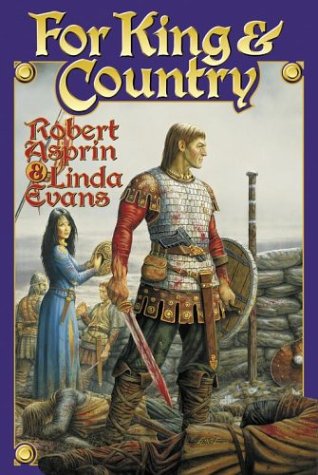
Review: For King and Country by Robert Asprin and Linda Evans


In this interesting take on time travel, only the time-traveler's mind can move back through time. On arrival, the time-shifted person provides guidance to (or takes over) a person in the destination era, in a schizophrenic guest/host relationship.

The story is driven by an IRA terrorist who is known to have acquired a place on the time-exploration team, and complicated by uncertainty about his (or her) precise identity. The terrorist's goal is to assassinate King Arthur, and so prevent the ascendancy of Britain over Ireland.

But how will the terrorist, who is after all unable to carry modern weaponry back to Arthurian times, manage to create this mayhem? The answer is the terrorist's knowledge of a bio-weapon, available anywhere (even today), and a plan to "weaponize" and deliver it to the best effect.

This is not a riveting novel; it is easy to put down and just as easy to pick up again later and read on from that stopping point. It is enjoyable and well-written, with engaging characters and a diverting story, worth reading for the plot twists and sense of everyday life in Arthurian Britain and Ireland.

Liner Notes:

  • The outcome from deploying the bio-weapon used in this story will appall anyone, yet it is equally accessible today for use by any terrorist.
  • After you've read this novel, you will never again casually slide a used knife into the slot of a knife-stand without sterilizing it.

Monday, March 14, 2016

Judicial Activism and the Power of Life and Death

Review: Decision by Allen Drury

When Pulitzer Prize winner Allen Drury wrote Decision, the US was deeply entrenched in the Cold War, the crime rate in the US was sky-rocketing, domestic terrorists wore peace signs, black berets and tie-dyed shirts, and the Supreme Court was already a center of "judicial activism," with decisions like Brown v. Board of Education and Roe v. Wade.


Drury's power does not lie in elegant phrases and interesting metaphors, but in his profound understanding of how men and women in positions of power work with each other. Drury wrote of a Supreme Court under fire from both sides of the American political spectrum; a court which, although divided inside by the passions and beliefs of its associate justices, must present a united front to reach a decision. This was a Supreme Court just coming to realize the potentials of its power:
"They can't just arbitrarily set aside one sentence and impose another!" gasped the young lady from the Des Moines Register, a new reporter at the Court. "Who says they can't?" the Washington Post responded tartly. "They're the Supreme Court of the United States, aren't they? Who's to stop them?"

Drury wrote from a conservative stance, and at the time he wrote this novel, was still willing to embody reasonable people in his more-liberal characters. So we meet new Associate Justice Taylor Barbour, coming to the court after a whirlwind confirmation by a conservative Senate, appointed by the Eisenhower-esque President for whom he had served as Secretary of Labor. Barbour has a good friend and former Yale study-partner, Moss Pomeroy, already on the court. He comes to a court that is precariously balanced between conservative and liberal. Taylor Barbour intends to embody that balance within himself, as he has all his life.

As these events transpire in Washington, DC, a shadowy figure gradually emerges into the light in Moss Pomeroy's home state, South Carolina. At first glance, Earle Holgren is a survivalist living modestly to avoid detection. But we learn of the inheritance that bankrolls his bitter fanaticism and of his plan to "make a statement" about the local nuclear power plant that has finally been completed.
...He estimated that at the time of the explosion, it would be quite dark. It would be a pretty sight against the looming mountains and trees. It would flower like a fountain. It would be a rose of death... He neared the roped-off area where uniformed guards watched impassively as a small group, some students and some leftovers like himself from an earlier age, stomped and shouted, their placards proclaiming hatred, dire prediction and fear. He stopped for a moment and watched them with contempt. What children they were... He felt no community with them any more. His methods were more direct.

What makes this novel echo so eerily in this millennium is the central emotional issue in the subsequent trials of Earle Holgren. Taylor Barbour's bright daughter Janie is visiting Sarah Pomeroy on the day of the power station opening. The explosion kills Moss Pomeroy's daughter outright, but injures Jane Barbour severely, and as the trial commences, she is in a persistent vegetative state. Barbour must set these emotional reactions aside as the suspected perpetrator comes to trial, much as Chief Justice Charles Evans Hughes advised a new colleague on the court in 1939:

Justice Douglas, you must remember one thing. At the constitutional level where we work, ninety per cent of any decision is emotional. The rational part of us supplies the reasons for supporting our predilections.  —The late Chief Justice Charles Evans Hughes, quoted by Justice William O. Douglas in his autobiography.

Drury's novel brings other characters into the fray: a huge national organization named Justice NOW! that seeks to strengthen criminal penalties, including the death penalty; as well as a curious amicus curiae filed on behalf of "CBS, et al" (the alii in that "et al" comprise all the major TV news broadcasters of the time) which seeks a judgment from the court to allow televising the execution of Earle Holgren, once his sentence has been imposed.

Allen Drury is always compelling reading, and of his novels, perhaps only his Pulitzer-winning Advise and Consent is more meaningful to current events than Decision. If your local library doesn't have them both, I'll be surprised.

News from 1632

Review: Grantville Gazette, edited by Eric Flint


When Eric Flint conceived the “Ring of Fire,” a cosmic event in that transposed an entire town (Grantville) from year 2000 America to year 1632 Germany, he created more than the basis for a series of novels. The concept attracted fans, inspiring them to comment and even write their own “fanfic” stories in the milieu Flint devised.

Some of those fans are writers in their own right: Mercedes Lackey, for one. Others are just as able if less well known, as this second collection of fan stories shows. Many of these stories began their life in the 1632 Slush Pile at Baen’s Bar. (For those who desire to get into science fiction writing, this is one path to publication.)

My favorite of these compilations is the second. (The first was Ring of Fire whose highlight was a David Weber story.) Grantville Gazette includes five fiction and three non-fiction pieces, plus an introduction by Eric Flint. The book also gives the ground rules for stories in the Ring of Fire milieu, the most important being, if it isn’t native to the time, and wasn’t in the real-life town of Mannington, West Virginia, you can’t use it in the story. For that reason, ideas and knowledge are the strongest assets possessed by the Grantville “up-timers.”

Portraits” by Eric Flint places an up-time American nurse posed as a cheerleader in the model’s seat of Pieter Paul Rubens. Technically, Rubens is an enemy, yet he manages to persuade the girl to sit for him, dressed in nothing but Old Glory and her own dignity. She has a secret agenda, however, one that is only revealed after her portrait is complete.

Anna’s Story” by Loren Jones tells the events of the night of Ring of Fire from the perspective of a rural German girl, and the crotchety old farmer who takes her into his farmhouse. Anna is appropriately wide-eyed over the wealth of the Americans, while her mother is worried that this lord they have come to live with will expect more from them than a servant’s work.

Curio and Relic” by Tom van Natta introduces a type of gunsmith not often discussed in time-travel stories. Paul Santee has a gun collection ranging from matchlocks to machine guns. More important, he knows how to repair, cross-part and modify ammo to supply most of the firearms that made it down-time with Grantville. The Vietnam vet has an important part to play in Grantville's defense.

Sewing Circle” by Gorg Huff is the longest story in the anthology, and my favorite. Junior achievement meets time travel in this tale of five high-school freshmen (with a cartel of middle-school investors) who bring twenty-first century economics and nineteenth-century technology together to help prevent inflation in Grantville.

Virgina de Marce returns in this second Grantville story collection with “The Rudolstadt Colloquy.” American notions of freedom and tolerance run headlong into Medieval religious thought, and the result is a quiet—even yawn-inducing—meeting. The problem, from the American’s point of view, is that Medieval passions run to suppression of freedom. What’s needed is a call to revolution, taken straight from the music of “Mother Maybelle,” Johnny Cash’s mother-in-law.

On the fact side of the ledger, three fascinating pieces explain the technological background of the Grantville universe. “Radio in the 1632 Universe” by Rick Boatright (the source of Eric Flint’s radio expertise for the novels) explains the Maunder Minimum that affects radio reception for Grantville, and also details the limitations on up-time materials experienced by the locals. Remember, if it wasn’t in Mannington, WV, it can't be in Grantville. Period.

They’ve Got Bread Mold, So Why Can’t They Make Penicillin?” by Bob Gottlieb explains the difficulties and challenges of up-timer doctors in 1632. They know where penicillin comes from in the same way most of us know how TV works. Making it is a whole ‘nother industry! Meanwhile they have plagues, starving refugees and a local war to contend with.

Horse Power” by Karen Bergstralh puts the genetic contribution of up-time horses into perspective with details of two equine genes (X-Factor and HyPP), one beneficial and one lethal, and the difficulty of identifying either one in 1632. A catalogue of down-time horse breeds and the availability of Belgian draft horses within the Ring of Fire completes her discussion of the “horse power” available in Grantville.

If you’ve enjoyed the “1632verse” novels, both the fact and the fiction in this compilation are must-reads. For those who have never encountered Eric Flint’s Ring of Fire, I recommend reading at least 1632 first.

Saturday, February 13, 2016

In the End, It Killed Him

Review: The Man With Three Wives, with Beau Bridges and Pam Dawber


Last night I got sucked into a 1993 made-for-TV movie, The Man With Three Wives. I cannot explain why this sleaze even caught my eye sufficiently to cause me to turn it on—perhaps it was the concept that it was based on a true story. 


Maybe it was just the opportunity to see Pam Dawber again.

Whatever my initial motivation, I was thoroughly hooked by the first commercial break. Beau Bridges, who played Dr. Norman Grayson, the polygamist of the title, presented a complex character with confused motives. Genuinely caring, a truly good doctor, Grayson suffers because he really does love all three women.

Yet he lies to them constantly, by omission and by action, covertly and overtly deceiving everyone for whom he supposedly cares. He complains of stress in his life; his solution is to marry a third woman. He even juggles two wives who live in the same community, managing to keep them separate. Wife #1 (Lillian, played by Kathleen Lloyd, a veteran TV-movie actress) is the mother of Grayson’s three adult children. Wife #2 (Katy, played by Joanna Kerns, familiar to wide-screen audiences from Girl, Interrupted) owns her own business; Katy’s father is another doctor at Grayson’s hospital, and his good friend.

The unbelievable cojones required to keep up this balancing act can be encapsulated in one scene. About four years into their marriage, Katy arrives at the hospital and asks Grayson to take her to lunch at the mall. She knows Lillian (whom she believes to be her husband’s ex-wife) is participating in a bicycle safety event there. Grayson not only consents to introduce them to each other (by first name only, needless to say), but stands there with a gentle smile on his face as the women exchange guarded greetings—he even invites Wife #1 to lunch with him and Wife #2! (Fortunately for Grayson’s adrenals, Lillian cannot leave the booth she’s tending.)

Bridges’ Grayson never breaks a sweat in public—but at night, as he weaves his pattern of false emergencies and late hours to sleep with both local wives for a few hours each night, the years of bigamy begin to take their toll. Increasingly, he wakes in a cold funk, and needs to gobble antacids to return to sleep. When Grayson helps Robin (Pam Dawber) through her divorce, this woman with whom he has a long history of friendship becomes first a refuge from his stress, then a new source of it when he marries her, as well.

The third marriage escalates his problems, as Grayson begins to lose some control in this incredible juggling act. He “forgets” to make several mortgage payments on the house he is buying with Katy, in order to pay the income taxes for his household with Lillian. Checks are being returned NSF from all the accounts he’s opened for the three homes. His marriage to Robin entails travel every other weekend, and when he rejects Robin’s offer to come visit him at the hospital, saying he “can’t afford to put her up in a motel” there (which is probably true on several levels), her suspicions are aroused.

Robin, unlike either of Grayson’s long-term wives, is sufficiently worried to hire a private detective. What she learns sends her storming into Grayson’s office with a full annulment, and a restraining order to keep him away from her daughter. She does, however, consent not to tell anyone else about her “husband’s” infamy.

Throughout the movie, I was engrossed by the narrow escapes and the effrontery of this man, whose three wives could say, even after his bigamy was revealed, “But I still love him!” I knew his artificial world would eventually come crashing down. The grace of this movie (which, given the topic, could easily have been as sleazy as its title implies) is that we want Norman Grayson to succeed, even while we know that he deserves, and is ultimately doomed, to fail.


Liner Notes:


  • This review was first published in 2005 in my blog Paper Frigate. It also appeared in Blogcritics and was republished in print in the Cleveland Plain Dealer.
  • The real-life polygamist, Dr. Norman Lewiston, lived and worked in the San Francisco Bay area. Wife #3, Robyn Phelps, met him when she worked at the same hospital, but married him after she had moved to San Diego.

Wednesday, December 23, 2015

Comedy of Manners and Time Travel

Review: To Say Nothing of the Dog by Connie Willis

Connie Willis has a unique twist on time travel: the "net" through which travelers access other times is self-correcting. Not only can one not travel to a time in which one has already lived, one cannot bring "through the net" anything that might cause an anachronistic incongruity. Crisis points are even more tightly controlled: no one can travel to Waterloo, for example, or get close to the grassy knoll. 

So when in To Say Nothing of the Dog, Ned Henry is dragooned by Lady Shrapnell into traveling back in time to research the "bishop's bird stump" at Coventry Cathedral just before it was destroyed in the Blitz, he is baffled by his inability to find it. Back and forth he goes, getting more and more time-lagged as he visits jumble sales ("maybe it was sold as a white elephant"), the bombed-out smoking remains of the cathedral ("That's a cat! I thought it would be the size of a wolf, somehow...") and the putative peace and quiet of the Victorian age. 

The last visit is necessary because somehow, a cat (extinct in 2067) has been brought forward through the net. Ned is volunteered to take it back, and somehow get Lady Shrapnell's great-great-great-grandmother to visit Coventry so that she will write about the bishop's bird stump in her diary, because, so Lady Shrapnell will be inspired to rebuild Coventry Cathedral and restore the bishop's bird stump to its rightful place in history and the hearts of Englishmen. 

Mr. Dunworthy and Finch, whom we met in The Doomsday Book, are back. They want to make sure the net stays open and history happens. Lady Shrapnell is determined to get the cathedral rebuilt on time, with the bishop's bird stump, despite the laws of physics—besides, "laws are made to be broken." Professor Peddick wants to defeat his rival Overforce with his ideas of a "Grand Design" that "shapes our ends, rough-hew them how we may." Verity Kindle wants to make sure the cat she rescued isn't drowned, "incongruity or not." Ned just wants to get a full night's sleep. 

What transpires out of this knot of competing ambitions is a wonderful comedy of manners, with modern perspective applied with liberal amounts of humor and allusion. History is used as a sustaining structure seen by the participants in the way we note limbs, leaves and stems on a tree: as a confusing mass dimly perceived in detail, and really understood only as a gestalt "tree." (Even while Lady Shrapnell reminds us that "God is in the details," we see clearly that using computer models to guide our choices is a poor strategy, because "that's the problem with models—they only include the details people think are relevant...".)


It is also an Agatha-Christie-style mystery whose deftly-handled clues span 700 years of history. At least. The wonder of Willis' writing is that the novel succeeds brilliantly on every level, and rewards re-reading with new insights each time.

I recommend it highly. 

Thursday, September 17, 2015

Quick Recipes For Dummies Like Me

Review: 30-Minute Meals For Dummies by Bev Bennett

I’m a sucker for cookbooks with a twist, and this super compilation of quick recipes in the For Dummies series, Bev Bennett’s 30-Minute Meals For Dummies, is certainly skewed far enough to suit my tastes. 

I also love a chef who shares my own approach to cooking, in which many favorite recipes begin, “Open a can of…”

Bennett starts with a brief review of why family mealtimes are important. In addition to the family bonding that takes place at the table, she stresses the importance of nutritional control, and the dietary training that starts in the kitchen. 
She avoids being preachy by delivering this message with humor:
  • Assumptions about my readers: You buy every book with a black-and-yellow cover that you run across…
  • Packaged foods don’t all come in the macaroni-and-powdered-cheese variety. You don’t have to eat like a 7-year-old when you cook from a box.
  • In case you’re thinking about double-duty, a “poached salmon in the dishwasher” recipe occasionally makes the circuit of Internet message boards and spiral-bound school fundraiser recipe books. It’s not a technique that I endorse. I tried it, and my dishes smelled fishy for weeks…

I wasn’t tempted to poach salmon in the dishwasher, but I did try Bennett’s Hot Sweet Chicken over rice from this chapter, and although my prep time ran 10 minutes instead of the 5 she estimates, with the 20-minute cooking time, it still came in at a half-hour. This dish was such a hit, I’ll try it with the pork tenderloin variant next time!

Like the Working Stiff Cookbook (reviewed under What's for Dinner? [And Who's Cooking?]), this cookbook spends a chapter recommending the contents of a well-stocked pantry to help speed the task of cooking. Beans, grains, and canned fish and tomatoes top the list of pantry-stuffings, with spices and herbs for the seasoning cupboard. 

Among other recipes, the vegetarian Kale and Canellini Bean entree shows the value of having ingredients ready to hand. Canned canellini (white kidney) beans are a favorite of mine because of the way they fall apart in a slow-cooker, making a delightful thick soup. Matched with garlic and kale fresh-picked from the garden, this soup-pot meal took less than the 27 minutes estimated (mainly because I used pre-minced garlic). I’ll probably convert it to a slow-cooker recipe in the future.

Dining Once, Eating Twice is Bennett’s suggestion for the occasional restaurant meal. In response to super-sized servings of steak, fries and roasted chicken, she recommends eating a sensible portion, then bagging up the rest with an eye to recipes that rock out on leftovers. My favorite in this chapter, I have to admit, is French Fry Soup. Knowing that fries are basically inedible once they cool and lose their crisp “tooth” leads many of us to eat the entire serving. But with this clever, quick recipe, you combine those cold, limp leftovers with a large can of chicken broth, some dill, garlic and pepper, and get a super soup in just over 10 minutes. It’s much easier to stop cramming fries down long after the satiation point when you know the rest will be reborn in this tasty dish.

The next chapter, Cooking at Warp Speed, advises how to use pre-packaged meals to reach a nutritional conclusion in a short cooking time. Restaurant risotto is a dish that takes a long time to prepare. The rice is stirred slowly over a low heat, so that the grains develop a slightly sticky consistency—definitely not a candidate for a quick meal! Yet packaged risotto mixes can be prepared in much less time, yielding a similar result from your “home cooking.” The Bacon and Vegetable Risotto was the first recipe I tried from this cookbook, since I had a package of plain risotto mix and uncooked bacon already. Because I needed to cook the bacon first, it took me 20 minutes, as opposed to Bennett’s estimate of 1 minute prep-time and 15 minutes cooking time when pre-cooked bacon is used.

Bennett even includes a list of time-saving equipment to boost your kitchen productivity. From silicone spatulas to parchment paper, these items can help reduce prep and cleanup time, making your cooking time more effective.

I have a final word for Bev Bennett. Don’t be so quick to dismiss the blue-and-yellow box! Packaged macaroni and cheese is available as Kraft Easy-Mac, in microwave-quick servings. I make Kickin' Kraft Easy-Mac by stirring chopped jalapeños and a small can of drained tuna into two of these single-person packages after cooking. The result is a hearty adult meal for both of us in just under 5 minutes.

Bon appétit!

Liner Note:

30-Minute Meals For Dummies is available for Kindlealthough who buys a cookbook on Kindle?

Tuesday, September 1, 2015

Before the Bohemian Club

Review: Out of the River Mist: A Guerneville Area History by C. Raymond Clar


Before the Bohemian Club, before the wineries and vineyards, there was a crop that touched the sky and drew settlers to the misty reaches of the Russian River. 

The Pomo Indians appear to have called the river Shabaikai. In 1812, or thereabouts, Russian fur trappers came up the river from the coast, and they called it Slavianka, "pretty little Russian girl." 


In 1823, the northernmost Spanish missions were established in Sonoma and San Rafael—but it was not until a decade later that Spanish scouts explored into the Santa Rosa valley, checking up on the Russians. They named the river San Ysidro, or possibly San Sebastian.

At this time, there were still major stands of redwoods in the area, undisturbed. The Russians were only interested in the animals who lived in the redwood forests, and in the fish who teamed in the river. The Spanish were primarily interested in converting the indigenes to Catholicism.

By 1844, however, land grants were being made along the river, and it was now noted on maps as El Rio Ruso, the Russian River. Early settlers' names are still to be found on the maps of the area: John Heald (Healdsburg), George Guerne (Guerneville), William Henry Willits (Willits), Elijah K. Jenner (Jenner). These settlers who came into the area viewed the huge trees as a substantial asset, but only where they could be moved downstream to the lumbermills. 

The red-letter day for lumbering on the Russian River occurred when the first milling equipment was laboriously carted from Forestville over the low divide into Pocket Canyon, to be installed in a new lumbermill at the location of present-day Guerneville. According to Clar, the partners in this mill were John Heald, William Willits, John W. Bagley, and George Guerne. They set to with a will, and were so busy that the growing community around the mill (which included Clar's grandfather) was initially known as "Stumptown."

Clar writes a capsule description of the end of the mill's life in a brief passage:

It is doubtful if anyone working in the great virgin forest that fed the "big mill" of Guerneville ever gave any serious consideration to the possibility of harvesting a second crop of lumber from this land... My father, the expert chopper and shingle sawyer, could not comprehend why or what I was doing when I enrolled as a college forestry student... At any rate, came the day when the last practically available log was transported to the sawmill. The boilers were allowed to cool... A bustling era had come to an end.

The best history to read is the one that connects the past with our lives today, and for me, Clar's history of the area where I now reside meets that requirement.

Saturday, June 13, 2015

This Too-Mortal Clay, and This, Too

Review: Kiln People by David Brin


After a decade spent exploring his Uplift Saga (with detours for The Postman and his contribution to the Second Foundation prequel trilogy, Foundation's Triumph), David Brin has written another stellar entry in original, thought-provoking science fiction.
"More than any writer I know, David Brin can take scary, important problems and turn them sideways, revealing wonderful opportunities. This talent shows strongly in Kiln People..."  ——Vernor Vinge
In Brin's novel Kiln People, the home computer and home FAX machine have been joined by another widely-distributed technology: the home copier. It's not for copying documents onto paper, though, it's to copy your soul's "Standing Wave" onto a clay "ditto." People have become used to living multiple lives, sending their duplicates out into the world to clean their toilets, mow their lawns, work at their boring jobs——and also dance (and brawl) in their night-clubs, walk their streets and star in their porn movies, kill their enemies (in duplicate only, of course); even go home to a boring wife and bratty kids.

In the best sense of hard science fiction, Brin has explored all the implications of this technology. To start, if your soul is what is impressed on the blank clay ditto, what does that imply about people who are unable to duplicate themselves? In this society, they are shunned as "soulless." And what happens when the original, "real" person dies before his duplicate expires? His "ghost" is still embodied in the duplicate, able to revenge his murder or mourn his natural death, but unable to be copied into another ditto blank or load its memories into another person.

The soul is seen as separate from the personality, as well; people routinely create "ebony" duplicates capable of great focus and dedication to a single intellectual task, then "inload" the memories (and information) gleaned from that ditto's efforts. It is also separate from sensuality; the "ivory" ditto carries a full sensorium to allow sexual contact at one remove—you can't catch an STD if the only thing you take from an encounter is the memory! One character is so capable at imbuing her ivories with her own "smoldering sensuality" that her ivory dittos are routinely "ditnapped" by the criminal Beta.

Ditto tech has implications for warfare, too—armies are composed of thousands of duplicates of a few highly-trained and capable warriors, who set their souls into the quiescent clay, which can then be frozen and stored ready to fight when required. In a bizarre mirror of Robot Wars, would-be warriors create fighting ditto shapes and contend in an arena to "try out" for the ranks of soldiery.

For many people, ditto technology means they have no place in the working world. Instead, vast numbers are paid a "purple wage," and left to rely on their dittos for entertainment. So large parts of the city are given over to the recreation of re-creation, in which the copies of ordinary citizens can pretend to be Montagues and Capulets, or Ozzie and Harriet.

Albert Morris is lucky. His dittos rarely go "frankie," running off to live their own short-lived lives as they please. They all come supplied with his overwhelming curiosity and desire to get to the bottom of things, so he has a thriving business as a private eye. And while not all of his gray dittos get home in one piece, they manage to get back often enough that he is one of the best in the business. It's why Geneen Wannamaker, the porn ditto queen, and Aeneas Kaolin, the owner of Universal Kilns (monopoly maker of ditto blanks) have both hired copies of Morris to help them solve their problems.

Brin tells the story from the multiple first-person perspective required by this technology, weaving the disparate tales of the two gray dittos Morris has assigned to work for Wannamaker and Kaolin; plus his very first frankie, a green ditMorris that did not want to clean toilets that day, as well as realMorris. A witty line at the beginning of each chapter tells us which of the Morris avatars is speaking, and Brin has warped the language in believable ways to incorporate personal duplication.

I loved this story, and especially liked the clever way Brin named his characters. Two (Kaolin and Montmorillin) are named for types of clay. Two more (to tell would be a spoiler) share names with people in the golem myths. Several others bear the names of dolls or puppets. Brin has also borrowed behaviors observed in the explosions of social media, Internet-surfing and blogging, and then applied them to his fictional technology in ways that make sense.

This is a mystery story wrapped in a roller-coaster of punning energy and technology gone right in unexpected ways. I recommend it highly.

Sunday, March 22, 2015

Sweet YA Sci-Fi for An Adult Afternoon

Charles Sheffield is known for the depth and scope of science in his adult science fiction; as if he had added to Asimov's famous line, "To be good science fiction, it must first be good fiction," the reservation, "but it must also be good science." 

This charge Sheffield has met even in his fiction for the Tor Jupiter series, with four juvenile novels (Higher EducationThe Billion-Dollar BoyPutting Up RootsThe Cyborg from Earth) released between 1997 and 2003. 


All four books are enjoyable even for adults, but (and I have the word of two neighbor children here) they are great fun for teens as well. 

Higher Education was co-authored by Larry Niven. The story begins in the extremely poor schools of Earth's cities, in which the Rick Luban, like other students, is repeatedly given a pass for incredibly bad behavior, until suddenly, one day, he passes over an invisible line and is expelled. Now Rick faces either a grim life of useless poverty on Earth, or being drafted into a program designed to recruit asteroid miners. 


His choice to take training is his first step into space, and into adulthood. Along the way he and the reader learn some basic physics and astronomy in the easist way possible (as characters in the tale.) Rick's growth from a spotty obnoxious dork to the mature, poised hero is realistic and (even better for the juvenile reader), is obviously values-based. 

The Billion-Dollar Boy is, as many reviewers have pointed out, somewhat a space-fiction Captains Courageous. Shelby Cheever is the eponymous boy who decides that he can pout and tantrum his way to what he wants. In a move to get attention from the staff on his mother's space liner, Shelby lands himself in an outbound ore carrier, on his way to a ship-bound society where a man's name means less than his word (and where Shelby's word has no value). 


Once again, character growth proceeds along realistic lines: Shelby learns how to negotiate rather than lie, contribute instead of throwing tantrums, and appreciate the value of others' efforts in his behalf. 

Putting Up Roots is a 90-degree shift from the first two novels, in that its main character, Joshua Kerrigan, is a great kid, whom we can like from the start. Unfortunately, he's saddled with a mom who shifts him with her from pillar to post; and eventually she dumps him on a farming family that is already overburdened. 


Their response is to sign up Joshua, and their own autistic daughter Dawn, to be farmers on a colony planet. Once there, the young adults find little farming. The colony seems to be organized more to support prospecting, and the adults are ignoring obvious signs of an indigenous intelligent life form. The way in which Joshua supports Dawn as they both grow is well-written, and her autism is handled with a light touch. 

With its theme of finding freedom in a frontier society, and the way the youngsters have to face and overcome the moral failings of adults who are nominally charged with their care, this novel reminded me strongly of L. Neil Smith's Pallas

The Cyborg from Earth again starts with a fairly likable teen. Like billion-dollar boy Shelby Cheevers, Jefferson Kopal is heir to a fortune. In Jeff's case, though, a sinister uncle acquires the fortune. Despite nearly failing his exams, Jeff is still allowed the family-traditional stint in the Navy, but is assigned to duty as far away as possible, to the outer-system colonies. 


He coasts from near-disaster to near-failure, until finally he is taken as hostage by cyborgs. Jeff's growth comes as he realizes that someone called a "villain" may not be evil, but that he himself accommodates actual villainy by not doing his best. 

The story makes teen-accessible the moral of the adage, "All that is needed for evil to florish is that good men do nothing." 
__________________________________

None of the four are very long reads (only The Cyborg from Earth is more than 300 pages, and that just barely), but they are each enjoyable. As I read them, I was reminded that there really are no "bad kids", just kids who haven't had an opportunity to be good yet. That, and the science, is reason enough to read them again.

Tuesday, March 17, 2015

Waitin' On the Levee

When Hurricane Katrina was still just a Weather Channel threat predicted to strike the historic city of New Orleans, and orders for evacuating the city were still days in the future, my thoughts turned to an already-stressed structure located several hundred miles upstream of New Orleans at the distributary channel of the Atchafalaya with the Mississippi River.

The Old River Control structure was built over fifty years ago (forty-plus years before Katrina) by the U.S. Army Corps of Engineers to prevent Mississippi drainage from switching to the steeper Atchafalaya channel.

Geologically, the Mississippi River has switched channels many times to build the Mississippi delta. Today, a channel change would mean stranding the port economy of New Orleans, leaving farmers and industries along the lower reaches of the Mississippi without the water they need. The expensive levee system erected along the Mississippi (extensively rebuilt following Katrina) would no longer be needed, while a new levee system would have to be built on the Atchafalaya.

In addition, the Atchafalaya River could not accept the Mississippi flow without massive flooding of the basin's bayous, necessitating extensive relocations, and causing upheaval of the social and economic patterns of the area. Since the completion of Old River Control in 1963, therefore, the Corps of Engineers has striven to prevent the river from jumping channels.
The Mississippi Flood of 1993 may have been a 100-year event.

But the water will not be denied forever.

Since 1963, the coastal salt marshes, an important buffer for New Orleans against Gulf hurricanes, have diminished as the basin subsided. The Mississippi River continues to raise its bed in a natural process of stream-bed deposition, even as the surrounding ground sinks lower. The result is a city not only mostly below sea level, but also well below river level. Only the levees (whose bases have also been sinking) prevent the Mississippi from overrunning its banks and flooding the streets, even in the driest season.

Also since 1963, the Mississippi has experienced several devastating floods. During the high waters of the Flood of 1973, water undercut the Old River Control structure and nearly swept away an entire sidewall. Rather than lose the control structure, the Corps let the water run through into the Atchafalaya basin, restoring the 70% flow to the lower Mississippi River only after the flood waters subsided. The record-breaking flood of 1993, even though its effects were mostly felt along the upper reaches of the river, also required the control to be let run, which further undercut the structure. 

Breaches of the levee structure in New Orleans during Katrina in 2005 did extensive damage to property, but this very flooding may have saved the city—for the time being—from the disaster of the river switching channels.

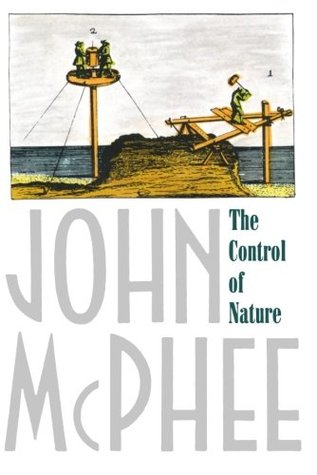
In John McPhee's marvelous essay, "Atchafalaya," published in his book The Control of Nature, McPhee relates the first-hand account of the damage taken by the control structure in 1973.


When Dugie himself went to look at the guide wall, he looked at it for the last time. "It was dipping into the river, into the inflow channel." Slowly it dipped, sank, broke. The foundations were gone. There was nothing below it but water. Professor Kazmann likes to say that this was when the Corps became "scared green." Whatever the engineers may have felt, as soon as the water began to recede, they set about learning the extent of the damage. The structure was obviously undermined, but how much so, and where? What was solid, what was not? What was directly below the gates and the roadway? With a diamond drill, in a central position, they bored the first of many holes in the structure. When they had penetrated to basal levels, they lowered a television camera into the hole.

They saw fish. —John McPhee, "Atchafalaya"

The flood of 1973 was a "40-year event," meaning that one might be expected, statistically and on average, every forty years. That the next flood came only thirty-two years later takes nothing away from this assessment: the river's overbank flow during and following Katrina had contributions from the release of impounded water from behind upstream levees, and energy from these successive releases owes much to the continued attempts by the Army Corps of Engineers to deny the river’s natural inclination to jump to the Atchafalaya drainage.

So inundation of the city from Katrina, a Category 5 storm, caused primarily by over fifty levee breaches, might have produced overbank flooding on the upper reaches of the river sufficient to allow the Atchafalaya to finally capture the Mississippi, had stress not been relieved farther down the river.

Besides, "[n]othing says capture has to happen at Old River," McPhee was told by a local. "It could happen anywhere the two channels are close enough. It probably will someday." The city of New Orleans may have survived the storm surge of Hurricane Katrina—devastating though it was—only to be hit sometime down the road with a second economic disaster. 

It could happen anytime an up-river rainstorm causes the Corps of Engineers to lose their 52-year battle for control of the Mississippi River.