Showing posts with label Re-Reading a Favorite. Show all posts

Sunday, February 2, 2020

The Son of the Shaman: Listening to the World

South Coast (A Shaman's Tale Book 1) by Nathan Lowell


“Honey, everyone here fishes,” his mother said with a smile. “Even your father. It’s just some of us catch different things."

We met the slightly-scary, strangely spooky Sarah Krugg in Half Share, Book 2 of Lowell's Traders Tales From the Golden Age of the Solar Clipper series. In one sense, this is the first volume of Sarah's backstory. More than that, it is the background tale for the whelkies, carved animal figures inlayed with purple-shell hearts, that play such a crucial role in those stories.

The whelkies that Ismael Wang purchases at the flea market (in Quarter Share) on the orbital above St. Cloud speak to him. At various points in the Traders Tales, each whelkie "finds" someone it will help, and Ismael makes it a gift. Shamans on St. Cloud create the whelkies—and by tradition, they are never sold, only given to those they match. The shamans walk the beaches to collect driftwood and purple whelk shells that are carved and combined to form the mystical figurines. And they "listen to the world." 

Otto Krugg is the son of such a shaman. By company rules on St. Cloud, he will be a shaman because he is the son of a shaman, and as such, he is exempt from the requirement to be working for the company by age eighteen, or he will be kicked off-planet. Only Company employees—and shamans—may reside on St. Cloud. But Otto really would rather be a fisherman, like most of his schoolmates. His father Richard, however, insists he must "go into the family business," and learn to listen to the world as he does.

When a business threat derails the fishing community's comfortable way of life, many things will change. Including Otto's future, his parent's, and indeed, that of the entire South Coast of St. Cloud.

There are multiple levels of story here. At its simplest, it is a tale of a community industry under threat, and the clever ways its members find to work together to solve their dilemma. Slightly more nuanced, it is the story of how a father can teach his son to follow in his footsteps when he himself isn't quite sure where he is going. And deeper than that, it shows how the respect of man for his environment can lead beyond mere survival to contentment.

But only if we are listening.

Thursday, October 5, 2017

The Revolt Against Asimov’s Second Empire

Review: Psychohistorical Crisis by Donald Kingsbury


One of the pillars upon which the giant reputation of Isaac Asimov still rests is the sweeping Foundation Trilogy.


These three novels detail how mathematician and historian Hari Seldon foresaw a 30-millennium-long Galaxy-wide collapse of civilization, and devised a plan to shorten those coming dark ages to a single millennium. Seldon planned an openly-acknowledged path of historical development for the newly-created Encyclopedia Foundation located on a world at the fringe of the Empire whose collapse Seldon predicted. 

Periodically, this Foundation would face a Seldon Event, a psychohistorical crisis, in which a threat to its existence which would constrain the nascent second empire to follow a single, pre-determined, path. To keep the Seldon Plan on track, a second, hidden foundation consisting of heirs to Seldon’s science of psychohistory would act as “wizards behind the screen” to ensure the coming of the Second Empire.

In Psychohistorical Crisis, Donald Kingsbury looks at the re-established Second Empire, over 2700 years after the crafting of the Seldon Plan. In this far-distant future, Seldon’s name is lost in the mists of history, and psychohistory is a occult practice, whose “Psycholars” maintain their Galactic rule by keeping the tenets of their science a deep secret. Citizens of the second empire exist in their complex society only with the aid of a mind-enhancing outgrowth of Asimov’s mind-probe, the quantum-mechanical familiar, or “fam”. On the surface, all is pleasant and peaceful.

Beneath that calm, however, are roiling currents of revolution. And bobbing along, pulled this way and that by these currents, is Eron Osa, a mathematical genius with a modified fam. We meet Osa as he is stripped of his fam for an unspecified crime. Condemned to live without his memories (but warned by the rebel Psycholar Hahukum Konn not to use the “prosthetic” fam supplied by the ruling council), Osa is forced to live by his native wit—even to the extent of actually reading with his eyes (gasp!) a purloined book of the Founder’s lessons as he attempts to recover the science he has lost.

We then flash back to Eron’s childhood, where we meet Hiranimus Scogil, another rebel, who is seeking a brilliant student to place as a sleeper in the Psycholar’s Lyceum on “Splendid Wisdom,” the seat of the Second Empire. Scogil places his student in the hands of Nemia of l’Armontag, who modifies his fam, ostensibly to give him faster access times, but with a longer-term plan to allow the mysterious Oversee organization to activate their sleeper when desired. 

We meet Kikaju Jama, yet another schemer bent on manipulating events by training and releasing agents, the tattooed barkeep Rigone of Splendid Wisdom, and Frightfulperson Otaria of the Calmer Seas, all of whom have designs upon the mind and future of Eron Osa. In deliciously complex inter-woven character histories, Kingsbury examines the human desire to manipulate others, on the personal as well as the Galactic scale.

Wrapped in layers of philosophy, history, metrical science and astrology, Kingsbury has also given us a closer look at the central premise of Asimov’s trilogy: that what men can predict, men can control. He then challenges this premise, exploring themes of free will vs. prediction; the scalability of government styles, knowledge acquisition and knowledge retention; and the quantum-cat nature of both prediction and history.

This is a demanding read, with sly references to a wide range of science-fictional works in addition to its densely-woven core story. You can enjoy the novel as a mystery (why does Eron Osa merit the execution of his fam?), as science fiction (will the various rebels succeed in overthrowing the Psycholars’ rule, and what is the mechanism by which knowledge slides into myth?), or as skillful homage to Asimov. 

However you read it, the book is thoroughly enjoyable.

Liner Note

At the time of this review, the book was not available on Kindle.

Wednesday, October 4, 2017

Light Horror from a Dark Past

Review: The Boys Are Back in Town by Christopher Golden


“Like Rod Serling. Stephen Donaldson. L. Frank Baum crossed with Stephen King.” 

Reviewers have struggled to place Christopher Golden’s work into a specific niche of the horror genre, but previous books have defied such placement. The Boys Are Back in Town is no different.

Oh, Boys begins typically enough, B-movie script expectable. Will James is a world-weary tabloid reporter, collecting yet another story before he heads back to the home town for a tenth-year high-school reunion. 

He’s made plans to meet with all his old friends while back home, exchanging eMails and setting up dinner plans with each of them. Aside from Mike Lebo, though, Will hasn’t seen most of them since high school. 

Then he arrives for the reunion, and his innocent inquiries after Mike are met with shocked stares. Everyone else remembers Mike Lebo’s death during their senior year.

As Will examines his memories, a darker history than he recalled before the reunion begins to emerge. There’s a reason he’s not an award-winning journalist. There’s a reason Will alone remembers Mike Lebo alive after graduation. And there’s a sinister reason Mike eMailed him before the reunion.

It’s all tied up with the black magic these high-school friends practiced ten years ago. Will finds his world changing around him as his memories shift. He must travel back in time to undo the disastrous events that have set an entire high school class onto a twisted path.


Golden writes dialogue in a very “new age” style, with the choppy rhythm of eMail, tweets, and voice-mail. Yet he uses a descriptive technique straight out of Dashiel Hammett: objective, blunt and unemotional. The combination works to create a modern atmosphere for some very creepy action.

The novel lightly explores the way our destinies are determined by choices we make, and how our identity is inextricable from our memories. Like most horror novels, the message is superficial. If you’re not looking for anything deep and lasting, this is an excellent choice.

Thursday, September 28, 2017

Great Book, Appalling Movie

Original DVD Cover Image, 1998

Review: Starship Troopers with Casper van Diem, Michael  Ironside vs. Starship Troopers by Robert A. Heinlein


Challenged to name a movie that fell disappointingly short of its source, my first reaction is Starship Troopers, out in a 20th anniversary edition this month.

Two decades ago, I was tremendously excited when I learned they would make this book into a movie, even as I doubted they would capture its flavor in full. The problem is internal dialogue. Truly interesting books take us into the inner life of their main characters; in revealing those meditations and self-recriminations, they expose their souls. 

Without that insight, fictional characters are as intellectually interesting as rock-em-sock-em robots.

Typically, movies substitute external dialogue and narrative for these inner debates. An example of this done well can be seen in the 1984 version of Dune. Without the narrative voiced by Gurney Halleck (Patrick Stewart) and Princess Irulan (Virginia Madsen) in that film, its story would be impenetrable. With it, and by dint of voicing much of the book’s mental dialogue, it succeeds as an adaptation.

So I knew it would not be impossible to capture the philosophy- and social-commentary-laden substance of Heinlein’s novel. Then I saw it in the theatrical release, and was sorely disappointed. This is simply not Heinlein’s story.

Oh, the bugs are there. The sneak attack by this alien hive-dwelling race that wipes out Johnny Rico’s home city is in the movie. The Mobile Infantry are there, with their armored suits complete with heads-up displays, pocket nukes and jump jets. What didn’t survive the cut? Only the reason why Johnny joins the service in the first place.

Heinlein’s novel hinges on two social differences in the world of Starship Troopers. First, only veterans—those who have chosen to place their lives “between their loved home and the war’s desolation”—have the right to vote. Civilians do not have that right, and neither do serving troopers. Heinlein justifies this very succinctly:
Suddenly he pointed his stump at me. “You. What is the moral difference, if any, between the soldier and the civilian?” ”The difference,” I answered carefully, ” lies in the field of civic virtue. A soldier accepts personal responsibility for the safety of the body politic of which he is a member, defending it, if need be, with his life. The civilian does not.”

Second, it is anyone’s choice to enlist at any time after their 18th birthday. The services will find something for the enlistee to do, to allow them to earn the franchise. But if they then go AWOL, resign, or are drummed out for any reason, they never have the opportunity to try again. Politicians from dogcatcher to President must, under this system, be veterans, and there are no “reserves”.

The movie barely mentions either of these two critical concepts. Worse, the main source informing Rico’s choices, his high school “History and Moral Philosophy” teacher, Col. DuBois (who pointed his stump at Johnny in the quote from the novel), is barely there in the first scenes, and not mentioned again. These ideas are presented in hit-and-miss fashion, as if they are part of the recruit training after enlistment, instead of why recruits choose to enlist in the first place.

Moving the important motivation to enlist into the recruit training has another consequence—we do not get a real sense of the conflict between Rico and his father. As a result, his reaction when his home city is attacked is shallow. He’s now an orphan, okay, move on. This robs the viewer of one of the most poignant scenes Heinlein has written, when as an officer, Rico is relying on his master sergeant.

Lieutenant Rasczak (Michael Ironside) is given most of the lines that Col. DuBois has in the novel. So we get a tepid, PC-diluted “Violence has resolved more conflicts than anything else. The contrary opinion that violence doesn’t solve anything is merely wishful thinking at its worst,” instead of
Anyone who clings to the historically untrue—and thoroughly immoral—doctrine that “violence never settles anything” I would advise to conjure the ghosts of Napoleon Bonaparte and the Duke of Wellington and let them debate it. The ghost of Hitler could referee, and the jury might well be the Dodo, the Great Auk and the Passenger Pigeon. Violence, naked force, has settled more issues in history than has any other factor, and the contrary opinion is wishful thinking at its worst. Breeds that forget this basic truth have always paid for it with their lives and freedom.

If this was the only shortcut, I would not complain. It is not. Sergeant Zim is another crucial character whose best lines from the book are given to Lt. Rasczak, or simply omitted. Rico’s relationship with training sergeant Zim is formative for him. Again, the movie simply ignores this part of the story.

In addition, the movie completely omits Juan Rico’s choice to go to officer training, and how this perspective changes his assessment of his life and responsibilities. I can see leaving this out to save time (and provide grist for a sequel). I suspect, however, that the movie’s creators were simply in a hurry to confront Rico with the alien bugs.

The other changes are minor, and do not, in my opinion, ruin the story. In Heinlein’s novel, women do not serve in the Mobile Infantry; Heinlein was a product of his time and served as a Naval officer in the 40s. He does give women a unique role that men cannot, for the most part, perform as well. In addition, Johnny’s best friend Carl does not end up as a commanding colonel in the novel—to describe where he does would be a spoiler. But these are minor changes, and I can roll with them. 

What I miss are the thoughts about why defensive war is necessary, and how best to conduct a war once one is begun. Once again, the words are those of Col. DuBois:
If you wanted to teach a baby a lesson, would you cut its head off?… Of course not. You’d paddle it. There can be circumstances when it would be just as foolish to hit an enemy city with an H-bomb as it would be to spank a baby with an axe. War is not violence and killing, pure and simple; war is controlled violence, for a purpose. The purpose of war is to support your government’s decisions by force.

Dune has been remade, and the second version has qualities that the first did not. I cling to the hope that Starship Troopers will be remade by someone with the vision to see past the great special effects opportunity to create a movie worthy of the power of Robert Heinlein’s novel.

In the meantime, skip the movie. Read the book.

Saturday, July 15, 2017

Pacifism versus Non-Violence

Review: The Gate to Women's Country by Sheri S. Tepper


In some future society, Tepper supposes, there will be a way to reduce the human impulse for war. 

Although this will require a change in human nature, it can be managed by a simple strategy. Women will marry warriors, but their children will secretly be fathered only by the peaceful "servitors." The women and servitors will raise the children apart from the quasi-military cohorts of men. At puberty, boys will be sent to live with their nominal fathers; while girls must choose (without knowing, though with hints from their lessons) to do the same as their mothers.

Thus everyone gets what they want: militant men get honor and the "naming of sons," women get a peaceful home, children, and a spouse-substitute help-meet, boys get a heroic role model until they are old enough to recognize the quiet power of the servitors.

At age 25, though, the young men face a choice; they may choose conflict and stay with the men, or they may return through the gate to Women's Country and become servitors—and be scorned by their military mates, their commanders and their nominal fathers.

Of all Tepper's novels, this is the one in which I find the most philosophic agreement. For one thing, the "pacifist" men are not helpless wimps; the servitor Joshua and the returned Corrig are both powerful fellows versed in self-defense. For another, women are not either/or: some are strong, but focused on family; some are high-achievers, wielding leading their communities, but puzzled by rebellious daughters. 

There is little of the "woman alone against men" flavor of Tepper's later novels. Households are woman plus man plus children, and only the division of woman-led Town versus warrior-led Garrison foreshadows the author's later work.

Tepper's novels often carry an obvious theme accented by a more-subtle leitmotif. Gate is one of the easiest to parse for these elements. Stavia and her mother Morgot, throughout the tale, are occupied with studying their lines to play a part in a recurrent performance of Iphegenia at Ilium, a reworking of the Dionysian play The Trojan Women (usually attributed to Euripedes). 

The lines the women recite all concern the suffering of women in the aftermath of war, an overt reason for the divided structure of their utopian (or protopian) society. Underlying this overt theme is the careful husbandry of humanity in the hands of the women, symbolized by Finns with their reindeer herds. Even nearly thirty years after it was written, this poetic coupling of "why" with a plausible "how" gives power to the struggle to move humanity beyond war. 

Together, they make this Gate worth opening.

Friday, November 25, 2016

Post-Apocalyptic Networking

Review: Web of Everywhere by John Brunner


The societal consequence of instantaneous matter transportation is a recurring science-fiction theme. No one has ever done it better than Alfred Bester in The Stars My Destination, though many have tried. (Or have not tried, as with the inconsequential matter transmitters of Star Trek.)

John Brunner came closest to out-Foyling* Bester with this little-noticed novel. Unlike Brunner’s The Infinitive of Go, published six years later, WoE concentrates on the social and political implications of a matter transmitter called a “Skelter.” In the mid-70’s, with the horror of the Tate-LaBianca murders still fresh in everyone’s minds, the name was evocative. 

And like the “helter skelter” cult, the result of the Skelter technology’s free access to everywhere was murder, plus explosive plagues, terrorism dwarfing 9/11, and the collapse of civilization. A “puerperal fever” kills 80% of the world’s women, leaving many of the rest sterile. Only the invention of the “privateer,” a method to lock the Skelter doors against uninvited guests, and a strict law against using unauthorized Skelter codes, has managed to salvage what remains of civil society.
Theseus / Blinded by the dark / Followed Ariadne’s clew of thread.
Ariadne / Has ceased her spinning / And all doors lead to the Minotaur.
—Mustapha Sharif

Hans Dysktra is a deeply unsatisfied man. He is married (a rarity in this post-Skelter world), but his wife is shallow, vain, stupid, and fat. He works exploring the nuclear-ravaged Skelters of Europe under the aegis of a world-wide government headed by the inventor of the privateer, Chaim Aleuker. But secretly he explores unauthorized locations, documenting the state in which he finds these abandoned houses and the restorations he applies. His secret work, he tells himself, must not be revealed until after his death.

His partner in these efforts is Mustapha Sharif, a blind poet with a method for discovering Skelter codes. Sharif is the opposite of Dykstra in many respects; he lives calmly in a non-Skelter community, he is respected, even revered by many of the world’s leaders, and he deeply appreciates what he has. Despite Sharif’s disability, it is Dykstra who is blind, and Sharif who leads him.

Dykstra’s dark-room work on his latest “find” is ruined when his wife opens the door before the photos are developed. To punish her, he accepts her “treasure hunt” invitation to a party at Chaim Aleuker’s house, and solves the puzzle himself so effectively, he comes to the attention of the world leaders. When the party is overrun by local terrorists, he grabs a young “wild girl” guest and flees with her. Like trying to grasp a cobweb without breaking it, his attempts to have the things he believes he wants lead Dykstra only to destroy them.

The action in the novel is physical as well as mental, but the webs that unite each place to everywhere else serve also to bind people together. Cobwebs in unused dwellings echo the threads of connection that link people to each other. At the center of all these webs dwells Mustapha Sharif, a Way of Life believer whose household is Muslim, a respected elder who directly abets Dykstra’s crimes, a peaceful man whose former partners met violent deaths, a blind man whose observations are sharp and precise.
Once I met a man / who every day / went around the planet counterclockwise.
He said by this means / he gained a day / and would therefore live for ever.
Unluckily for him / Death measures time / otherwise than with clocks and watches.
—Mustapha Sharif

You can now get this novel on Kindle, but for the full experience, you’ll want the paperback edition. You’ll have to watch for it in used bookstores. Ignore the cheesy cover art. This is a story that deserves a wider exposure.

Liner Note

*Gully Foyle is the central character of The Stars My Destination, an unwitting champion at using jaunte energy, who has succeeded in breaking the planetary barrier to "jaunting," as the self-transmission is called. Even after 50 years, TSMD is still the starting point for many science fiction readers.

Why I Re-Read Favorite Novels

I am currently re-reading my whole collection of Lois McMaster Bujold Vorkosigan stories. There's a reason that's specific to Lois McMaster Bujold and her Vorkosigan oeuvre, and there's a wider reason that pertains to every novel I've ever read and loved.

First, the specific reason: it's Gentleman Jole and the Red Queen. A frequent motivator to reread earlier books in a series is the acquisition of a new novel in the arc. And ever since I began reading a large percentage of my new-book consumption to the Kindle, I can add the release in e-format of earlier books in a series to that reason, as well.

The broader reason, though, is that my love for a book or a series is triggered by more than a story. I'd like to share those "more" elements that make a book worth re-visiting, whether it is once or twice, or on a regular basis.


Characters

It's easy to fall in love with lovable characters; but I am also drawn to complex ones. They reward a re-read by revealing more of their nature each time I encounter them. I see additional facets of personality or motivation with each new reading. Villains may provide more appeal in this way than heroes, but in the Vorkosigan novels, it is Vorkosigan himself who is most complex. And if the latest novel in this series has little of Miles in it, I can still get my fix from the earlier books. 


World-Building

Vorkosigan's world is political-cultural as much as science-fictional. Bujold shares that ability to create a tasty culture with another author whose entire multi-novel series I feel compelled to re-read each time a new one appears: C.J. Cherryh and Foreigner. But the world a writer builds may be the familiar one we live in, with a single element twisted in an innovative way. Sheri Tepper has done this with The Fresco and The Family Tree, and they are two novels I return to on a regular basis.


High Concept

This is a harder element to pin down. I often do not know until several books into a series why one story-arc will qualify as re-readable and another will not, and the deep, broad, or delicious idea that recolors everything outside the novel for days after I read it is one. Tepper's novels have this, too—I need not agree with the concept to have it set hooks in my brain. Elizabeth Moon's Seranno and Vatta series qualify, for instance, with a cogent question. What changes would access to a real fountain of youth make in society? 


There are other considerations, like "moral" protagonists (Honor Harrington or Harry Potter, for example, whose less-complex main characters embody the moral of the story), or quotable thoughts—anything by Rand or Heinlein is a goldmine for quotes, as are all of the Connie Willis novels. But the three above are sufficient to bring me back, again and again, to relive the joy derived from reading a good book.

Even when there is not a new book in a series-arc.

Saturday, November 19, 2016

Fault vs. Responsibility: Dangerous Ideas for Our Time

Review: Freedom Evolves by Daniel Dennet


Daniel Dennett is my favorite philosopher, for many reasons. One trivial reason: he writes to communicate, not obfuscate. On second thought, that's not trivial at all. His works on paper include web links, for another, and he chooses accessible illustrations to make his points. 

In the first section of Freedom Evolves, Dennett is discussing whether determinism—the idea that all outcomes/choices/decisions are set by the initial conditions, that "everything's fixed, and you can't change it," as 
Andrew Lloyd Webber's Judas complains to Jesus—means that no one is responsible for their choices in life. 

To illustrate that 
whether or not you believe in it, determinism cannot affect guilt, Dennett tells the story of the French Foreign Legionnaire who is hated by all at the fort. Tom, knowing that he will be sent on patrol the next morning, poisons the water in his canteen. Dick, unaware of Tom's actions, empties the Legionnaire's canteen and fills it with dry sand. Harry, also unaware of the previous interventions, pokes a small hole in the canteen so its contents will trickle away as the hated fellow marches out in the morning. When the Legionnaire does march off into the desert with his adulterated canteen, and eventually perishes of the lack of potable water, which man is responsible for his death? 

Dennett has said of Freedom Evolves, "If I accomplish one thing in this book, I want to break the bad habit of putting determinism and inevitability together. Inevitability means unavoidability, and if you think about what avoiding means, then you realize that in a deterministic world there’s lots of avoidance. The capacity to avoid has been evolving for billions of years. There are very good avoiders now. There’s no conflict between being an avoider and living in a deterministic world. There’s been a veritable explosion of evitability on this planet, and it’s all independent of determinism." [Emphasis mine, Dennet quote from a 2004 interview in ReasonOnline] 

Exercise for the reader: Was the Legionnaire's death by dehydration avoidable?*

This review is a brief visit because this is not a book to be grasped in a quick scan; that's the main reason I like Dennett's work. I read several pages, then sit back, stunned by the light of reason. Aha! And I must go reread this article, or that book, or even turn back to reread a few pages in Dennett, in the light of that new understanding. 

"Inevitable" is a word I'm hearing a lot these days. So is "guilt," and "blame." Dennet helps put them all into perspective for me.


Liner Notes:

My involvement with Dennett pre-dates this blog by decades; Darwin's Dangerous Idea was the my first encounter. I enjoyed the philosophical exploration of this scientific revolution, with its the pro-and-con arguments from Darwin's time and ours so much that I went Dennett-hunting. Consciousness Explained was next. I found this the toughest to read, because I was also reading Stephen Pinker's How the Mind Works at the time, and many of Dennett's thoughts on Thought run counter to Pinker's. Then I got Elbow Room: The Varieties of Free Will Worth Wanting, and had to reread both of those books in the light of what I learned. All, including Freedom Evolves, are now available on Kindle.

Other writings by Dennett are available on the Web: The Bright Stuff and Two Brights Side-by-Side are on The Brights web site. Kelby Mason does a good job of boiling down the naturalistic world view in Thoughts as Tools: The Meme in Daniel Dennett's Work. 
Google "naturalistic" or "determinist" plus "Daniel Dennett" for more. You may also be interested in the TED Talk: Dangerous Memes.

*And the Legionnaire's "inevitable" death? There was a fourth man involved with his canteen, the only one who ultimately needed to rely on its contents, whose responsibility it was to make sure the canteen was functional, and filled with clean water. A fourth man, who might, had he thought about it, have suspected that the canteen might have been tampered with. So while his death in the desert was not his fault—I'm not blaming the victim—it certainly was avoidable.

Tuesday, October 18, 2016

Pas-de-Deux with a Semi-Fictional Nureyev

Review: Dancer by Colum McCann


Rudolf Nureyev. The name is synonymous with ballet. 


But before the multiple entrechats, before the defection to the West, before the notable evenings in Paris and New York, there was a confused little boy who wanted two things from life: to dance, and to find approval.

McCann's Dancer is a loose grouping of snapshots, scattered in time and location, that serve as well as anything can to illuminate the tempestuous life of the dancer Nureyev, the little boy Rudik, the homosexual Rudi. 

In this arrangement, the author agrees with the opening quote:
In any case, when talking about the past, we lie with every breath we draw. —William Maxwell, So Long, See You Tomorrow

We see the child, slight and shivering, dancing to entertain shell-shocked soldiers returning to a hospital from the Western front. Rudik barely knows his returning father, and is repelled by the fish his father expects him to gut. The boy who dreamed of his father until he met him again, now only dreams of a stage with a red velvet curtain. 


What was flung onstage during his first season in Paris (1961):

  • ten one-hundred franc bills held together with an elastic band
  • a packet of Russian tea...
  • white lilies... perfectly weighted to reach the stage...
  • sixteen pairs of women's underwear, a phenomenon that had never been seen in the theatre before...
  • broken glass thrown by Communist protesters...
  • death threats
  • hotel keys
  • and on the fifteenth night, a single long-stemmed gold-plated rose.

Rudolf Nureyev defected while in Paris that year—not for political reasons, but because he had discovered the active homosexual life of 1960s Paris, and rejected the warnings of the commissar charged with watching the ballet dancers. He was sentenced to seven years' hard labor if he should ever return to the USSR. But Rudi was having too much fun, and it would be decades before he would consider a return to his motherland.

Watched All in the Family then cabbed to Judy and Sam Peabody's to see Nureyev (cab $2.50). Nureyev arrived and he looked terrible—really old-looking. I guess the nightlife finally got to him. His masseur was with him. The masseur is also sort of a bodyguard... —the Andy Warhol diaries, Sunday, March 11, 1979.

The book is neatly divided into four parts, like separate boxes of photos in a trunk. Book four brings Rudolf Nureyev back to Russia in the time of detente. "How come they let you back?" his life-long friend asks, and Rudi replies simply, "Raisa Gorbachev."
And are you still dancing? I asked.
They will put me down dancing, he said.
I couldn't help but believe him—one day they would exhume Rudi and find his bones set in an attitude of leap...

The snap-shot mode is difficult to parse at first, like a neophyte's understanding of ballet. But in the end, it is perfect for this tale, perfect for the dance we are invited to join.

Monday, October 17, 2016

High Tea and Romance

Review: Tea With the Black Dragon by R.A. MacAvoy


Oolong—black China tea—gets its name by combining the characters that mean "black" and "dragon." So when Martha Macnamara, Gaelic fiddler, joins Mayland Long, an intriguing dark-skinned oriental gentleman with curiously long fingers, for tea in his elegant, book-stuffed hotel room overlooking the Pacific Ocean, she is startled by an outstanding sculpture of a black dragon. Long tells her, "It's Oolong."


Yes, the tea is black China, and the sculture is a black dragon named Oolong. So, it rapidly becomes apparant, is Mayland Long. 


When he sets aside his scholarly search for the truth and his master, which he had been prophecied to find in San Francisco, to help Martha track down her daughter, he will put his own long life in jeopardy. 


I first read this book in the mid-80s, when I was just getting into computer programming. MacAvoy expertly wove a a tapestry of fine design by combining computer technology with the poetry of Zen philosophy and mythical Chinese dragons. I was rapt in the romance of a dragon's study of humankind, and taken with Long's life among books. Who would not want to be the dapper, wealthy, studied, elegant dragon in his hotel-room tower?


Reading it again in the Kindle edition for the first time in a decade, I now see more of the appeal of Martha Macnamara, and the romance between these two older people, both slightly alienated from the push and thrust of modern life and modern technology—especially now that my own years are advanced! It helped to be familiar now with San Franciso, although MacAvoy's descriptions of the city are so evocative that this knowledge adds only a minor gloss to the tale.

Either way, the book has not lost any charm due to the slight dating of computer tech in the modern half of the story, but has only acquired more polish from its age. Make an appointment to enjoy this high tea, whether it is your first sip, or a familiar refreshment. Oolong does not disappoint, and neither does MacAvoy.

Wednesday, October 12, 2016

Typical Tepper: Excellent Enigmas

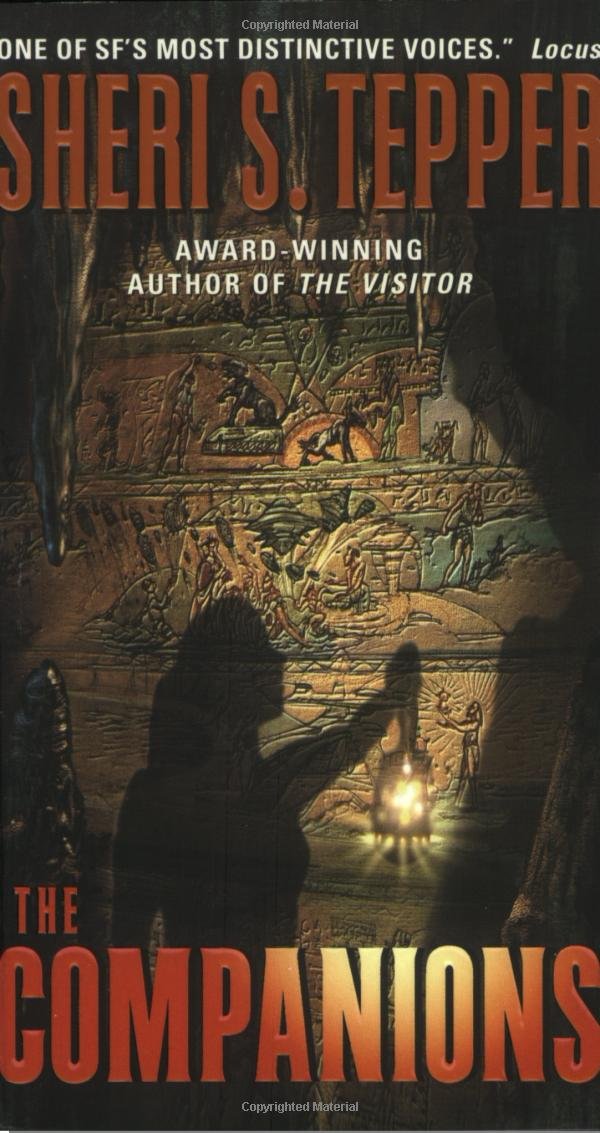
Review: The Companions by Sheri S. Tepper


I sometimes feel that every review of a Sheri Tepper novel should be subtitled, "Dances With Words." Even though I rarely agree with the writer's philosophy, the astoundingly graceful way in which she spins words into story is seductive, and subliminally persuasive:

The moss world... was a Victorian parlor of a planet, everywhere padded and bolstered, its cliffs hung with garlands, its crevices studded with cushions, every cranny silk-woven, every surface napped into velvet. Here were peridot parklands where moss piled itself into caverned outcrops of sapphire shade. There were violet valleys, veiled in lavender and wine, across a mat of miniscule, multi-colored moss beads...


I first read this book as soon as it was released in paperback, in September 2004. In addition to Moss, another mono-cultured world like Grass, which I reviewed in 2014, Tepper has introduced conquering canines, vat-cultured concs (concubines), a burkha-clad populace on Earth trying desperately to stay sane in the crowded conditions, and the siren comfort of the world of Moss, a pillowed and bolstered place that may (or may not) have inhabitants.

The most wonderful characters in the book are the six talking dogs rescued from Earth by the linguist Jewell. Together Jewell and her companions Scramble, Behemoth, Dapple, Titan, Wolf and Vigilant contact the intelligent life of Moss, and are "dognapped" to a world where canine-forms rule (and where Jewel is reduced to pet-status while her companions are lauded). Together they must solve the ultimate mystery posed by Moss and a dozen other worlds: where have the ancient races gone? 

You need not subscribe to the eco-crisis, feminist vision of Tepper to thoroughly enjoy the disturbing pleasure of her writing. Like scarlet moss, it carries the reader to ever-higher transports of delight. And if a Tepper novel does not exactly provide a happy ending, at least, like a well-composed fugue, it will always provide closure.

Wednesday, September 14, 2016

Stardom in the Blood and Bone

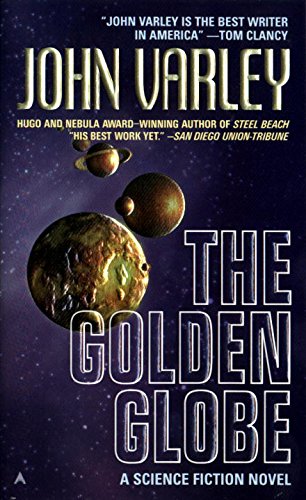
Review: The Golden Globe by John Varley


The life of an itinerant actor stumping from village to town, dreaming of his own theatre in the big city translates well to space travel when John Varley writes it. His brilliant poly-named polymorphic main character is sometimes star and sometimes hobo, sometimes leading man (or leading lady) but more often bit player or street performer. 

"Sparky," "Dodger," and formally, "K.C.Valentine," is how he refers to himself in his reminiscences. This tale is told almost entirely in first person, so we learn from those around him that he doesn't share his real name—or face—with anyone except his two constant sidekicks, Toby and Elwood.

Since Toby is a dog, and Elwood stays out of sight of everyone except Valentine, they aren't giving away his secrets.

So Valentine stays one step ahead of whatever bête noire chases him, equally ready to ride the twenty-second century equivalent of the rails as to travel in splendor on a luxury cruise line. He must adapt, chameleon-like, to each new community's standards, and adroit with a bribe as he moves from world to world, for:
...the more bureaucrats there are, the more laws are needed to keep them fed.

By contrast, when he sleeps we hear from the troubled soul of this mountebank. We learn of his courage in the face of an abusive father and troubled childhood. And we begin to see why Valentine is determined to "play Lear," to build a grand Shakespearean theater in the asteroid belt.
...we didn’t have to play Shakespeare in free fall, as we’d done at Boondocks and several previous engagements. Friends, Romans, countrymen, throw me a tie-down! Talk about your theater in the round.

This novel has a daunting physical and emotional scope, yet even so, the story does not feel heavy-handed. Valentine copes with the great talent and low support life has given him, and with the assistance of Toby and Elwood, stays as close to sane and happy as most men come. The tale ranges from high drama to low humor1; it was never more clear that Shakespeare was right:
All the world’s a stage, And all the men and women merely players; They have their exits and their entrances; And one man in his time plays many parts... —As You Like It, Act II, Scene VII 


Liner Notes:

  1. An example: Toby is quite the ladies’ man. I’d seen him, with more optimism than common sense, mooning over a Great Dane bitch he’d need a stepladder just to sniff. Sure, you can write that off to high hopes. But the amazing thing was, the bitch was looking really interested.
  2. The creator of Valentine's nightmare, DAEWOO, is a real, currently-existing company. I can't say more (it would be a spoiler), but this was just another element that seasoned the novel with real spice.  

Living Under the Knife

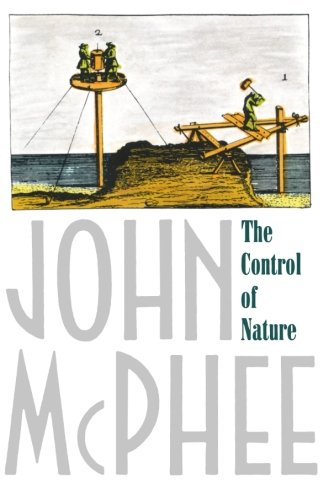
Review: Los Angeles Against the Mountains (from The Control of Nature) by John McPhee


Pulitzer Prize winning author John McPhee writes with a style informed by the journalist he was and the sciences he has explored for decades. When you read a piece by McPhee, you hear honest echoes of the people and places and concepts he explores.

I just re-read a favorite McPhee essay, Los Angeles Against the Mountains from The Control of Nature. Perhaps because when I first read it I was living near the "over-steepened slopes" of the San Gabriel Mountains, I remember a distinct frisson upon learning about their tendency to spawn killer debris flows, a little-advertised regional problem.
The San Gabriels, in their state of tectonic youth, are rising as rapidly as any range on earth. Their loose inimical slopes flout the tolerance of the angle of repose. Rising straight up out of the megalopolis, they stand ten thousand feet above the nearby sea, and they are not kidding with this city.

The source material for such a multi-ton flow builds up over decades, but needs a specific set of triggering conditions to mobilize it. It might take additional years for such conditions to be met—which makes this a genuine problem in a place where even last week is ancient history. Without realizing the danger, developers, realtors, home buyers, and other newcomers to the area are often led to occupy hazardous properties. 
People have been buried alive in their beds. But such cases are infrequent. Debris flows generally are much less destructive of life than of property. People get out of the way.

The good news, as they say, is that 30, even 50, years may go by without a killer debris flow. 

The bad news is that when it does come, you can't outrun it. And everything it sweeps past (or over) is plucked up and added to the tonnage of the flow: cars, refrigerators, garden sheds, iron gates. Los Angeles has tried to control these flows by trenching debris basins above the built-up areas. Emptying them periodically—theoretically, anyway—serves to trap future flows before they can sweep through residential areas and businesses. 
A private operator has set up a sand-and-gravel quarry in the reservoir. Almost exactly, he takes out what the mountains put in.

And it would work, too, except that people keep building new houses above the elevation of the basins, along picturesque creeks below the mountain skyline. 


Right in the path of the next debris flow.

Monday, September 12, 2016

Surfing the Ozone

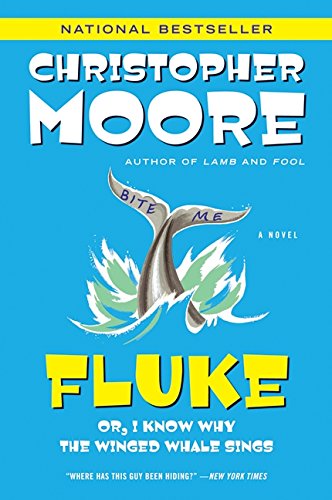
Quick Review: Fluke (Or, I Know Why the Winged Whale Sings) by Christopher Moore


Christopher Moore has tapped into the weird and wonderful in every book, and this is no exception. From middle-aged "action nerd" Nate Quinn with his angst over and attraction to nubile research assistant Amy, the joyously strange blond Rasta stoner Kona (né Preston Applebaum), and marine photographer Clay and his "pirate booty" girlfriend Claire, Moore has woven another sleigh-ride through the land of odd. 

Nate is in Maui researching whale behavior, specifically, why humpback whales sing. (Hence the subtitle.)

[M]uch about the humpback song is still unknown. Although scientists do know it tends to be in the New Age music section, as well as in tropical waters. There is no reasonable explanation for this, but as of yet no tagged humpbacks have been tracked to the New Age section at Sam Goody's. Author's Notes

So what is Nate supposed to think when he spots a humpback male whose flukes sport the legend "Bite Me"? Someone is so threatened by his research that they trash his office, format his hard drives, sink Clay's boat and cause his only photo of the fluke graffiti to vanish. And why does the Old Broad who provides his funding insist he needs to take a pastrami sandwich with hot mustard along on his next dive?  Kona's profound reasoning channels Arthur C. Clarke:
The science you don't know looks like magic.

If you haven't run into Moore before, be warned! Nothing is sacred, everything is fair game for his humor. I guarantee you'll howl• over the tale of why Nate's ex-wife became a lesbian. It's not what you expect; in fact, it's nothing you can expect. Just strap in for the ride.


Liner Note:

  • The last time I was taken over the edge so uncontrollably was when I read the turkey-bowling scene in Moore's Bloodsucking Fiends.

Wednesday, September 7, 2016

Charming History, Dirty Politics

Review: Exit Lady Masham by Louis Auchincloss 

You know of John and Sarah Churchill, the Marlboroughs, although perhaps you know them primarily as the forbears of Sir Winston Churchill. You may even be aware of the stormy relationship between the Duchess of Marlborough and Queen Anne, the last of the Stuart line to reign in England. But have you heard of the Queen's chamber-woman, Abigail Hill?

Or maybe you know her better as Lady Masham, the reputed lesbian lover of the Queen.

Auchincloss wrote this novel, the first-person look at this tempestuous triangle, from the point of view of Abigail Hill, later Lady Masham. Abigail was a first cousin (cousin-german, in the parlance of the era) of Sarah Jennings Churchill. She was one of four children from a bankrupt family, and was working as a laundress when Sarah took her up to be nanny to the Churchill children.

At the time, Sarah was the intimate favorite of Princess Anne, the heir to William and Mary. Auchincloss uses Abigail's position to voice the complexities of succession in England at the time, and to foreshadow the future troubles between Sarah and Abigail. Although Abigail constantly refers to herself as "a red-nosed, brown-faced laundress," Sarah becomes jealous of her ability to talk with the Earl, John Churchill. To remove her from the house, but still take advantage of her abilities, Sarah recommends Abigail to Queen Anne as bedchamberwoman.
In a less exalted milieu I should have been considered a chambermaid, but royalty sheds dignity over the most menial tasks.

Once there, history tells us that Abigail supplanted Lady Churchill as the favorite. (Although the fact that Sarah was made Mistress of the Robes after Anne's coronation argues that she continued to be a favorite for years after the introduction of Abigail Hill.)

In the perfervid political climate of the Palace, Abigail falls into the pacifist camp of another cousin, Lord Harvey and his coterie of literary folk. She marries one of his friends, and works with Harvey and Irish activist and anti-Papist Jonathan Swift. They want Abigail to encourage the Queen to withdraw her support for the War of Spanish Succession, and for her Captain-General, the Duke of Marlborough. The first step in that campaign is the removal of Sarah from her post at court.

In Lady Masham's world, the equivalent of blogging is one's propensity to correspond. Writers collected letters (especially from the famous), and published them with their own letters, editing as they desired. Queen Anne's fear that Sarah will publish correspondence between them, edited to indicate the Queen's attraction for Sarah was "distasteful" (subtly helped along by Lady Masham), finally tips the balance.

This is a short novel, and a very charming tale of nasty political infighting and influence. That it is dedicated to Barbara Tuchman is not surprising; that it is reminiscent of much in politics today, surprisingly—is.

Friday, August 5, 2016

Chandler Homage with Kangaroos

Brief Review: Gun, With Occasional Music by Jonathan Lethem


In Jonathan Lethem’s amusing novel, which 
won the Lotus Award for Best First Novel in 1995, Conrad Metcalf lives in a new-age San Francisco where a kangaroo in a dinner jacket is as likely to show up as the Thought Police. For a private eye with an disinclination to back away from the tough questions, either one is an unwelcome visitor. 

But Metcalf also has to deal with a revolt among the babyheads, requiring his presence in this noisy milieu he would rather avoid. Besides, there’s a murder that persists in coming to Metcalf’s attention, despite all his efforts to avoid being involved.
…I was beginning to feel the proverbial breath on my neck, but I tried not to let it spook me into a wrong move. A tail is like a pimple. It comes to a head on its own time. You can rush it, but it usually makes a mess if you do.

This is a world where, if you don’t toe the line, you run out of karma. Metcalf is a man whose business regularly takes him over that line. As we move deeper into the shadows of Metcalf’s San Francisco, we realize that his karma will not last to the end of the book. What happens when his karma drops to zero? The answer is part of the mystery he’s trying to solve.

”Let’s go someplace,” I said. “Your place.”
”My place isn’t good,” she said. “Let’s go to yours.”
I looked at her funny. “Isn’t Kornfield supposed to have someone watching it?”
”Yes,” she said. “Me.”

Lethem has caught the brutal, objective, descriptive style of Raymond Chandler perfectly, and written a good mystery with noir flavor and science fiction spice. It succeeds both as mystery and homage. I recommend it.

Thursday, August 4, 2016

Kissing Frogs

Review: The Unhandsome Prince by John Moore

John Moore’s Heroics for Beginners, which I reviewed in March 2016, was a delightful entry in light, comedic science fiction, and this is a great follow-up. The story begins with the Frog Prince scenario, then hops off in unexpected directions.

Caroline is a commoner, the most beautiful girl in her village. When she learns that a local witch has bespelled a prince into a frog, she (and every other local commoner girl) decides to free the prince with a kiss. Problem is, there are a lot of frogs in the swamp, and what’s needed to find the right one is determination, dedication, and a plan. 


Plus, you have to keep kissing frogs.

Caroline has the stubborn nature and methodical approach needed, and sure enough, she eventually finds Prince Hal in froggy form, kisses him, and *poof*. There is Prince Hal, the third son of the King. He’s not handsome. In fact, he made a prettier frog. And he’s not even remotely in line to be King someday.

Caroline feels cheated, because she hadn’t done all that work to be a runner-up in the Queen sweepstakes. She sues the Witch (who has since died), and the local Council decides that, since a handsome prince was implicit in the contract, the Witch’s daughter, Emily, must travel with the two to set things right, or forfeit her mother’s estate. Emily can’t afford to give up her mother’s magic library, so she agrees to go along.

Along the way to Prince Hal’s castle home, the three encounter Rapunzel, a “hair-head” of monumental proportions, and Rumpelstiltskin, who is more of a con-dwarf than a magical spinner (and Jewish to boot). At the palace they meet Hal’s older brothers: Kenneth, the strong, handsome and arrogant jerk, and Jeffrey, the handsome accountant who is the only one in the family besides Hal who seems to realize the Royal Accounts are empty.

The resultant scramble to get Caroline hooked up with an appropriately handsome prince, get Emily and Hal to realize they are in love, resolve the Royal Bankruptcy, save Rumpelstiltskin from the anti-Semitic efforts of the vile Prince Kenneth, and finally rescue Rapunzel, all before Hal turns back into a frog for good, make hilarious reading.

Once again, John Moore has given us a great twisted fairy tale. His stories have an internal consistency that underscores the humor, giving us leave to laugh, even when the subtext turns a little dark. And we know it’s a fairy tale, so we can be sure that every one who deserves it will live happily ever after.

Or if not ever after, at least eventually.

Wednesday, August 3, 2016

From Foolishness to Fraud

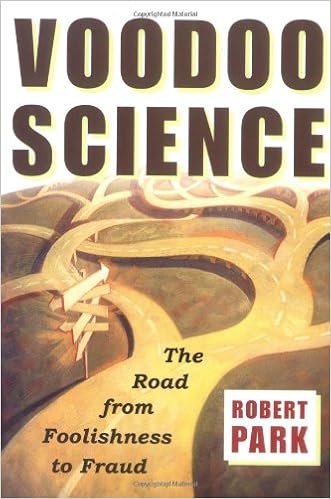
Review: Voodoo Science by Robert L. Park

His examples may be slightly dated, but the concept is crucial: science is a specific discipline, not just anything with that label. Professor Robert L. Park discusses the ways junk science masquerades as the real thing, and details how much accepting such claims costs all of us.

It’s Not News, It’s Entertainment opens the book. This is a crucial point; if the largely entertainment-focused media did not 
supportively cover these topics as it does, most junk science claims would not get very far. Their willingness to support junk science is motivated by ratings and readership. (No less true in the "blogosphere" than in traditional media,” I think.)
Science fascinates us by its power to surprise. Unexpected results that appear to violate accepted laws of nature can portend revolutionary advances in human knowledge… Alas, many “revolutionary” discoveries turn out to be wrong. Error is a normal part of science… Scientists, no less than others, are inclined to see what they expect to see, and an erroneous conclusion by a respected colleague often carries other scientists along the road to ignominy… If scientists can fool themselves, how much easier is it to craft soft arguments deliberately intended to befuddle jurists or lawmakers with little or no scientific background?

Park next takes on The Belief Gene, the concept that we are all equipped to give credence to an idea that has once captured our attention. Using the Natural Law Party’s peace experiment of 1993, and fears about global warming, he looks at how this system of building beliefs proceeds apart from data collection, and often, in opposition to the data gathered. This is the “don’t confuse me with the facts, my mind is already made up” mindset.

Placebos Have Side Effects builds on the first two essays to examine the voodoo medicine field, specifically, homeopathy and magnet therapy. Park discusses the placebo effect, and concedes that placebos do have a medical effect: “The placebo… works by fooling the brain into thinking the problem is being taken care of. Once the brain is persuaded that things are under control, it may turn the [pain] signal down by releasing endorphins…” Homeopathic remedies are placebos, he further explains, because their dilution removes the possibility of the “active” ingredient actually being found in the mixture.
Avogadro’s Number is memorized in freshman chemistry. Homeopathists have calculated the dilution limit, and they agree that not a single molecule of the herbal extract or mineral could remain in their medications. But they insist it doesn’t matter…

Many science fiction readers may wish to part ways with Park in Chapter 4: The Virtual Astronaut. Park admits his desire to believe in the possibility of human space travel nearly became his own bout with voodoo science. Reluctantly, he argues that man cannot possibly expect to travel in the flesh to distant star systems, citing logistical and philosophical limits that make it far more economical to send robots and electronic sensors. He concludes with John Glenn’s historic second trip into space in 1998:
…the real symbolism of the mission was that after thirty-five years, John Glenn had traveled only eighty miles further from Earth than he did the first time.

The costs of supporting voodoo science stretch far and wide, and never more than when Congress gets involved in legislating science, by awarding grants and funds from tax dollars. There Ought to Be a Law looks at this process, with examples from cold fusion to Joe Newman’s perpetual motion machine. We see this going on today, with Federal and state legislators firmly behind “green energy” solutions. Lawyers and other politicians are simply not equipped to judge the feasibility of such technologies, but they often dismiss opinions from those who are so equipped as “controversial” or “biased.” 

Park’s point: When scientific reality clashes with political goals, politicians are easily drawn into support for voodoo science.

The desire to get something for nothing seems deeply rooted in the human psyche, and Perpetuuam Mobile explores several schemes that are essentially perpetual motion voodoo, “in which people dream of infinite free energy.” Dan Rather, former anchor of CBS news, makes a prominent appearance in this chapter, by the way, for giving a somewhat-awed boost to Joe Newman and his Energy Machine. (Newman’s appearance before Congress was featured in a previous chapter.) 

Not to be outdone, ABC News touts the Patterson cell, a cold-fusion process that generated for Patterson’s CET Inc. more money than it did energy. There are multitudes of such devices, which every conspiracy theorist "knows" the energy companies have suppressed.

Perhaps the problem is that power lines cause cancer. Currents of Fear examines this scare, and the panicked shutdowns, relocations and loss of property value that resulted from it. (This cost was estimated in 1999 by the Clinton White House Science Office to be in excess of $25 billion.) 

From this example, Parks launches into Judgement Day, an examination of junk science in the courts. Fears about power-line-caused leukemia, allegations of birth defects triggered by pharmaceuticals, and silicon implants and immuno-suppression claims have all placed severe strains on the judicial system.
In junk science, we contend with scientists, many of whom have impressive credentials, who craft arguments deliberately intended to deceive or confuse… [that do] not rise quite to the level of fraud… Junk science can exist entirely outside the realm of scientific discourse, immune from the self-correcting mechanisms of genuine science.

With Only Mushrooms Grow in the Dark, Park extends this argument about the cost of junk science to areas “protected by official secrecy.” Two words are all one needs to encapsulate this chapter: Area 51. In fact, many UFO theories can cite real U.S. government projects as “proof” that the truth is out there. The Reagan Era SDI's “mythical X-ray laser” in the U.S. is matched with the “mineral sniffer” plane that France tried out. Both projects were scams that ate billions in government funds before they were finally debunked.

Park closes by taking on Deepak Chopra and other “new age” mysticisms in How Strange is the Universe? New age philosophies, “in which ancient superstitions reappear as pseudoscience,” take religious or quasi-religious concepts and recast them as quantum physics or chaos theory. This process, Park admits, is aided by physicists working on the frontiers of science, who cannot “resist pandering to the public’s appetite for the ‘spooky’ part of science.”

Lest you be ready to charge in, guns blazing, to defend any of the voodoo science Park cites, it would be better to read the simple description of a scientific inquiry into healing by touch. The test, which cost all of $10 to set up, showed that the touch healers tested could not even match results that could be had by guessing at random. The experimenter was nine-year-old Emily Rosa.
In 280 trials, the therapists scored 44 percent. The therapists were stunned. They were honestly convinced of their ability… Emily Rosa, the scientist, is doing what scientists are supposed to do—taking the strangeness out of the universe.

These are not exhaustive essays; they do not cover every known instance of junk, pseudo or fraudulent science known. Instead, Park uses his examples judiciously, to illustrate the ways in which we come to be duped by the mere flavor of science. Even where the substance is obviously flimsy, we want to believe, and that desire feeds our credulous acceptance of claims that are purely voodoo.