Showing posts with label Multiple Reviews. Show all posts

Thursday, September 28, 2017

Great Book, Appalling Movie

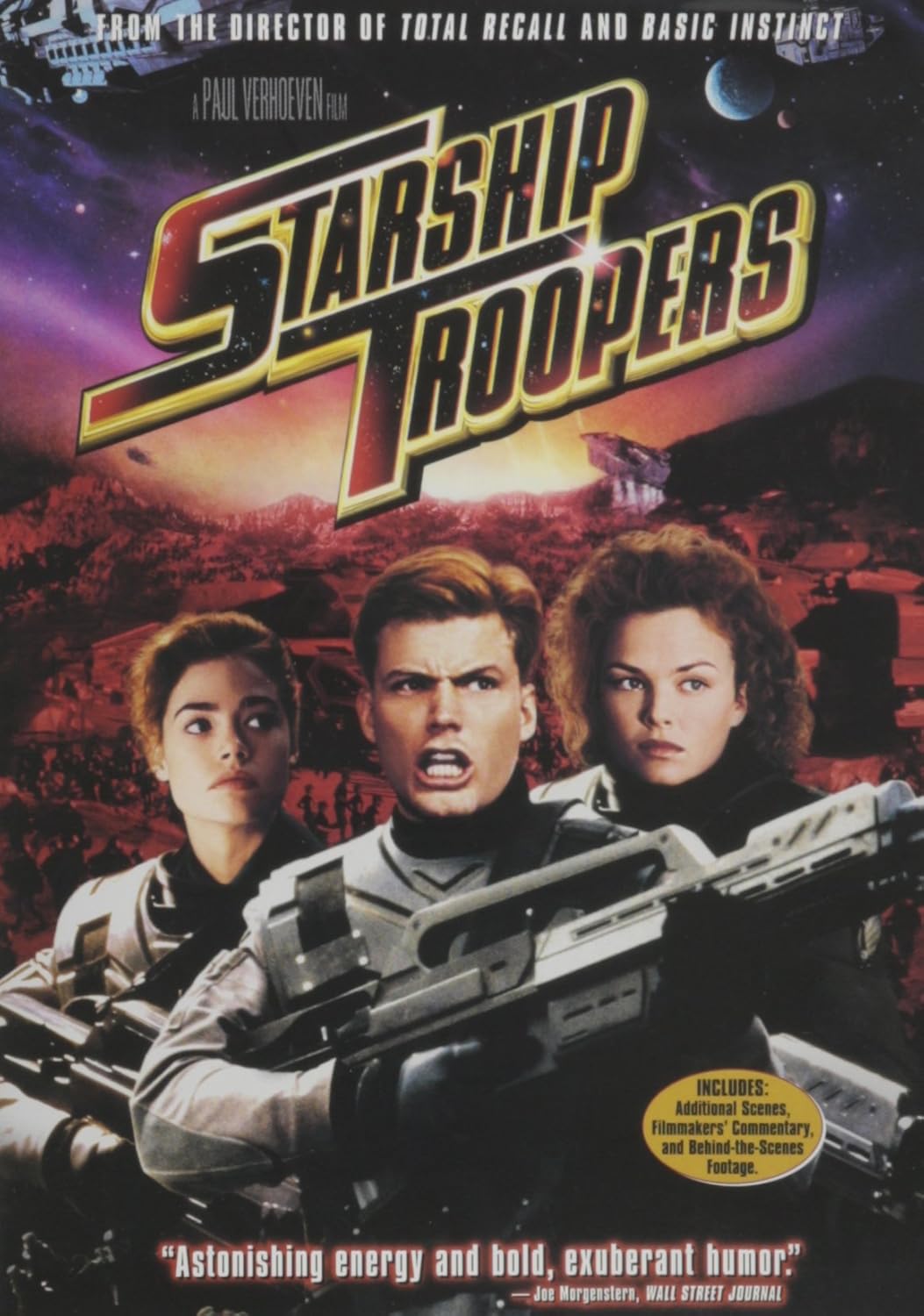
Original DVD Cover Image, 1998

Review: Starship Troopers with Casper van Diem, Michael  Ironside vs. Starship Troopers by Robert A. Heinlein


Challenged to name a movie that fell disappointingly short of its source, my first reaction is Starship Troopers, out in a 20th anniversary edition this month.

Two decades ago, I was tremendously excited when I learned they would make this book into a movie, even as I doubted they would capture its flavor in full. The problem is internal dialogue. Truly interesting books take us into the inner life of their main characters; in revealing those meditations and self-recriminations, they expose their souls. 

Without that insight, fictional characters are as intellectually interesting as rock-em-sock-em robots.

Typically, movies substitute external dialogue and narrative for these inner debates. An example of this done well can be seen in the 1984 version of Dune. Without the narrative voiced by Gurney Halleck (Patrick Stewart) and Princess Irulan (Virginia Madsen) in that film, its story would be impenetrable. With it, and by dint of voicing much of the book’s mental dialogue, it succeeds as an adaptation.

So I knew it would not be impossible to capture the philosophy- and social-commentary-laden substance of Heinlein’s novel. Then I saw it in the theatrical release, and was sorely disappointed. This is simply not Heinlein’s story.

Oh, the bugs are there. The sneak attack by this alien hive-dwelling race that wipes out Johnny Rico’s home city is in the movie. The Mobile Infantry are there, with their armored suits complete with heads-up displays, pocket nukes and jump jets. What didn’t survive the cut? Only the reason why Johnny joins the service in the first place.

Heinlein’s novel hinges on two social differences in the world of Starship Troopers. First, only veterans—those who have chosen to place their lives “between their loved home and the war’s desolation”—have the right to vote. Civilians do not have that right, and neither do serving troopers. Heinlein justifies this very succinctly:
Suddenly he pointed his stump at me. “You. What is the moral difference, if any, between the soldier and the civilian?” ”The difference,” I answered carefully, ” lies in the field of civic virtue. A soldier accepts personal responsibility for the safety of the body politic of which he is a member, defending it, if need be, with his life. The civilian does not.”

Second, it is anyone’s choice to enlist at any time after their 18th birthday. The services will find something for the enlistee to do, to allow them to earn the franchise. But if they then go AWOL, resign, or are drummed out for any reason, they never have the opportunity to try again. Politicians from dogcatcher to President must, under this system, be veterans, and there are no “reserves”.

The movie barely mentions either of these two critical concepts. Worse, the main source informing Rico’s choices, his high school “History and Moral Philosophy” teacher, Col. DuBois (who pointed his stump at Johnny in the quote from the novel), is barely there in the first scenes, and not mentioned again. These ideas are presented in hit-and-miss fashion, as if they are part of the recruit training after enlistment, instead of why recruits choose to enlist in the first place.

Moving the important motivation to enlist into the recruit training has another consequence—we do not get a real sense of the conflict between Rico and his father. As a result, his reaction when his home city is attacked is shallow. He’s now an orphan, okay, move on. This robs the viewer of one of the most poignant scenes Heinlein has written, when as an officer, Rico is relying on his master sergeant.

Lieutenant Rasczak (Michael Ironside) is given most of the lines that Col. DuBois has in the novel. So we get a tepid, PC-diluted “Violence has resolved more conflicts than anything else. The contrary opinion that violence doesn’t solve anything is merely wishful thinking at its worst,” instead of
Anyone who clings to the historically untrue—and thoroughly immoral—doctrine that “violence never settles anything” I would advise to conjure the ghosts of Napoleon Bonaparte and the Duke of Wellington and let them debate it. The ghost of Hitler could referee, and the jury might well be the Dodo, the Great Auk and the Passenger Pigeon. Violence, naked force, has settled more issues in history than has any other factor, and the contrary opinion is wishful thinking at its worst. Breeds that forget this basic truth have always paid for it with their lives and freedom.

If this was the only shortcut, I would not complain. It is not. Sergeant Zim is another crucial character whose best lines from the book are given to Lt. Rasczak, or simply omitted. Rico’s relationship with training sergeant Zim is formative for him. Again, the movie simply ignores this part of the story.

In addition, the movie completely omits Juan Rico’s choice to go to officer training, and how this perspective changes his assessment of his life and responsibilities. I can see leaving this out to save time (and provide grist for a sequel). I suspect, however, that the movie’s creators were simply in a hurry to confront Rico with the alien bugs.

The other changes are minor, and do not, in my opinion, ruin the story. In Heinlein’s novel, women do not serve in the Mobile Infantry; Heinlein was a product of his time and served as a Naval officer in the 40s. He does give women a unique role that men cannot, for the most part, perform as well. In addition, Johnny’s best friend Carl does not end up as a commanding colonel in the novel—to describe where he does would be a spoiler. But these are minor changes, and I can roll with them. 

What I miss are the thoughts about why defensive war is necessary, and how best to conduct a war once one is begun. Once again, the words are those of Col. DuBois:
If you wanted to teach a baby a lesson, would you cut its head off?… Of course not. You’d paddle it. There can be circumstances when it would be just as foolish to hit an enemy city with an H-bomb as it would be to spank a baby with an axe. War is not violence and killing, pure and simple; war is controlled violence, for a purpose. The purpose of war is to support your government’s decisions by force.

Dune has been remade, and the second version has qualities that the first did not. I cling to the hope that Starship Troopers will be remade by someone with the vision to see past the great special effects opportunity to create a movie worthy of the power of Robert Heinlein’s novel.

In the meantime, skip the movie. Read the book.

Friday, September 8, 2017

Women on His Mind

Review: Lois McMaster Bujold's Penric & Desdemona Novels


Early in the novel Penric's Demon, a gormless young man pauses on the way to his arranged wedding to help an old woman at the side of the road. Unfortunately, she is inhabited by a demon, which jumps to young Penric when she dies, bringing along the memories and personalities of everyone possessed previously... all women.

As if being possessed by a demon weren't bad enough, Penric must now contend with the curious attention of a dozen women—many of them elderly—watching and criticizing his every move.

It's not all bad news, though. Penric acquires the powers of his ancient demon, whom he names Desdemona, along with the inescapable company of the clique of dames residing between his ears. And if their advice ruins his morning self-embrace, it saves him embarrasment far more often, and provides short-cuts to the scholarship he needs in order to be a competant sorcerer.

This book borrowed from world-building Bujold had already done for the Chalion fantasy series, although it is set in a different time in that world. The second two books of the Chalion trilogy are echoed in Book Two of this series, Penric and the Shaman. "Shaman" is the animal-bolstered equivalent of the sorcerer, so Inglis is, to some extent, Penric's peer. I was intrigued to see a different fantasy construct, the were-wolf, incorporated into the "paladin of souls" concept in Penric's world.

You can read these novels in any order you like, but I find they work best read in numeric order, 1-5. Further paragraphs may contain spoilers, so if you haven't read any of them yet, please stop here!

Book 4, Penric's Mission, came out before Book 3, Penric's Fox, was available for Kindle, so I orginally read them out of order. The third novel's story rises naturally out of the second, though, since it concerns a demon who has jumped, not to a human, but to the nearest creature available, a fox. It is also the closest to a murder mystery I have read from Bujold's pen. Desdemona really comes into her powers here, lending all her various riders' knowledge to the task of rescuing the lost demon.

Mission, on the other hand, is about Penric rising to the use of his powers, coordinating everything he has learned with the sorcerer's abilities to rescue General Arisaydia and his sister from an oppressive government. There is almost an engineering quality to his use of Desdemona's powers. (This is nothing more than I would expect from Bujold; my first encounter with her work was Falling Free.)

Book 5 is the first that doesn't feature Penric in the title. Mira's Last Dance has one of his embedded personalities, a courtesan with a predatorial way of controlling men, take center stage in the effort to enroll General Arisaydia in Penric's sponsor's cause (the escape that began in Mission). 

Not only does Penric's mission continue in Book 5, but his developing relationship with the sister does also. The convoluted way in which his female inhabitants inhibit this blossoming romance is a delight to read, conflict being the principal driver of good fiction! Throughout the series, in fact, I was reminded of the conflicts between Johann Smith, Eunice Branca and Jake Saloman (all residing in Eunice's head) in Heinlein's I Will Fear No Evil.  


Liner Note:

Amazon lists these books as novellas. At around 100 pages, four of them are definitely short enough to class as novellas, but Penric's Mission is 224 pages. Further, all five read as novels, with lots of action (mental and physical) to reward the reader. 

Friday, July 21, 2017

In Defense of Philosophical and Religious Fiction

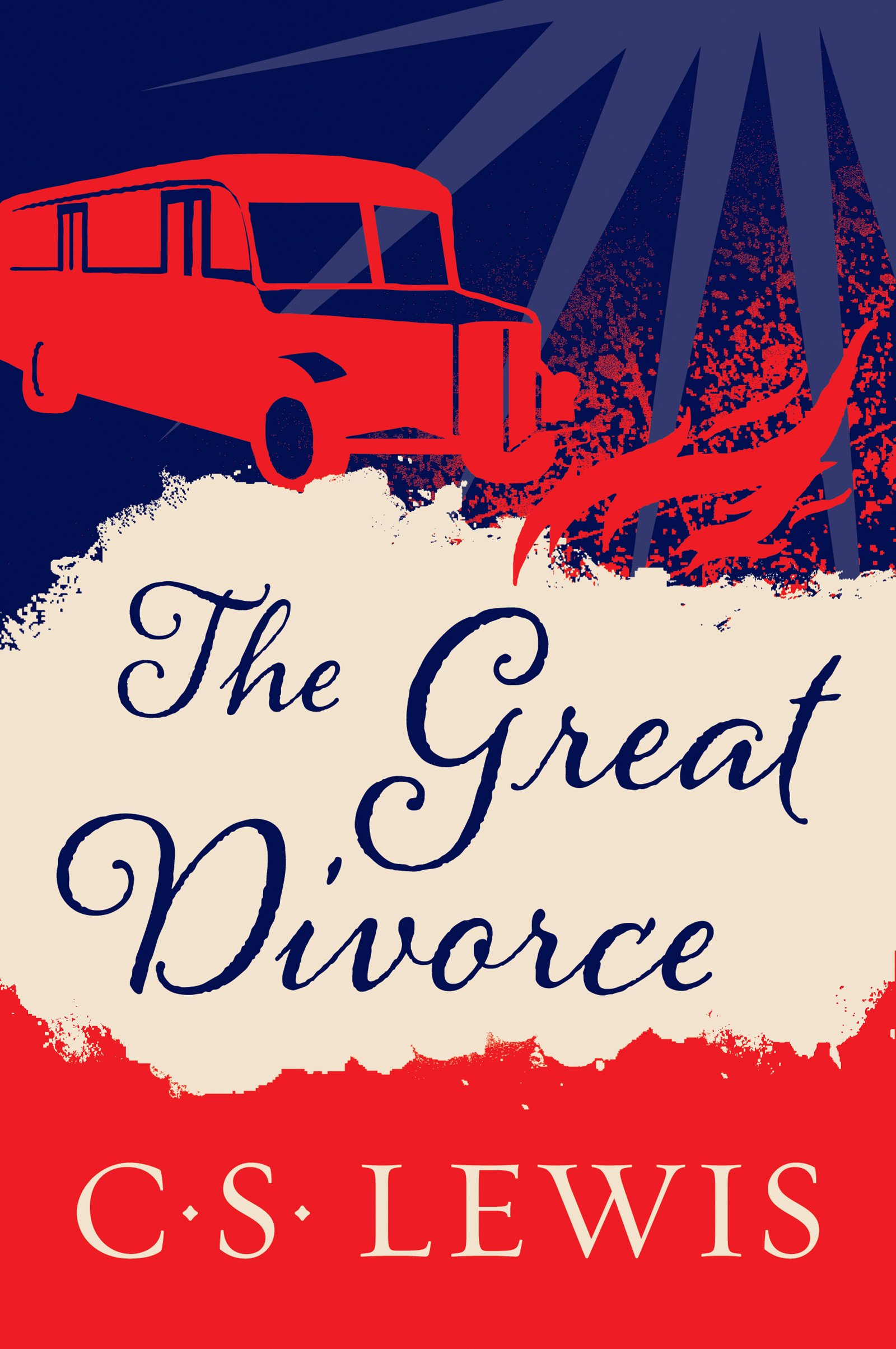
The Great Divorce by C.S. Lewis; Atlas Shrugged by Ayn Rand; Stranger In a Strange Land by Robert A Heinlein


"It was a bit preachy..." "Author went on and on about personal beliefs..." "Just when I thought I understood the main character, they went off the deep end into religion, and I lost interest..."

There's something to be said for preaching to the choir: They get the message, you don't have to work too hard, and you can count on a rousing AMEN! at the end of your sermon. On the other hand, you finish with a sneaking suspicion that you haven't moved anyone off the point where they already stood. Who has been saved?

Philosophy and religion share some characteristics, after all. In the former, studies, explorations, thoughts and insights make sense of the philosophical space we have defined, and allow us to reach conclusions about its nature, within the confines of that pre-defined space. In the latter, studies, explorations, thoughts and insights make sense of the conclusions in which we rest our belief, and allow us to define its nature and extent, within the confines of that faith.

For both philosophy and religion, though, participants tend to be either preachers or members of the choir. A layer of fiction can make these insights available to those who are neither. In reading fiction, we take a step back from the tenets of faith or philosophical axioms, and interpose a story between them and us as readers. The story's characters, their actions and choices, make sense of the fictional space that has been created (and consequently, make the philosophical or religious space more accessible.) 

What C.S. Lewis did in The Great Divorce, for example, was to reveal that Hell is a choice made continuously in life (and after death), and that we can turn ourselves around at any point. Heinlein's Stranger In a Strange Land, on the other hand, posited that Heaven is accessible before death, if we let go of negative emotions and love each other. Ayn Rand's polemic Atlas Shrugged dismissed Heaven and Hell with the philosophy this world counted most; that doing one's best is the path to joy and salvation. 

You may take away a different message; that's much of the joy of reading such fiction. It doesn't matter what conclusions the characters come to, or even the one the story presents. What matters is the journey the author takes you on, from which you can take a longer, wider or deeper step into these thoughts than you would be able to on your own.

Monday, July 17, 2017

Fractured Fairy Tales

Review: Isabella and the Slipper by Victorine E. Lieske; Cinder Unit (Duplicate Book 1) by H.A. Kinani


Ready-made stories are everywhere. For the novice no less than the seasoned writer, starting from an existing tale is an inviting shortcut. If your story derives from another author's world-building, it may be dismissed as "fan-fic." Yet it can still be compelling, as long as you avoid the pitfalls any short-cut can entail.

Two of my recent Kindle Scout nominations were based on the same fairy tale, Cinderella, but each took radically different looks at the story—and this is why I cannot dismiss such novels as "derivative."


Isabella and the Slipper

If you've seen the Hilary Duff movie A Cinderella Story, you're acquainted with the plot gimmick for this novel: in the movie, a cell-phone mixup leads step-daughter Duff into a text and email relationship with her high-school prince. Isabella's cell-phone mixup leads her into a text and email relationship... Yeah.

Even the slipper of the title barely appears in the tale. This is a light romance with very little substance, perfect for a summer read if you have nothing better to do. Fortunately, of the two reviewed here, the Isabella nomination was selected, so I was able to read it for free. The earlier nomination in my list, Cinder Unit, which I paid for, was a better story with more complexity of plot and characters.


Cinder Unit

The Ella of this novel is not a step-daughter pining for a dead father, but a clone. The duplicate Ellas are all cleaning girls, though what they clean depends on where they are assigned. The Cinder units all clean soot and ashes (and cinders, of course) from the buildings where they toil. Kitchen Ellas clean pots and pans, and so on.

When unit Cinder-03-Ella-11 is reassigned to a top-secret science building, her new job is to clean soot, cinders and ash from the two-room lab of Mr. Anthony. The only cinder-cleaner in the building, she loses her numbers to become simply Cinder-Ella. The sinister Mother, a prototype-model robot, seems determined to break her Cinder unit, and the human user of the lab is equally determined not to have his lab disturbed by cleaning.

Ella's night at the ball cannot happen if she allows either of them to succeed; yet the story feels new, non-derivative, and deliciously complex. We delight in the echoes of the original fairy-tale, and enjoy the ways in which our Cinder Unit is not Cinderella seeking her prince

This is a genuinely new take on the tale, and leaves me to wait breathless, wondering what clone might be at the center of Duplicate Book 2.


Liner Notes


  • Both novels were only available in Kindle editions at the time the review was written.
  • Both were nominated for Kindle Scout selection, but only Isabella and the Slipper was selected.

Monday, June 5, 2017

Hooking Readers, or Why 50SOG Beats My NaNovel

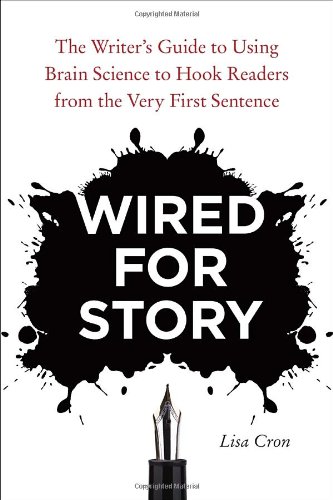
Review: Wired for Story and Story Genius by Lisa Cron


Like many amateur writers, I thought knowing how to write beautiful language (English, in my case), following the rules of grammar and including the occasional poetic passage, was the key to producing a winning novel. NaNoWriMo showed me I could produce the volume of words needed to successfully do that.

I have spent months of concentrated effort, writing and plotting and editing and rewriting, but my NaNovel is still a flat thing. So uninviting, my spouse wouldn't read it. Worse, if I hadn't written it, I wouldn't read it.

Meanwhile, so many poorly-written novels full of one-dimensional characters and grammatical errors galore—Fifty Shades of Grey is the iconic example—top the charts and capture the reader's dollar. Yes, even mine.

Fortunately for me, I latched onto these two works by Lisa Cron, They not only tell me why my fiction books are not absorbing, but provide a step-by-step plan to help me correct the issue.

Wired for Story

Why does the engaging story pull us in, over the bumps of typos and plot errors, kludgy scene development and character description? In short, why does Fifty Shades of Grey with its oft-reviewed flaws and derivative nature top the charts and launch a successful movie series on top of its publishing success? Cron argues that our brains are prepared to listen and heed stories of a particular kind. More, that our own brains reward us when we spend time absorbed in such a tale.

But it isn't just any story. The tale that rewards us is one that promises a lesson—and then delivers. The protagonist must confront a choice that matters to his or her life. Whatever choice is made, the consequences that follow are the lesson our brains reward us for learning. Such learning, even through the mythical lessons of others' success or failure, is a survival mechanism.

So: Should Joe have bacon or kippers for breakfast? Not a world-shaking or life-changing choice.

Except... what if choosing bacon meant that Joe would soon be in a battle for his life, because of a mutated pestilence that had infected the swine from which the bacon was made? To catch the reader's attention, the story must show right from the beginning the serious nature of Joe's breakfast choice, and then incorporate the consequences in a way that rewards the expectant reader.

According to Cron, it isn't the obviousness of the dilemma, but the way it is presented—the way it is written—that absorbs that survival skill in the brain, and rewards the ardent listener to a well-told story.


Story Genius
If story is the critical element of a successful, engaging novel (using the brain science presented in Wired for Story), how do we write to reveal the heart of the story? That's the thrust of Cron's second book on story creation, presented as a series of steps for us writers, with a chapter-by-chapter example of story development from real life that follows these guidelines.

Think of that old joke, "What's the book about?" "Oh, it's about 350 pages.." If you cannot summarize the key thought, the chief dilemma, in your novel before you write it, chances are good it will not be there to inveigle the reader after it is written, either.


I was so taken by these concepts that I have planned my Camp NoNo project around it for this coming July. If Cron's instructions can resuscitate the story structure for my ailing NaNovels, I'll be ahead of the game for November.

Wednesday, November 30, 2016

Story: 10, Grammar and Punctuation: 2

Review: Born a Witch, Drafted by the FBI! and Conjuring Quantico by T.S. Paul


The first two offerings in the Federal Witch series by T.S. Paul will likely be the only ones I buy. Despite an admittedly great story with an intriguing, vaguely alternate-history, plot-gimmick, I can't force myself to wade any further through the extremely poor editing.

I might have been warned by the cover composition, and the fact that these books are only available in e-format.

The concept is a good one: magic users (Paranormals) are a sizeable group in every country, and have been at the center of each historic conflict since the Great War (WWI in our history), which they call the Great Purge. Because the Allied victory in this war involved killing off the vampire clans in Europe (including neutrals, and those allied to Britain), the paranormal community is extremely leary of cooperating with government agencies like the FBI.


Born a Witch

Agatha Blackmore is not only a witch, she is the most powerful witch of her generation. She is also a loose cannon with a tendency to commit wild magic with unintended consequences. Who better, then, to finally step up to work for the FBI? If her magic goes awry, as expected, at least she'll not be anywhere near the witch community.

This prequel tells Agatha's back-story: the "incident" when she was six that terrified her widowed mother and her aunt, and brought into her life the familiar Fergus, a My-Little-Pony-sized unicorn that talks—and cusses. The story reveals her strong bent toward law enforcement, and provides some reason to why she would comply with her family's desire to have her out of the community.

It also establishes the bias and bigotry of the FBI Academy's director and staff, not only toward Agatha, but toward other paranormals like her Were roommate Cat. The characters each have their own voice and set of quirks, including the politically-incorrect Fergus.

The novella would have been an enjoyably quick read if I hadn't spent so much time documenting the dauntingly numerous instances of apostrophe-abuse and number disagreement. What writer old enough to have a wife, as T.S. Paul's bio indicates, does not know that plurals do not have apostrophes, and possessive nouns (except pronouns) do? I reported dozens of such errors from this short 55-page novella.

Paul is lucky I ignored the apparent inability of the author to use commas; I would have still been reporting them if I had not. Leaving them out makes the reader work so much harder to figure out who is speaking to whom.


Conjuring Quantico

Agatha Blackmore and her roommate Cat are both accepted to study at Quantico. I didn't expect to find a close match with actual FBI Academy practices in a novel about witches and were-cats, so I wasn't disappointed when I didn't. It felt more like the movie Feds: cute girl roommates and a dweeby guy form a pact (or in this case, a Pack), and triumph as student-agents by using teamwork. 

In this iteration, however, they're pitted against a team of powerful demons instead of clueless fellow students.

Here again, the story and character development rates a 10, but the apostrophe-abuse continues. And Paul adds a new issue: rampant capitalization. Random nouns are "properized" by capitalizing them. "Were" (a shape-shifter Paranormal) is proper in one sentence, and uncapitalized "were" in the next, and "were-cat" is just as likely to be rendered "Were-Cat" or "Were-cat." (It doesn't help that the Were Cat is a were-cat.) 

I finally blew my stack when "Dike" and "Sill" (the igneous geologic structures) were properized.

I was sensitized by the time I came across two instances of blatant number disagreement. "There was two..." and "There was several..." made me see red. And don't get me started on the author's blatant disregard for the proper use of commas. "See Cat being a natural leader..." is just not the same thing as "See, Cat, being a natural leader..."


I wanted to love these books. I really did. I'm angry that the abyssmal editing prevented me from doing so, and even more incensed that I spent my own money to experience such a disappointment.

I can't recommend them to anyone else.

Monday, November 14, 2016

Growing Up, Growing Better

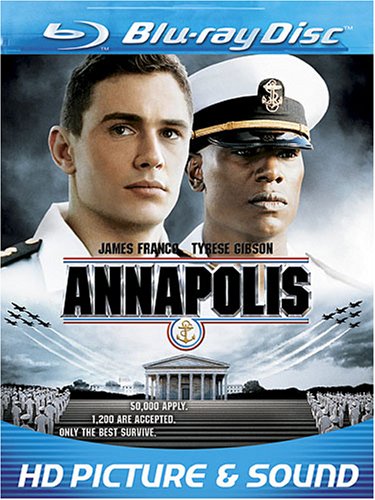
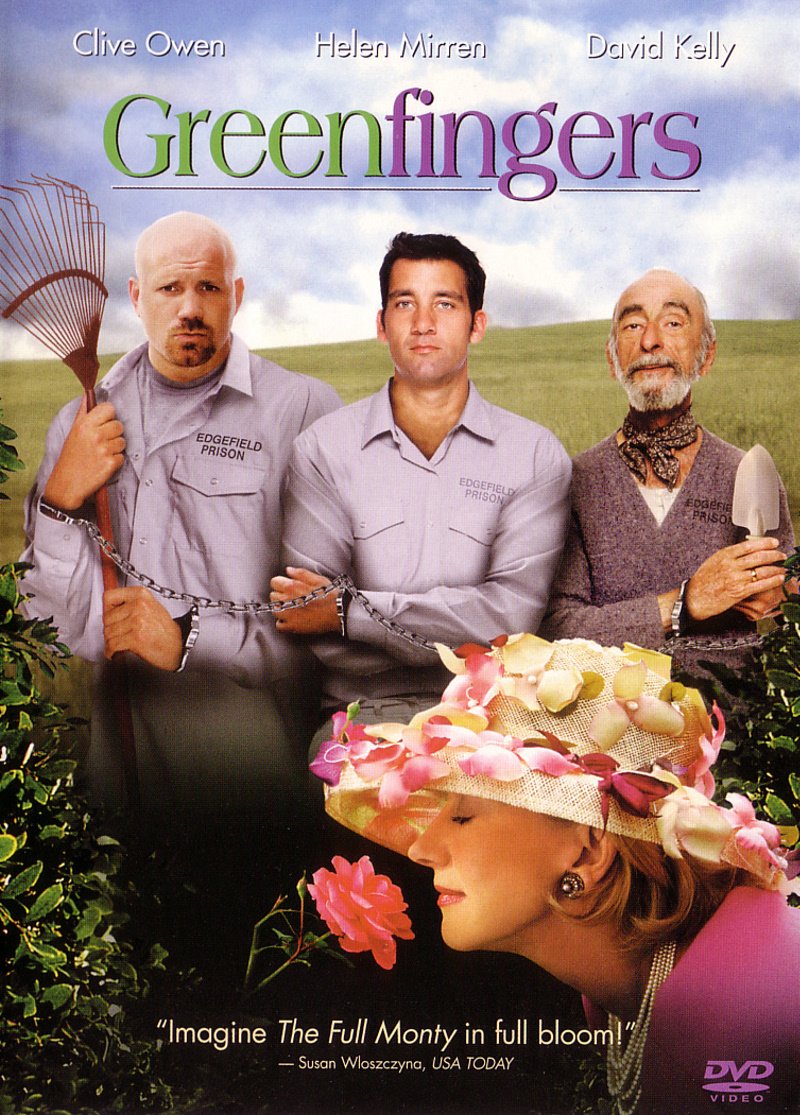
Review: Annapolis with James Franco, Tyrese Gibson, Jim Parrack; Greenfingers with Clive Owen, Helen Mirrin, Danny Dyer


Life after the semicolon; what changes in us after a disastrous life-turning event depends on what follows after. Do we wallow in victim-hood, or do we move on, up, and out of the pits life has landed us in?

Good films with this theme are not hard to find; it is a common story for us all. I was particularly inspired by two movies that share this theme by telling two very different stories: Annapolis (2006) and Greenfingers (2000).


Annapolis 


This is the tale of a ship-fitter, Jake Huard (played by James Franco), working for his father's construction crew on the docks across the river from the prestigious Naval academy. Jake's dream is attend Annapolis, but he was wait-listed when he applied. So he fills his days with the hard work of a welder and riveter, and his leisure with training as a boxer.

We first meet Jake as he prepares to go into the ring against co-worker AJ, a taller, heavier boxer. (AJ is portrayed by Jim Parrack, who was a main non-vampire character in the HBO True Blood series.) Jake refuses to fight as directed by his father, closing with the larger boxer and defeating him despite multiple knock-downs. The naval officer in the crowd of dockworkers, conspicuous in his whites, has come to offer him a place at Annapolis. Lt. Buxton (Donnie Wahlberg) comments on how unusual it is for an application to come from someone in Jake's position. We get another glimpse of Jake's persistence thereby: he had apparently pestered a Senator daily for over a month to help.
   People who live in Arkansas, you know what their favorite state is? Mississippi. Cause Mississippi's the only thing that keeps Arkansas from being the worst state in the whole country.
   I'm Mississippi.
   Well you sure as hell ain't California. Listen, Cole and Whitaker are so busy tryin' to run you out they forgot about me. As a matter of fact, they've forgotten about every other plebe in this whole company.

For Jake, the "semicolon" is not just leaving the comfortable environs of family and friends to join the company where he will be "boxing over his weight". It is facing life-crippling bias. Jake grows his life in the direction he chooses by feeding his habit of persistence in the face of prejudice, and staying true to his dreams. 
Some of you have only known success your entire life. But this year, your plebe year, you will know failure... because failure is a far greater teacher than success.

And that's the point. Failure is not a stopping place; it can be a launch-pad to success. One only has to survive, and persist.


Greenfingers


The theme I'm exploring, improvement over one's past, might seem to be belied by the opening scenes of Greenfingers, in which we see Colin (Clive Owen) stealing a bouquet of yellow roses and being reincarcerated in a British prison. But all is not as it seems in this movie based on a true story.

Immediately after the initial looting scene, we flash back to Colin's life in prison just one year prior. Facing his parole board, he learns that he is eligible for transfer to a new program in a lower-security prison. He's become resigned to his imprisonment, and tells the board, "If you don't mind, I'd just as soon not change."
Fergus: [Waking up and seeing the flower on the nightstand, then seeing Colin, who had received the flower as a parole gift] What's that old thing doing back here?
Colin: It wasn't ready for the outside world.

Nevertheless, he is transferred, and assigned a roommate, Fergus (David Kelley), and a grim job dealing with the prison toilets. For Colin, there is little to choose between his work and Fergus, whose cheerfulness in the face of life is an affront to Colin's pessimism. He tries, but Fergus refuses to be shut out. Eventually, they bond over the planting of a packet of violets in the snow, and protecting the fragile flowers that bloom despite Colin's conviction that they are doomed.

Like the violets, Colin and the other convicts who become involved in building the prison's formal garden bloom in the regard of professional garden-writer Georgina Woodhouse (Helen Mirrim).

The moral is that just as winter and death are inevitable, so too are spring and the flowering of whatever seeds we plant. The path to improvement for the convicts of Greenfingers was to choose which seeds to plant, and then tend then carefully.

One need not be a gardener to see the truth in that.

Friday, October 21, 2016

Arc of Triumph, Arc of Pain

The arc of any man's life must always include some courage, some fear, some pettiness and some generosity, some defeat and some triumph. In an exceptional man's life, these arcs are world- or even universe-spanning.

The seven novels of the Seafort Saga by David Feintuch (Midshipman's Hope, Challenger's Hope, Prisoner's Hope, Fisherman's Hope, Voices of Hope, Patriarch's Hope, and Children of Hope) detail these arcs of life for a very exceptional man indeed. I re-read the saga every few years, often just the first two novels. It is enough to recall the entire heroic arc of Nikky, raw young officer, cocky and confident, to aging colonial leader Seafort, full of self-doubt, yet still compelled to be the hero.


Midshipman's Hope

Nicholas Ewing Seafort's arc begins when he is the first midshipman, a minor officer in the heirarchical line of command on a starship whose society is patterned after 18th-century naval life. He struggles with his position in that heirarchy, with the skills he needs to acquire to do his job, and especially with his own conscience. Nikky Seafort is a man by decree and by burden, but a lonely adolescent by age.

In a single disaster, Midshipman Seafort becomes the senior officer aboard UNNS Hibernia. Seafort is a teenager in command of a ship that includes passengers, ordinary sailors and other officers, one of whom is older than Seafort, but not senior in the line of command.

To add to his troubles, the passengers don't understand why the Chief Engineer, an older, much more experienced sailor, or the Pilot, another more-experienced man, cannot take command - especially when there is an alien life form outside the ship, one that appears to have "killed" another vessel, and may have also killed the senior officers of Hibernia.

Seafort must determine where his duty lies, resolve to do that duty, and contend with a host of others - including the ship's "glitched" computer - to see it done. 

The action is well-laid out and the aliens are truly strange (something one cannot always say about science fiction aliens). Seafort's internal dialog contributes immensely to the tale; many of his burdens are self-imposed, and that dialog is the only way we know how heavy those burdens are for the youngster.

The novel can stand on its own, but read as the opening to the entire saga, it is outstanding.


Challenger's Hope

Too young to be confirmed as Captain in his own right, the still-teenaged Nicholas Ewing Seafort is given Commander rank, and placed in command of the UNNS Challenger, which is part of a fleet of ships under the command of Admiral Tremaine. Their goal is to find and confront the aliens Seafort's former ship, UNNS Hibernia, confronted in the space around Hope Nation.

At the outset, Admiral Tremaine is opposed to the young commander: he starts by moving his flag (and flag captain) to Seafort's ship, transferring Commander Seafort to the smaller UNNS Portia. Then he organizes the fleet to make short hops - seven or more - between Earth and Hope Nation, with Seafort's somewhat faster ship preceding the rest of the fleet and then remaining in place until all the others have passed.

What none of them know is that the Fuse drive they use is calling the alien "fish"; Seafort's ship will be exposed more than any of the others.

Further complicating the command he has been given is the crowd of "trannies"; transient street people or transpops, that have been loaded on to his ship. These ill-educated children, none of them out of their teens, are expected to bunk six to a cabin. Even worse, the regular passengers object to sharing a dining room with them.

Seafort's wife and infant son are along. He also has the entire chain of command in which he has been placed in loco parentis. Seafort, whose own childhood was disturbingly lonely and without demonstrations of paternal love, must find a way to be father, commander and pastor to his entire crew - especially after they are all transferred back to the hopelessly damaged UNNS Challenger and abandoned to the fish.

Book 2 of the Seafort Saga is a thrilling blend of action and internal struggle, triumph over despair, and refusal to surrender even in the face of overwhelming odds. Its ending, which leaves Commander Seafort further burdened with his own grief and self-recrimination, sets the reader up for the next novel, but read with Midshipman's Hope, the two are complete on their own.

Wednesday, October 19, 2016

Breaking the Wall

Review: Matthew Templeton and the Enchanted Journal by Natalie Grigson, Kelpie Dreams by Steve Vernon


One of the hardest techniques for an author of fiction to master is addressing the reader directly. Speaking directly to, acknowledging, or including your audience through the imaginary box of observation is known as "breaking the fourth wall". It takes a very light hand, and is easily overdone. Many readers—myself included—dislike it intensely as an annoying distraction from absorption in the narrative.

It can be done, however. In order to succeed, the narrator must include the reader with asides that share expectations or acknowledge a quiet joke at the characters' expense. It must also be continual; a sudden comment to the reader in Chapter Eight is a jarring occurance, but a string of subtle asides that begin in Chapter One becomes part of the narration. Gentle, quiet, and subtle will be less annoying than sudden, jarring and unexpected


Matthew Templeton and the Enchanted Journal

This novel was a Kindle Scout nomination of mine that was not selected. I bought it anyway, intrigued by the concept of a journal that could bring about anything written into it. (Shades of Stranger than Fiction here; I kept thinking of Emma Thompson writing Will Farrell to death.) Matthew's journal is a birthday present from his librarian, Ms. McCaffrey. 

A thirteen-year-old boy might be presumed to be less than delighted at receiving the gift of "a diary", but it beats what Matthew got from his hideously self-centered and mean parents: nothing. Well, nothing except a promise of military academy, despite his intense wish otherwise on his "birthday match". 

Throughout the tale of Matthew, his only school friend Ryan, and the others they collect on their adventures, we are invited to laugh at the folly of the humans, snicker at the petty evil of Matthew's parents, and enjoy the daft way the journal continually skews what Matthew wants by misinterpreting his written words. Ordinarily I would despise such asides, but Grigson has a sweet way with them. They help the reader along rather than breaking the fourth wall.

This is a tale of revenge and murder, treachery and lies, with knights and their ladies fair, lost princesses, evil wizards, montrous wergs, and rebellious villagers. Yet not one of them is what we expect; every character (except Matthew's parents, perhaps) has a unforseen side. The result is a light-hearted, humorous, and thoroughly delicious novel with the promise of a sequel.

I'll be waiting on the other side of the wall, with bated breath, for Grigson to break it again.


Kelpie Dreams

This novel, by contrast, was accepted as a Kindle Scout publication. It had a HOT label on it from the first, and I understood why when I read the concept: a paranormal romance novel (kelpie librarian, 200-year-old sea captain, zombie lighthouse keeper, sea hag villain) for folks who HATE to read romance novels. That's me! I thought, and nominated it. (Besides, I had nominated Vernon's A Blurt In Time, bought it when it was not selected, and enjoyed it a little. Surely I would enjoy this one a bit more?)

I barely read the excerpt, I was so taken with the concept. If I had, I would have noticed the blaring asides, the all-caps shouts. (And paragraphs of hyphenated stuff, breaking oddly due to my font-size settingI should have remembered them from Blurt.) I was never allowed to simply become absorbed in the tale, but was constantly dragged from my observer's post to get involved in the action. 

Perhaps it would have been less annoying if the asides and comments weren't so crude and gauche. OK, there's a bit of a snicker in someone's mother wanting to name her Hemorrhoid. But:
Can you actually imagine spending your entire lifetime constantly spell-checking your own name? Go ahead—just try to close your eyes and spell out H-E-M-O-R-R-H-O-I-D without having to resort to a discrete peek at a medical dictionary. I dare you.

If that was the only such, I might have forgiven the writer and moved on. But there is scarely a page without a similar observation, blatantly breaking the fourth wall to drag me, the reader, into the character's head. I don't come to discover the main character's motivation, I am drenched in it:
My son had died picking his nose in a stolen neon yellow Audi. Try and think about that, if you will. Let the thought crust and dry, and let it stick to your mind’s finger like a hard and completely unflickable booger of undeniable truth. I had always thought that the word irony was the opposite of wrinkly, but if this wasn’t ironic, I don’t know what else it could be.

OK, I'm not with it. I don't get it. Except occasionally, I do, and then I regret every one of the break-wall asides I got annoyed at when I come upon something really cool and evocative:
I stared right back. I was not going to give the man a single inch of leniency. I mentally tried to evoke a psychic soundtrack of all of the Ennio Morricone background music from all three of Clint Eastwood’s Man with No Name westerns. Ooeeooeeoo . . . wah-wah-wah. Ooeeooeeoo . . . wah-wah-wah.

Eventually, having battled nearly half-way through the up-and-down narrative, I quietly closed the book and abandoned the effort. That was mid-May. I told myself, Steve Vernon shouldn't have to suffer a bad review because of my inability to get past his brittle-wall syndrome. It wasn't until I read Matthew Templeton and the Enchanted Journal that I realized breaking the wall doesn't have to throw the whole labor onto the reader.

Vernon has a readership, and my comments will come late in the stream, easily ignored by them. But this is one time I'm really glad I didn't pay for a book.

Wednesday, August 31, 2016

Some Like It Drag

What is the appeal of a guy in a dress? Comic and pathetic by turns, movie transvestites (as opposed to your everyday TV) possess some magic that can turn a drab story around, or sink a poorly-conceived flick into B-movie oblivion. Donning a dress can gain an actor kudos, or haunt his life ever after with innuendo and rumor.

Director Ed Wood (Glen or Glenda, Plan Nine from Outer Space) was a real TV in the most classic sense. To borrow the campy tagline from his transvestite mystery Glen or Glenda, Wood “...Loved Women So Much, He Dared To Dress Like One!” Johnny Depp was able to portray the disturbed director, complete with cashmere cardigans, without significant harm to his acting career. (Although Depp seems Teflon-coated in this regard, having also survived the raised eyebrows from wearing beaucoup mascara in several outings of the  Pirates of the Caribbean.)


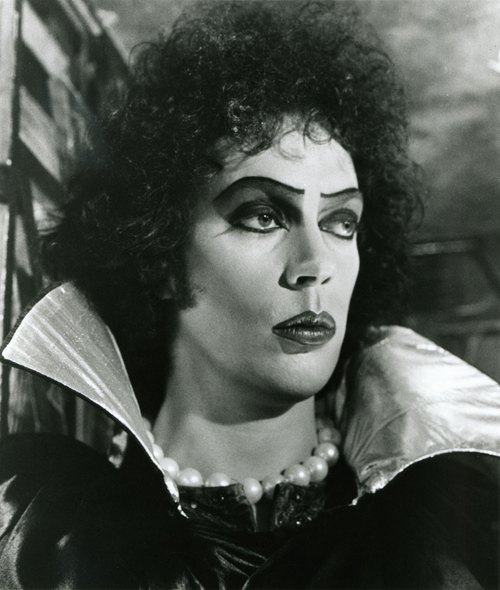
The thoroughly-camp Rocky Horror Picture Show makes a dark hero out of the gender-confused alien Doctor played by Tim Curry. Thousands of otherwise-straight men around the world have put on his gartered-stockings-and-bustier-corset costume, and sung—in public—his paean to muscle love. Some of them have even returned their costumes to the shop afterward.

In one of its darker themes, Rocky Horror first makes the TV an alien, then reveals the allure of transvestitism to even the squarest among us. Cross-dressing, we learn, is about “absolute pleasure.”

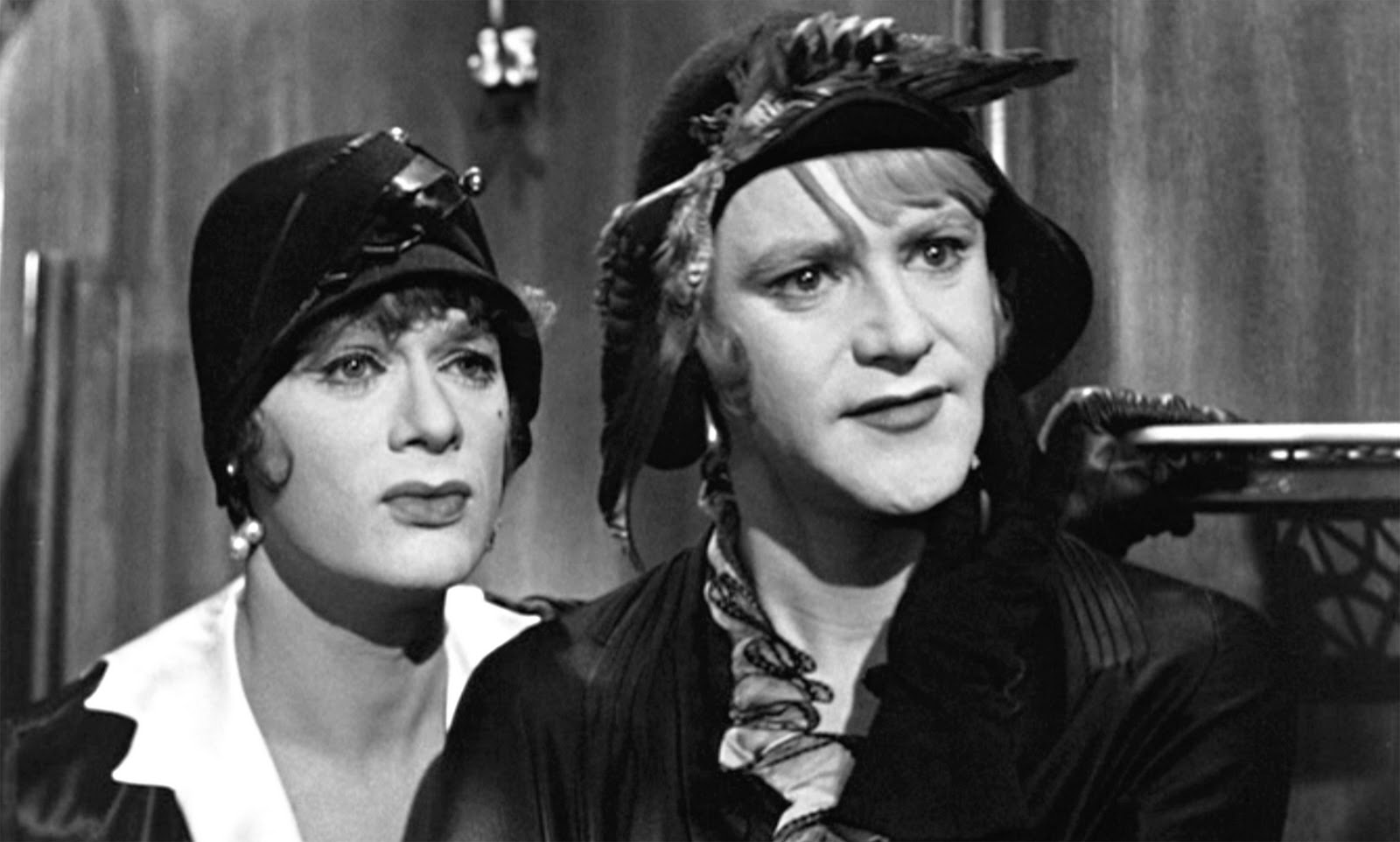
In a far more traditional men-in-dresses theme, it’s actually about disguise. For Jack Lemmon and Tony Curtis, going drag in Some Like It Hot, a girl’s band was the one place their pursuers would never look for them. Comically-gentile antics of guys in dresses are predicated on these men's simon-pure-straight sexuality; it isn’t funny unless Curtis's drag-disguise conflicts with his desire to woo Marilyn Monroe, or if Lemmon is not trying to stave off the advances of Joe E. Brown.


Dustin Hoffman? Or Jane Fonda?
In Tootsie, Dustin Hoffman took the disguise theme in a different direction. It’s not gangsters he’s trying to escape, but his own reputation. Here, again, is the conflict with the outward face and the inner desires, as Hoffman’s Dorothy character melds both the would-be-lover of a woman (Jessica Lang) with the object of a man’s affection (Charles Durning).

Some movies showcase the abilities of their actors by having them play both masculine and feminine roles. Diedrich Bader is genially goofy as Jethro Bodine of The Beverly Hillbillies, but truly hilarious as his cousin, Jethrine. And without the exquisite gay drag of three of George Hamilton’s five roles in Zorro, the Gay Blade, that movie would have been fatally overwhelmed by the all-caps dialog of Brenda Vacarro and Ron Liebman.


Like Jethrine Bodine, sometimes the guy-in-a-dress role is meant to be all female. The classic case is Divine as the coarsely-obese mother in Hairspray (1988). (Divine also had a male cameo as the high-school principal.) In 2007's remake, the musical Hairspray gave us John Travolta in the role as a rotund, yet surprisingly nuanced and nimble, Edna Turnblad. Travolta got the role after it was offered to Robin Williams, who turned it down. Perhaps Williams thought that his three gay/transvestite roles in three years (1993, 1995 and 19962) were enough.

Nathan Lane used his dress-up performance to poke some fun at the stereotypes of masculine and feminine in The Birdcage. Interestingly, Robin Williams’ gig as the “masculine” partner of this gay couple was equally powerful and ambiguously-gendered. Where La cage aux folles, the film’s French progenitor, was focused on the conflict between family values and gay partnerships, The Birdcage moved this debate to the battle between image (especially political image) and substance.


The best (and worst) drag-queen performances portray these men as what they are. To see what I mean, watch the amazing performances that give us the lonely but coping-with-life Vida Boheme (Patrick Swayze), Noxeema Jackson (Wesley Snipes) and Chi-Chi Rodriguez (John Leguizamo) in To Wong Fu, Thanks for Everything, Julie Newmar. Then contrast them with the scuzzy, sleazy, conflicted, lost men1 of The Adventures of Priscilla, Queen of the Desert, the movie that spawned To Wong Fu.

Hugo Weaving's outing as a desperately lonely drag queen didn't stall his career at all. After Priscilla, he was the scary-stern Mr. Smith of The Matrix, and the scary-stern half-elven Elrond in The Lord of the Rings. And I’ve commented before on the fact that neither Snipes nor Leguizamo appear to have been hurt by their roles in To Wong Fu, but that Patrick Swayze’s star seemed tarnished by his stint as Vida Boheme. This is despite the fact that, even in a dress, Swayze managed to get in some bare-knuckle fighting and rescue a woman—perhaps the problem is that, as in Pretty Woman, “she rescues him right back.”


Not elfin at all, Mr. Smith in drag: Hugo Weaving (R)
To Wong Fu gives us the beauty and fun of life in drag, but reveals its secret heart of alienation, and yearning for something that can never be. In a more-brutal way, Priscilla does the same thing, minus the glamour and a (somewhat) happy ending. 

And if one is Hollywood and trite, and the other Australian and bitter, these are the usual two faces of transvestitism in the movies.

Now, I know I’ve left some out. Y’all jump in here and tell me about them!

Liner Notes:

  1. Terrence Stamp in a dress has to be seen to be believed.
  2. Robin Williams has escaped entirely any stigma from three roles where he plays gays, and one—Mrs. Doubtfire—where he appears, not just in drag, but in frumpy drag. His greeting to the three drag queens in To Wong Fu is perfectly gay: “Oh, my God! I’m like a compass near north.”

Friday, August 19, 2016

When Home Is Prison (Double YA Review)

Review: Meritropolis by Joel Orman and The Home by Eric Tripp


Home and imprisonment are recurring themes in YA novels, and so are the concepts of feeling loved and valued. By chance, I purchased two books together that explore these ideas, and since I read them together. I decided to review them in the same post.


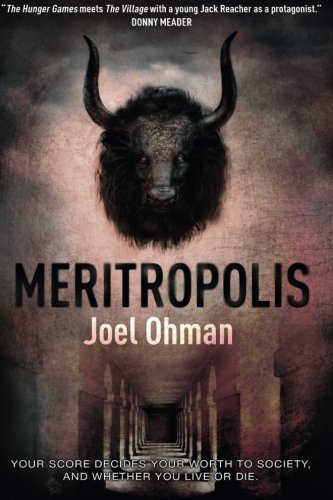
Meritropolis

This novel is post-apocalyptic dystopian, set in a world with bizarre and hostile mutations that merge animals in obviously deliberate ways. The bion is a bison-lion combination, for example, a vicious meat-eating, bull-stubborn giant with a devil-red pelt and eyes. The snick is a winged bloodsucker formed from the genes of a snipe and a tick; it flies in flocks and can drain its victims dry. Chimpzelles, merging chimps with gazelles, hunt in tribal groups with primitive hand-weapons, and will devour humans as happily as any other prey.

Holding these hostile hordes at bay, Meritropolis itself is a walled city in which citizens have carefully-defined roles that rise from their measured merit: each citizen receives a periodically-reassessed Score that determines whether they will be permitted to stay in the city. Since it is accepted that being outside the wall at night is fatal, getting a low Score is a death sentence. 

That's what happened to Charley's brother. Charley is stunned by the verdict, especially when his own Score turns out to be high. It has left him burning with anger against the city management, motivated to do well in warrior tests, and questioning the fairness of the whole Score assessment system. In short, he is messed up.

The way Charley fits himself into the system to discover its problems and its value to him is the only way his high Score is obvious; in every other way, his behavior and choices only reveal him as a disturbed adolescent. The flow of the story is not helped by the many other voices sharing its narration, none of which are clearly distinguishable from Charley's. 

Nevertheless, the novel's unrelenting physical and philosphical action, and its high concept and creative world-building, serve to offset these minor issues of technique. It is a very enjoyable read.

Liner Note: The book's title was a tongue-twister until I recalled the Fritz Lang classic film, Metropolis. Suddenly it began to fall more naturally on my reading ear.


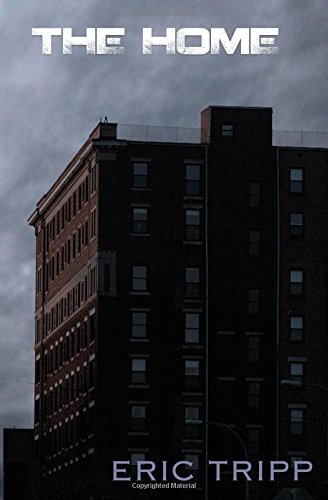
The Home

The concept for The Home was promising enough that I nominated it for publishing on Kindle Scout: hundreds of children are tended in a single building by their "Father," who either kidnapped them or coaxed them off the streets as runaways. 

These children don't work like Fagin's crew, nor do they go to school. They seem to spend their time playing video games and earning tokens by doing chores or gambling. The carny atmosphere doesn't disguise the fact that none of them are allowed to leave. Think of boys-becoming-donkeys on Pleasure Island in Pinocchio, and you've got the vibe.

The tale is told by two voices: Bom and Mystic are older children in the Home. Bom is a natural leader, a young man in age, who is being groomed as a sort of deputy-Father. Mystic is a new addition to the ranks—who incidentally, also fills the author's need of a foil for explanations. (In '50s pulp science fiction, for example, this role was filled by a buxom blonde lab assistant.)

In the only subtle concept of the novel, the Home itself becomes a representation of many inner-city societies, with a "welfare class" trapped in sterile leisure by a benign but strict provider, and an upwardly-mobile (or "outwardly-mobile") group seeking a way to live on their own terms. 

By contrast to Meritropolis, this novel was dismayingly simplistic and badly proof-read, with an annoying number of grammatical and typographical errors. The most distressing "typo" left me looking for an escape with the same fervor as Bom and Mystic. The word is in quotes because its near-universal occurrence indicates it was a writer's or proofer's error of knowledge rather than a mistake in typesetting: the omission of commas before every name used as a directed address in dialog. It was never "I was looking for that, Bom..." but Watch out! Duck!:
"I was looking for that Bom..."

About halfway through, I stopped noting error corrections in my Kindle, especially as a frequent use of the wrong homophones made me suspect this was a novel written using speech software. Mispronounced words or sloppy pronunciations might have yielded some of the more amusing choices: "crown" for "crayon" for example.

Since I understand such systems ask the speaker to select among homophones like "you're" and "your" or "rain" and "reign," there was an opportunity to correct it. It is more likely someone simply accepted the most-frequent default without looking at the options. Either way, in writing The Home using speech software, the author made another wrong choice.

Wednesday, August 17, 2016

State, Smoke, and Survival

Review: Larry Niven's State/Smoke Ring Series: The Integral Trees, The Smoke Ring, and World Out of Time


It puzzled me for a while; when you look at the listing for the audiobook of Larry Niven's wonderful 1984 novel The Integral Trees on Amazon, it has a parenthetical comment, (The State series, Book 2). The Kindle and print listings note this same novel as (The Smoke Ring series Book 1).  I began to get paranoid. Was there a pre-IT novel written about a powerful State for that ominous year?

Yes, there was. It turns out that reading the first novel last is a good thing. And thereby hangs a review or three...


The Integral Trees


A team of misfits on an adventure makes a good basis for a story, and tribal cultures are always tasty. Let Larry Niven loose on them, though, and you get a novel that is nominated for a Nebula for Best Novel in 1984, and a Hugo ditto the following year.


Niven's tales often hang on a structure—Ringworld is an excellent example. In The Integral Trees, a central star ("Voy") is too close to its gas-giant planet ("Gold"), and the atmosphere of Gold has been sucked off into a gas torus, a vast ring around the star. The thicker part of the torus is breathablethis is the Smoke Ring where humans can survive.


The humans that do live here have adapted to the conditions in the torus, where gravity is nonexistent, but tidal forces may be felt. Mostly, the tides affect dwellers at the "out" and "in" ends of any of the millions of integral trees.  The length of these massive growths can almost span the smoke ring, and they were dubbed "integral" because the opposing winds at either end bend the tufts outward into an ∫ shape. These tufts collect smoke, dirt, animal life and insects from the wind; tufts and trunks impact free-floating water globules—"ponds"—and this provides moisture for the life on the tree.

When Quinn tribe's tree sinks too far in the smoke ring toward Voy, the tribe's leader—the "Chairman"—sends the tribe's least useful citizens to climb the tree to its free-fall zone at the trunk and farther "out" on a hunting trip, to find a way for the tribe to survive. Unfortunately, the tree has its own plans, and those plans don't take into account the humans living on the "in tuft."

The State is hinted at in flashbacks and founding documents, and in the opinions of Discipline, the AI personality of the ship that brought humans to the smoke ring. Discipline has carefully forgotten the mutiny that separated it from the humans, so it cannot be biased against the descendants of the mutineers, and it stays out of the gas torus to preserve the ship's physical integrity. 

When the disaster at the Quinn tree brings Discipline back into contact with the survivors, that contact brings humans under the eye of the State for the first time in hundreds of years. The Quinn survivors worry about being made corpsiks (slaves) by another tribe or captured by the longer-limbed free-falling fluff-jungle dwellers; they should be more worried about Discipline's intentions.

If you haven't encountered The Integral Trees yet, it's time. The people of the Smoke Ring may be strangely shaped by their gravity-less environment, but their cultural adaptations prove they are all too human.


The Smoke Ring


The group that began as Quinn tribe misfits in IT has settled the Citizen Tree, begun having children (some of whose parentage is in question), and cultivated native smoke-ring and integral-tree life in their gardens. They've made a comfortable clone of the Quinn culture, with elements from home-cultures of their other members, and their own Scientist and Chairman. 

Stolen star-technology, a Cargo and Rescue Module (CARM), plus the armored silver suit brought from Quinn Tree, give the Citizen Tree a way to stay in touch with Discipline, if they choose to do so.

When the Citizen Tree tribe rescues a family from a burning tree, they unwittingly expose their existence to the State-like Cluster, a growth-structure in the Smoke Ring at one of the Lagrange Points. The Cluster differs from the Integral Trees; it includes outer green growth areas like fluff jungles and an inner core of material dense enough to be called Dark. It's the closest thing in the smoke ring to a solid planet.

The problem with the Cluster is its non-tribal economy and its Navy. The Navy believes all star technology belongs to the Navy. This even includes the occasional chunk of metal collected by an integral tree, perhaps following the breakup or explosion of metal brought from Earth by Discipline's crew. However, the Navy will pay the finder for metal. The Citizen's Tree folk are not sure they will pay for the CARM or the silver suit.

Discipline wants to contact the Cluster, though; its State-like culture appeals to the AI personality. The persuasive ship musters all its arguments to maneuver the choice. Will the Citizen Tree save itself from the State, staying hidden from the Cluster Navy? Or will they let Discipline argue them into trying for the records held by the Navy, and wind up being absorbed into the nearest equivalent of the State their forebears supposedly committed mutiny to escape, hundreds of years ago? 

I recommend reading the two SR novels back-to-back for best enjoyment, then follow with the "first" novel in the State series. That way, A World Out of Time doesn't serve any spoilers, and yet still makes sense.


A World Out of Time


In 1976, well ahead of building the world of The Smoke Ring, Niven published a far-future novel that included many of the cultural building-blocks of the SR series: AI personalities super-loyal to the State, slave corpsicles, and evolutionary, adaptive changes to the human body and mind. 

A World Out of Time begins long before Discipline arrives at the gas-torus smoke ring. Jaybee Corbell had legally died long ago from the cancer that led him to be cryogenically preserved, but RNA from his frozen cells retained enough of his personal memories to be harvested and implanted in an empty body. The predecessor in Corbell's new corpus had been a brain-wiped criminal.

Corbell is not a citizen. As a corpsicle, he owes the State his life. He can pay his debt with thirty or forty years of slave labor, and become a citizen in the end. But the only job he's suited for is ramjet driver, and that's a life sentence alone in space. The State has strict plans for his tasks and journey aboard the starship he will command, and they program his loyalty with suitable additional RNA doses. 

Unfortunately for the State, Corbell has his own plan, to travel to the galactic core, and he manages to overcome his programmed State loyalty to steal the ramjet on its way out of the Solar System. In a last-ditch effort to bring him back, a minion of the State remote-programs his ship's computer with his own personality, but to no avail. Eventually, Corbell's 200+ years of ship-time bring him back to an Earth nearly 3 million years advanced. Changed. Moved to orbit Jupiter after something made Sol run hotter.

It is not only the planet that has changed. Humanity has split again; once corpsicles and citizens, now it is immortal—but sexless—Boys and Girls, and normally aging and dying—but reproductively active—adults. There is even at least one survivor (via a "zero-time" prison) from the time of Corbell's State. 

Then there's the AI ship, Perssa, who might yet, at last, have something to say about Corbell's fate.

Wide-ranging, epic even when the world-building is restricted to the Solar System, this novel deserved to be resurrected and included with the SR novels. I'm glad the cryptic Amazon label on an audiobook sent me looking for it.