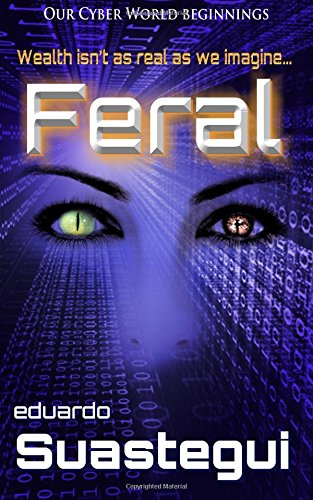
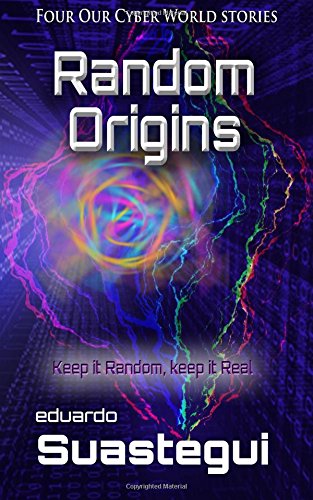
I have just enough background in writing code (at the hardware, firmware and macro-programming levels) to get the gist of what Suastegui's hacker protagonists are doing. You don't need much: the author gives a pretty clear description of each neat trick and technique without overwhelming the narrative in tech-speak. It makes me wonder what he does for a living.
No, I don't suspect he himself is a cyber-spy. I'll bet he's given more than one technical, security-focused briefing to a crowd of bored bureaucrats or government officials. There's enough authenticity in the "not another meeting" angst of his main characters to reveal his personal experience with the beast of the boardroom.
Unbridled Cyber Terror
In the dark old days of the Cold War, spies were in the cold, or out of it. In our cyber-saturated present, however, they can be tame, domesticated hackers whose talents are reined in by the federal agencies that employ them. Sometimes, they slip their bridles and run wild.
Feral is an exciting prequel to the tense action of Dead Beef, the first novel in Suastegui's Our Cyber World thrillers. It spins the hints from Dead Beef about Martin Spencer's initial meeting with his wife Cynthia, and the near-disaster of his hacking battle against the wild agent code-named "Feral" into a nail-biting chase through program codes and physical landscapes.
Glimpses of Chaos
The short stories in this collection tell the backstories of two characters that will appear in (chronologically) later novels, Julian and Bogdan. Far more interesting to me, though, is the third "character," a style of coding that is either stochastic or programmatic.
Stochastic, or random, events are typical of nature, and Julian embraces the random style of the universe, as he observes it. His fatalistic acceptance of disaster or triumph as simply what happens—in other words, not under our control—is a direct forerunner of his actions in Dead Beef. Reading the prequel stories after that novel makes it a lot more obvious why Julian makes the choices he does in that later conflict.
Bogdan's approach is the opposite of fatalistic, so the complex programmatic clockworks of his code are perfectly understandable. Like Martin Spencer, whose code Julian would later stigmatize as "a calculator," Bogdan tries to tie down every possible outcome and its solution. Only his chess-master brilliance makes it remotely possible he might succeed.
These novels can be read either before or after their sequel, which is a hard feat to accomplish. Suastegui has done it, though. Bravo!
One of the unexpected side-benefits of being a plotter instead of a pantser this year is that having a road map for the story tells me where the chapter breaks will arrive, and when to ring in the crucial scenes that I will have to flesh out as I write.
I can jump ahead to to the "hinge" or "mirror scene" (as advised in one of my preparation reads, James Scott Bell's Write Your Novel from the Middle), and know who can appear in the scene, and what their current relationship and stance is to Roger at that point in the story.
I could even write the climax of the story before I have Roger embroiled in his conflicts and minor resolutions. But I probably won't. Pantser habits die hard, and I'm enjoying the building of this book from the front onward.
As you can see from the illustration, I'm back writing in my favorite non-home venue, Chick-fil-A. My calendar cards are good for a milkshake each this month, and I plan to hold out until the seasonal Chocolate-Chip Peppermint shakes appear. It could be a dangerous strategy: if they haven't shown up by the end of the month, I will have to pig out in the final days of NaNoWriMo on Double-Chocolate Shakes instead. (They are on the secret menu.)
Word Count: 1834 Day 4 and 9838 Total
Most of us nowadays subscribe to the "she shall have music wherever she goes" philosophy. We carry our music libraries with us on smart phones, move through clouds of Muzak in stores and restaurants, and rarely have a moment of silence to write in.
This can be a good thing. I've found that almost any non-verbal music is a good background to writing. Instrumental music lubricates the verbal process without derailing it. For me, classical music or quiet jazz is preferable to show tunes and pop songs, because even when there are no words, some part of my brain tries to supply them.
That conflict can dry up the flow of words through my fingers to the keyboard.
The right background music can be a valuable tool to keep you focused, and stave off writer's block. I chose my writing venues now as much for their choice of Muzak as for caffeine and comfortable seating. At home, I turn on one of the cable music channels that feature instrumental music and let it play.
Side benefits: my spouse likes the same quiet music to read by, so we share the companionable music-filled space. And it fills up the distracting chatter of "Check Google+... Check Twitter!" urges in the back of my brain.
Word Count: 2088 Day 3 and 8004 Total
One of my favorite tools for first-draft writing is in the Cloud. It's WrittenKitten, a configurable writing space that rewards word production and doesn't judge its quality.
I'm serious. Aside from noting possibly misspelled words, WrittenKitten is set up to feed me a new kitten picture in return for writing each hundred words, without trying to tell me about incomplete sentences, doubled words, awkward phrases, clichés, broken or too-short paragraphs.
Its small view window keeps me focused on churning out the draft. Okay, it's not a word-processor—but it is a word evoker. It may not work for you, but I find it draws words from me like no other tool I've used before.
I've also reconfigured it as needed: you can shift the reward picture to a number of different options. The reward trigger can be set to 10 words or 10,000, although the latter wouldn't really be noticeable. Each time I've reconfigured it, though, I put it back to the original 100 words/new kitten reward setting.
I worried a bit this year. Would WrittenKitten stop working for me as a plotter rather than pantser? It may be early to say, but based on two writing sessions yesterday that generated 4053 words, I'd say it's still going strong.
I think I'll stay with the engineer's maxim: If it ain't broke...
Word Count: 1863 Day 2 and 5916 Total
For a different reward, try writtenkitten.net/?search=highheels
I don’t care if it’s three a.m. I will not fall asleep! No! Never! Not even if—*snore*” —Brandon Scott, Coolerbs Reviews
I never learned to drink coffee. I maintain it is an acquired taste, one which I simply never acquired. Caffeine, on the other hand, needs no acquisition. Our brains are preprogrammed to adore it.
Think of the effects. They match those of excitement, love, assertive confidence, joy.
We partake—in coffee, tea, cola, chocolate, or stim-tabs—and our brains light up with all the colors of creativity and enlightenment. Suddenly we see connections we missed in the torpor of our decaffeinated existence.
Words flow. We dance in them, knowing that next time the drought comes on, we can release the flow again with a simple dose of the writer's drug of choice.
Have a sip. Now write...
Word Count: 3348 Day 1 and Total
Roger Pierce is odd. For one thing, he has learned to adapt to a new school every year. Part of his adaptation is knowing that next year, he will be in a different school, so he only has to endure a single year in any one school.
For another, he has an attitude. It comes from knowing more than his new schoolmates in each new location, and a little from often knowing more about some things than his teachers. He was reading high-school novels in third grade, and now that he's going to be a freshman in high school, he isn't sure he can take another year of throttling back his joy of reading to match the speed of his classmates.
In the opening paragraphs of the story, we get hints about Roger. What about the name of the high-school mascots in his new town, the Jaguars, raises his fear of "another" catastrophe? Why his scorn at the shops in downtown Meteor (especially the bookstore)? What makes him so sure he will be relegated to the attic and why his delight at a ground-floor bedroom?
Even the smallest details can assist this invitation to share Roger's anxious advent into the tiny desert town of Meteor.
I want to feed enough of the "stranger child" vibe into the opening chapter that I won't need a prologue to hook the reader. Whether we care about Roger because he's so weird, or we care because we have each been that new kid in school, will depend on how I write him.
In my planned NaNoWriMo novel, Roger and the Meteor Mass, one of the characters in the family known locally as "The Mass" is Jack. All of the Mass kids are unusual, and Jack is no exception. Jack's abiding interest is machines: taking them apart, putting them together again in a new way, and repairing the ones that don't function exactly the way he wants them to work.
Jack's sister Julia is the first of the Mass siblings Roger Pierce meets when he comes to town, but Jack is the first one Roger connects with. When I read the Carrot Ranch Flash Fiction Challenge for this week, I knew this initial meeting would feature in my flash fiction:
October 28, 2015 prompt: In 99 words (no more, no less) include a tool in a story. How can it enhance the character, tension or meaning? It can also be a story about a tool or a character’s obsession for tools. Go where the prompt leads.
In every previous encounter with boys his age, Roger has been the most knowledgeable. One of the first things Jack does is call Roger a dummy for not knowing something that seems obvious to him. It won't be the last time Jack outpaces Roger, either...
Roger “Runabout” Pierce has always been a strange boy. He blames his feelings of alienation on his family, who move to a new town each year when his dad is reassigned. But when he arrives in Meteor, a remote town smaller than any they’ve ever lived in before, he meets “The Mass,” a blended family of equally odd children and their superbly different parents. Roger has to face his own strange nature and make a momentous decision. Can he become ordinary? Does he even want to try?
_________________________________
Choice of Tools
From the open garage came a resounding clang, followed by a sharp whistle. Roger called from the threshold, "You okay?"
A shock of sandy hair came into view behind a metal tower, then two wide-set blue eyes. "Hey, can you grab that hock spanner for me? I'd get it myself, but I'm kinda tied up here."
Roger shook himself. "Sure!" He dropped his bike and scanned the array of tools laid out on the workbench. "So which one is the hog spanner?"
A peal of laughter answered. "HOCK spanner, dummy. It's on the end next to the ball-peen hammer."