That's neither "Final Meltdown" nor "Final Letdown," thank you very much, auto-correct! No, I'm talking about that vague, cast-at-loose-ends, depressed "what next?" feeling we can all expect by Wednesday morning.
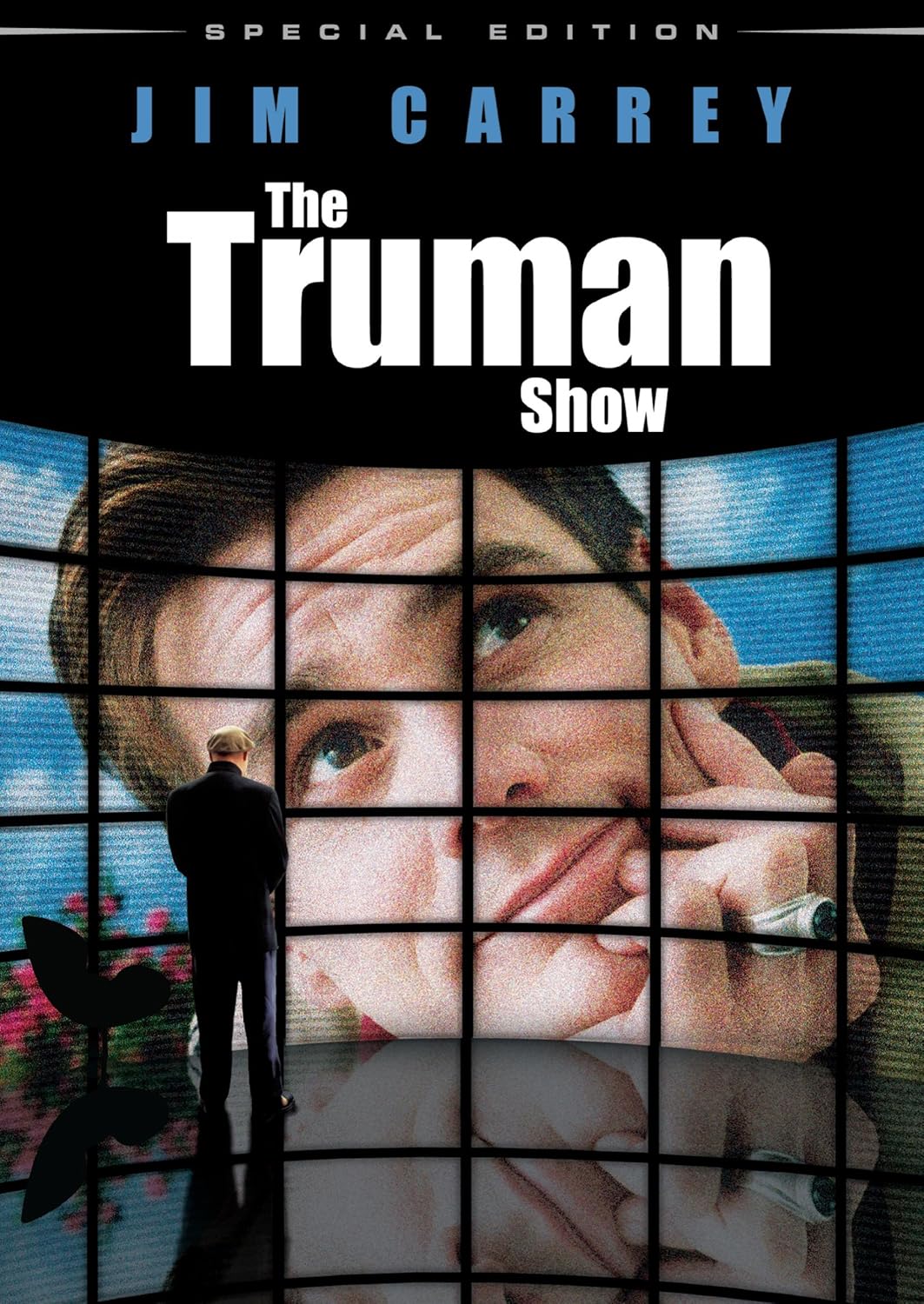
Remember the final scenes of The Truman Show? After Jim Curry bid the viewers "Good morning, good evening, and good night!" for the last time, we saw all the obsessed, life-on-hold viewers lean forward and turn off their TVs. I think we'll all have a massive "Goodbye, Truman" moment, day after tomorrow.
Maybe not. This might be more like in the movie as Truman Burbank first realizes that his world isn't real, when the viewers remain mesmerized waiting to find out how it will really end.
We could wake Wednesday to the prospect of a ballot contest like Gore v. Bush—Florida 2000, writ nationwide. There may be a Tammany Hall meltdown in our future, or a four-year Ken Starr redux to tune into. Whoever wins and however long it takes to decide the election, the real world will still be waiting.
Because in the real world, no finale is ever final. There's always the cold light of day and the consequences of choices to face, after the lights go dark and the cameras stop rolling.
Monday, November 7, 2016
NaNoWriMo Cooking: Time to Write and Still Eat Well
Review: Campbell's Sauces: Thai Curry, Toasted Sesame, Creamy Garlic Butter
I make dinner at our house. Actually, I make breakfast as well, but that is only picking from a menu at Chick-fil-A or one of our Sunday morning favorites. Dinner, though, is made at home, ranging in complexity from icebox potpourri (leftovers) to a full Thanksgiving-level roast. With occasional exceptions, on retirement we quit going out to dinner.
Except in November. In the past, my focus on plot, character development, and world-building made problems with finding time and energy to cook.
I'd find myself saying, "I'll get up in a minute and make dinner." Two hours later, still deep in the keyboard, I'd hear my spouse in the kitchen putting together a cheese sandwich to stave off starvation. Then I'd finally knock off for the day and binge on popcorn to still my own hunger pangs.
Creamy Garlic Butter Oven Sauce
This year, I tried something new. In October, I noticed a new product in the supermarket: Campbell's Oven Sauce. With a minimum of prep time (a few minutes to peel and dice potatoes and brown chicken breasts), I could put together something very like a roast chicken dinner. My favorite of several, the Oven Sauce Creamy Garlic Butter Chicken took less than 5 minutes to get ready for the oven, and rendered up three dinners: the initial feast on Sunday night, a toast-and-chicken sandwich Monday night, with a side of green beans from the original meal, and finally, a sauce over green beans meal with a side of scrambled eggs for the protein.We may have been a test market, because the next thing I knew, that single shelf section in the market had become a whole aisle section offering oven sauces, slow-cooker sauces, and my new favorite, skillet sauces.
Like the oven sauces, Campbell's Skillet Sauce is usually designed for pouring over cooked chicken, but the beauty is that they can be bent in unexpected ways to make tasty entrees "with legs." That's our phrase for a meal that has leftovers that can be recombined the next night in a non-boring way.
Thai Curry Chicken
Subtly sweet and slightly spicy, thai curry sauce seems designed to go over chicken. A $5 supermarket-brand pack of chicken tenders, a 16-ouce bag of frozen peas, broccoli florets, or cauliflower, and 10 minutes of kitchen work makes a super-tasty meal with at least one leftover-supper in it.I snip the tenders into bite-size chunks of raw chicken, brown them in the skillet, then dump the entire packet of sauce, and the frozen vegetables, into the skillet, stirring them together to get everything coated with sauce. Then I lid the pan, reduce the heat to low-medium, set the timer for 20 minutes, and go back to the keyboard.
The resulting sauce can be:
- added like gravy to scrambled eggs
- poured over toast
- spooned into baked potato
- served over rice, mashed potatoes, or pasta
The surprise comes with using the thai curry skillet sauce to finish fish sticks. Yep, those homely kid-meal favorites can be cooked according to the directions on the packet, then finished in the skillet with the "chicken" sauce packet for a savory meal that works nicely over toasted English muffin.
Toasted Sesame with Garlic and Ginger Ground Beef
Yes, I know the packet says "chicken." I add this sauce to a pound of browned ground beef, stir in a 10-ounce packet of frozen green peas I cooked in the microwave while the beef was browning, and lid the pan, letting it simmer for 10 minutes or so.
This is more like a meaty stew or a sloppy-joe filling than a sauce. We ate it the first night in hamburger rolls with leftover slow-cooker beans. It works over mashed potatoes, but might be too thick to do well on rice or pasta. Its tangy sweetness reminded me of South American picadillo empanada filling. Next time I make it, I plan to make biscuit empanadas with the leftovers, using ready-to-bake biscuits to cut time in the preparation.
Bottom line? You don't have to dine on sandwiches and potato chips just because it's November. Write a new plot using these amazingly tasty shortcuts, and return to your novel with a sated appetite and a satisfied family.
Wednesday, November 2, 2016
Repealing the Laws of Physics
Review: The Practice Effect by David Brin
This novel is the reason I began reading everything I could find by David Brin. He took a single premise (what if one of the laws of thermodynamics were repealed?), and wove it into a clever tale of practical magic.
Dennis Nuel is a post-doctoral physics student whose mentor died in mid-experiment. Worse, his replacement, a boring instructor named Flaster, has removed Dennis from the lab he helped design, and substituted his rival, Bernard Brady. Nuel is coasting, waiting for a sign—like the other-worldly flittermaus his makeshift sling brought down at a party several nights ago.
Then Flaster approaches him with a proposition. Nuel will be allowed to take over in the lab again, if he will solve a little problem that has arisen.
The problem is the zievatron. Nuel discovers that Flaster and Brady had been unable to get any results after the accident that killed his mentor, until they tried using Nuel's search program. That's when they found the alternate world, and sent through several robots to explore it. The problem is, the return controls don't work any more—they can send materials (and living things) through the portal, but nothing comes back. Nuel agrees to go through to repair the unit, provided they buy him lots of supplies, in case it takes longer than he expects.
In addition to his camping supplies, Nuel will take with him a piglet-sized winged animal that came originally from the other world. He will also take a mystery: just as the machine warms up, Brady snidely informs him that "one of the laws of thermodynamics doesn't work the same in the new world." Then he's through, and sees something even more disturbing: the reason the return controls aren't working is that the control panel has been ripped apart. Three large copper cables are completely gone, and many smaller components lie smashed on the ground around the machine.
And, from bad to worse, Brady appears to have bought all Nuels' camping supplies from a chintzy source. The camp alarm is set off by the least breeze, and shows no ability to display animals that might be nearby, as Nuel learns when the piglet-with-wings (which he christens a "pixolet"), blunders back into his camp. Then he is astounded by the high resolution of the video that the only surviving exploration 'bot has to show him.
By concentrating on the consequences of a single change, and extending those results throughout the society he created, Brin wrote a classic science-fiction novel worthy of Asimov or Clarke. Further, the central concept of the novel makes explicit the crucial difference between creators and users.
What is the Practice Effect? I could echo Brady, and simply say, "Guess!" Or you could read the book to find out.
I assure you, the answer is fascinating.
Butterflies and Billiards
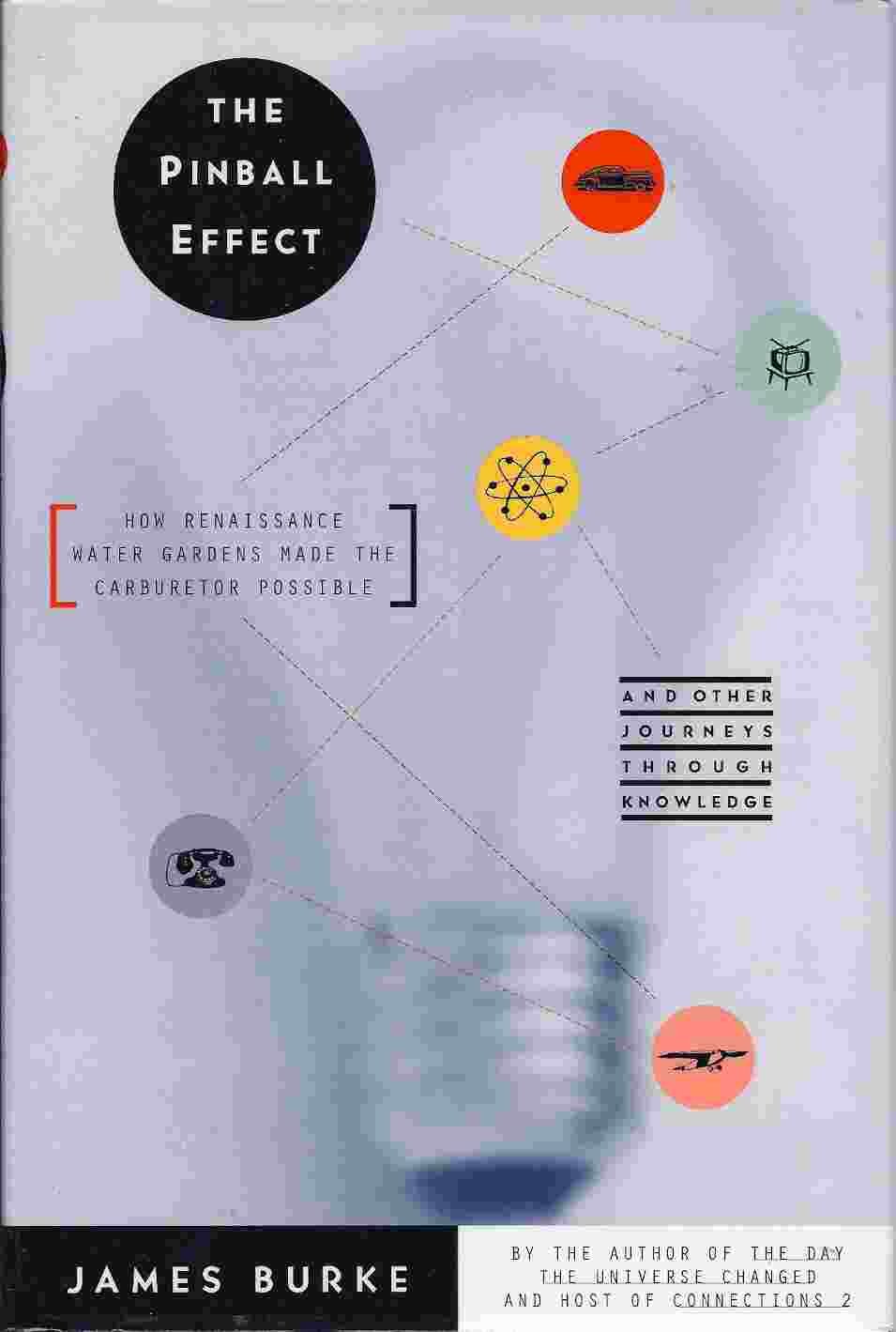
Review: The Pinball Effect by James Burke
James Burke, founder of The Knowledge Web, who hosted TV's Connections and The Day the Universe Changed, brought his view of the interconnected nature of technological change to this collection of essays. With the network of shotgunned factoids that once characterized his TV essays, Burke sets out to reveal once again how one discovery leads to, not another one, but to multiple others.
Supporting this interconnectedness is a hyperlink gimmick, in which footnote numbers refer the us to a link between the current factoid and one buried further along in the book.
I last saw this technique used in a juvenile "multiple endings" novel.
Some of the connections revealed by following these links are interesting, but others are a bit of a stretch. For example, the imposition of heavy import duties on fabrics by the Sun King's Minister of Finance, Colbert, is linked to Impressionism and the development of the RGB monitor by way of M.E. Chevreul, the head director of dyeing at the Gobelins tapestry factory in Paris.
Many of the capsule essays in the book (as opposed to the wider network of connections) have made their way to TV. "Hot Pickle," for example, details how spices were the driving motivation for the development of smart bombs (via exploration, leading to the need for better fuel and driving engines, from there to air conditioning, Corning glass and fiberglass, and onward to lasers. The Learning Channel produced it as a separate hour-long feature; Hot Pickle ran again just a few weeks ago, and I was reminded of its source.
So while the book is amusing, with a pleasing focus on progress and technological development, it fails to provide a real sense of the history involved. What Burke has done is provide a series of science sound-bites, carefully calculated to keep the attention of those with short spans. "See, here's a pretty fact! Look, how shiny! But now look, look, no, look here..." This cajoling approach to science history does quite well on TV, but fails to entice in book format.
The one place this book works well is the bathroom. As a short-span reader, it equals most editions of Uncle John's Bathroom Reader, because you get a satisfying sense of informing your brain (however shallowly) while taking care of other business.
Plus, James Burke, so there's that.
Tuesday, November 1, 2016
Dea Ex Machina
Review: The Goddess of Sumer by Jenna Smith (aka Jennifer Seaver)
The premise is von Daniken-esque, ridiculous; star-gods bootstrapping hapless Sumerian humans until one of the gods is trapped in an ancient statue. The characters are expectable, even stereotypical. The bad guy is, literally, Satan (or Sadin).
And I enjoyed every word of this novel, from the dream-sequence beginning to the happy-ever-after ending. Even while my inner voice kept saying you know what happens next, I had to keep reading. And that’s the power of good story-telling, you care what happens to the characters.
You don’t have to believe—it is fiction, after all. A good tale-spinner makes you want to know how it all turns out.
Jenna Smith’s tale opens on a nightmare. Jessica is being drawn to a glowing green female figure, even as she is chased by a growling beast. In her dream, she trips and hurts her ankle; when she wakes, her ankle is swollen. That’s our clue that her dream is something more than REM sleep.
When Jessica learns that her beloved uncle Derek has been hospitalized, she rushes home to be with him, despite the presence of an old flame, Randy, on her uncle’s ranch. Her uncle manages to tell her that there is an important box in the attic, and Jessica finds it contains a glowing green head from a woman’s statue.
Her uncle’s young friend Lance explains that the head is from a statue in which Sadin entrapped a Sumerian goddess, called Tiamat by some people, Horus by others. Lance has been chosen to be the next Guardian of the head, but Jessica’s uncle Derek has been Guardian for decades. Sadin’s powers, shattered by the goddess even as he trapped her in the stone, have had thousands of years to recover, Lance tells her. What’s more, the evil-doers have located the latest Guardian, poisoning Derek in their attempt to reach the goddess-head.
The statue heals Jessica’s injuries, and possessing it allows her to heal her uncle, and later, Lance. It seems the head also grants something like immortality, because the group meets with a “ancient Daoist,” Zhang Sen-Feng. Zhang is still going strong after spending hundreds of years as a Guardian. He also has the power to “cloud men’s minds,” which helps the group steal the body of the statue and escape the evil one’s henchmen.
Yes, it sounds trite and clichéd. And yes, every time the story knits itself into a corner, a new power of the goddess or her Guardians is revealed. Somehow, they squeak through, chasing across the planet to finish at a temple of Horus where the body and head of the statue can be joined to free the goddess at last.
It’s still a good story, thrillingly told (if hokey), with enough deftness of phrase and turn of events to draw the reader along. I enjoyed every page, and was almost sorry to come to the end.
Magical Moon
Review: Pauper by Jack McDonald Burnett
Burnett's Girl on the Moon (which I reviewed in March 2016 as Private [Starship] Enterprise) was a tour-de-force of hard science fiction. This novel, while still set in Burnett's wheelhouse (private enterprise funding space exploration, US returning to the moon, first woman on the moon), takes a large step away from hard scifi.
There are two moons orbiting Earth, you see. Luna has been explored, although the final expedition was a while ago. The second moon, Pauper, arrived in Earth's skies shortly after the Fall of Constantinople. Smaller than Luna, it shows clearly as an orb. That kick-started science and global exploration earlier than in our world.
And coincidentally with Pauper's arrival, magic came to Earth.
This alternative Earth boasts a US that does not include the southern Confederation states, the separate nation of Florida, nor the territory of the Lousiana Purchase. Mexico (which includes southern California and the four-corners states) and Texas are slave-holding regimes. The Canadian expanse with the northern half of the continent's west coast and Snake River Plain is occupied by the "First Nations." US citizens need a passport to travel to Texas or Florida.
Most politicians are "magikers" because, according to one character, "that's how they can convince people to vote for them." And no astronauts are. The reason is complex: there had been a theory that Luna was the source of magic, but that "disturbing" it by setting foot on Luna's surface would bring magic to an end. That there are still magikers about, after multiple moon-landings, does not negate this theory. Proponents simply point to the decline of magical power in the world since then.
Billionaire Frank Ebersole doesn't believe the Luna-source theory. He thinks Pauper is the source of magic, and to prove it, he puts together a carefully-designed expedition to the smaller moon. His group of "layman astronauts" includes, among others, a woman from the French Midwest L'Empire, an Amerindian US citizen who qualifies to emigrate to Canada, a teenage girl whose family were refugees from the slave-holders in Arizona, and his "bodyman" Garrett.
It also includes, unknown to the others, a magiker whose goal it is to sabotage the mission, lest setting foot on Pauper bring about the feared end to magic.
Ebersole will have to coax, cajole, bully, manipulate and sometimes, outright lie to his crew to bring about his goal. And he may have to extend his efforts to the wider world, because someone in the US government is determined to stop him.
Politics, Garrett thought. Like a food fight without the internal logic.
This was a satisfyingly complex novel, with very human characters. People who have public goals, and private ones that are not always the same. People who are jealous or noble or self-serving, who make mistakes and then struggle mightily to right them again. People who lose or succeed by taking action. People who are petty or generous, methodical or impulsive by turns. And an overall focus on the truly possible, despite the single extra non-science element of the tale.
In short, it was everything I have come to expect from Burnett. That it was a Kindle Scout selection which I nominated, and therefore received a copy for free was an additional benefit.
I would have happily paid full price. Burnett is now on my "buy anything he writes" list.
No Midnight NaNo Launch
2016 NaNovel: Patience of Snakes
Last night as I prepared for bed, I considered setting an alarm for 11:30 PM, to get up, ready myself to write, and be poised, fingers over keyboard, when 12:01 AM and NaNoWriMo arrived. In previous years, I have done that, then been unable to go to sleep for even the short hours between bedtime and nearly midnight. Novel churning in my seriously-deprived-of-sleep brain, I advanced into the NaNo fray.
This year I decided not to start at midnight, even if it does take me extra hours to fall asleep. I will keep my normal writing schedule, simply extending the hours as needed. And I will add Sundays, because November.
A midnight launch shouldn't be needed. Patience's protagonist, Carole Marling, is headed to a territory I've already visited in previous NaNovels. Her hometown, as yet unnamed, lies somewhere in the western prairies near Indigo, the site of three previous Pat Cummings novels begun in November. Her nemesis, though, is a new terror, different from the Fateful Weather of my Indigo novels.
And no, it is not snakes.
Buddies Wanted
You can join me in writing a novel this November. Head over to the NaNoWriMo website, create your writer profile, and make a commitment to put however many words on paper. Because the truth is, you can write. The only question is, will you?If you do join in, please go to the Buddy function and consider adding me as a writing buddy. My writing buddy philosophy is simple: if you write to me, I will reply. I will occasionally (maybe once a week) write to my whole buddy list. And I will send you encouraging words or congratulations based on your productivity.
That's all. My assumption is that buddies want to be writing their NaNovels, not messages.
Subscribe to:
Posts (Atom)