Showing posts with label Kindle Scout nomination. Show all posts

Friday, August 11, 2017

Si Vis Pacem, Para Bellum

Review: Son of Justice by Stephen L. Hawk


Remember the hedonistic thugs of Rollerball? "In the future there will be no war. There will only be Rollerball." Hawk's future with no war has an Earth where expressions like "when the shout hits the air" and "don't give a flock" have replaced their more violent, vulgar predecessors. 

Yet even a peaceful society needs warriors—especially when their space is invaded by warring aliens. That's where Eli Jayson comes in. He's joined the ranks of a military where most of the privates are orphans from Earth, raised in an institutional environment that promotes a level of competition unwelcome in general society.

Not Eli, though. He's incognito; his real surname is "Justice" and his father is the renowned commander of the Shiale alliance of four races: Human, Telgoran, Waa, and Minith. Eli grew up on Waa, was trained in weapons-handling by truly-fierce Minith warriors. He learned a bit of all three non-human languages. And he's determined to make it on his own, without trading on the family name. 

All he needs to do is not stand out.

That, he discovers, is an impossible task when you can almost defeat one of the Hulk-sized green Minith with their oversized staves, or understand what the Minith sergeants are muttering when they conspire to wash out large numbers of the human soldiers and send them back to Earth.

Then Eli manages to enlist the help of one of the stand-offish Telgoran natives of the world where they are training, and use his assistance to win an unwinnable test assignment. His Kobayashi Maru victory lands him in a court martial.

If you have already encountered the worlds of the Shiale alliance, the name of Justice is familiar. I, however, was unacquainted with The Peace Warrior trilogy, but decided to buy SOJ when I saw the title on Kindle Scout. (I missed the campaign to nominate it.) Now that I've nearly finished the tale of Grant Justice's son, I've purchased the omnibus volume of the trilogy to read. Better late than never!

Either way, I strongly recommend Son of Justice for mil-SF fans and Bildungsroman-readers alike. Eli Justice is a winner.

By any name!

Monday, July 24, 2017

Prep(per) School

Brief Review: Collapse (The Ashwood Lies Book 1) by R.J. Infantino


Why would a high-end private school be stock-piling weapons and ammunition in the attics? Chase isn't sure, but knows something is wrong, and suspects his girl-friend's claims about her brother's death are more than just fantasy. If Maya's fears are real, graduating from Ashwood Prep may be less about getting into an Ivy League school, and more about surviving the Apocalypse. 

If disaster does strike, how will the elite students at Ashwood respond? As in real life: some will lead. Some will panic. And some will kill to preserve the status quo.

This is much more than a dystopian conspiracy set in end-times. Think Red Dawn, but one in which students defend themselves against an invader in loco parentis. Their professors, perhaps even their own parents, may be involved in this conspiracy, and much more than political survival is at stake.

I enjoyed the story, even with the cliff-hanger ending (and the promise of further titles in The Ashwood Lies series, based on the "Book 1" subtitle), but I will probably not be buying the next. This novel stretched my willingness to believe a bit far. Rather than explain (which would be a spoiler), I'll leave it at that: I liked the novel.


Note:  I received this novel free as a Kindle Scout selection.

Monday, July 17, 2017

Fractured Fairy Tales

Review: Isabella and the Slipper by Victorine E. Lieske; Cinder Unit (Duplicate Book 1) by H.A. Kinani


Ready-made stories are everywhere. For the novice no less than the seasoned writer, starting from an existing tale is an inviting shortcut. If your story derives from another author's world-building, it may be dismissed as "fan-fic." Yet it can still be compelling, as long as you avoid the pitfalls any short-cut can entail.

Two of my recent Kindle Scout nominations were based on the same fairy tale, Cinderella, but each took radically different looks at the story—and this is why I cannot dismiss such novels as "derivative."


Isabella and the Slipper

If you've seen the Hilary Duff movie A Cinderella Story, you're acquainted with the plot gimmick for this novel: in the movie, a cell-phone mixup leads step-daughter Duff into a text and email relationship with her high-school prince. Isabella's cell-phone mixup leads her into a text and email relationship... Yeah.

Even the slipper of the title barely appears in the tale. This is a light romance with very little substance, perfect for a summer read if you have nothing better to do. Fortunately, of the two reviewed here, the Isabella nomination was selected, so I was able to read it for free. The earlier nomination in my list, Cinder Unit, which I paid for, was a better story with more complexity of plot and characters.


Cinder Unit

The Ella of this novel is not a step-daughter pining for a dead father, but a clone. The duplicate Ellas are all cleaning girls, though what they clean depends on where they are assigned. The Cinder units all clean soot and ashes (and cinders, of course) from the buildings where they toil. Kitchen Ellas clean pots and pans, and so on.

When unit Cinder-03-Ella-11 is reassigned to a top-secret science building, her new job is to clean soot, cinders and ash from the two-room lab of Mr. Anthony. The only cinder-cleaner in the building, she loses her numbers to become simply Cinder-Ella. The sinister Mother, a prototype-model robot, seems determined to break her Cinder unit, and the human user of the lab is equally determined not to have his lab disturbed by cleaning.

Ella's night at the ball cannot happen if she allows either of them to succeed; yet the story feels new, non-derivative, and deliciously complex. We delight in the echoes of the original fairy-tale, and enjoy the ways in which our Cinder Unit is not Cinderella seeking her prince

This is a genuinely new take on the tale, and leaves me to wait breathless, wondering what clone might be at the center of Duplicate Book 2.


Liner Notes


  • Both novels were only available in Kindle editions at the time the review was written.
  • Both were nominated for Kindle Scout selection, but only Isabella and the Slipper was selected.

Wednesday, July 5, 2017

Like 50s' Juveniles!, said Tom Swift Retroactively

Review: Under Jupiter by J.E. Hunter


There was a time in the 1950s when juvenile science fiction was bowdlerized, tidied up to suit the narrow sensibilities of adults who bought for libraries. The result was often a Leave It to Beaver home-life sprinkled with robots and rocket ships and characters who swore by "My Universe!" and "Asteroids!" Brave teens fought against the stupidity of adults and the cupidity of criminal gangs with all the last-decade science they could muster, and somehow defeated them without taking more damage than a bruise or mussed hairstyle.

That's Under Jupiter in a nutshell.

Ignore the green-haired 40-year-old woman of the cover illustration; Jiden is a teenager banished from Earth by her widowed father after a drug-hazed near-fatal accident. He packs her onto a three-month-long trip to Europa. Which is apparently inhabited by "Europan's," just one of many frustratingly-consistent misapplications of possessive and plural in this novel. 

Even with that annoyance, though, the more egregious errors are conceptual. Jiden's fellow colonists survive in a chemically hostile environment despite the memory lapses that should have killed any number of them already. Equipment needed for survival disappears, and the adults around Jiden shrug and say "So what?" And aside from a "newly discovered power source, Amminium," the technology available to the Europan colony seems little advanced beyond that of our era. Or maybe 1990.

Worse, Hunter tosses in a historical "Robot Wars" (by way of a high-school class assignment), apparently to explain why the computing power available on Europa is so limited. No further details are given.

Explaining additional conceptual snafus would provide serious spoilers. I offer only one more detail: a pop band called "The Female Asteroids"—as if any women's band post-1959 would choose that as a name, or survive the inevitable hashtags it would morph into. Suffice it to say that I plan to remove the book from my Kindle after this review, and never re-read it.

I lived through the 50s and the Swifties. Once is enough for anyone.

Wednesday, June 28, 2017

Deep Peril, Deep Feelings

Review: In Too Deep by Jennifer K. Clark


Kudos to Clark for a thrilling story about coal mining and women working underground that gets it right. But the novel is only superficially about a woman miner at a Utah coal mine; this tale goes much deeper than that. It explores the depth of relationships, the depth of childhood traumas—even the depths to which people might stoop in pursuit of a political agenda or a business deal.

Haley Carter does well as a novice miner, despite a lot of mistreatment from the men, who call her "Scab", steal or spoil her lunch daily, and fill shower-heads in the women's changing facility with blue dye. 

As the story unfolds, we learn a lot about Haley and her inability to connect with others. We observe her courage in dealing with the petty harassment of her co-workers, and the painful challenge of caring for a parent who constantly calls her by her absent sister's name. 

Haley's childhood trauma has taught her to hold other adults at arm's length—her family, potential boyfriends, even her roommate Kim. After she begins working underground, though, there are obvious parallels between Haley's slowly-thawing heart, her widening circle of friends, and her gradual acceptance into the camaraderie of working miners. 

Clark has her facts correct. More important, she has caught the feel of miners for the dignity, even nobility, of their occupation:
There were those people who had walked on the moon, and then there were those who walked miles beneath the earth’s surface. It was an experience only other miners understood...

Yes.

Monday, June 26, 2017

From the Farm of Bitterness

Review: Keep in a Cold, Dark Place by Michael F. Stewart


Limpy's lot is not a happy one; like Jerusha Bromley in Michener's Hawaii, she seeks escape from a family potato farm where she toils without respect or appreciation. The girl's daily duties include all the cooking and cleaning, plus grading potatoes, bagging them, stitching the bags shut, and toting them down into the cool, dry cellar for storage. 

At school, she supplements her ordinary education with Internet research. If only the local art academy will accept her project, a fabric-art portrait of the town where she attends public school, she can escape. 

The farm is poor; Limpy's materials are limited to potato bags, twine, and her own boundless imagination. But sewing time is always being stolen from her. Bullies at school eat into her library stitching schedule, then punishments at home rob her of time to work on her art project, and she worries she won't be able to finish by the impending deadline.

It doesn't help that the farm is being foreclosed on, or that the deadline comes right in the middle of harvest time. The last thing Limpy needs on top of all that is a high-maintenance pet like Chup, a fluffy yellow critter who hatched from an egg she found buried in the cool, dark soil floor of the potato cellar—let alone six more trouble-making hatchlings that begin as needy youngsters, but rapidly become monsters.

At first, seeing this novel presented in the Kindle Scout list, I was reminded of Gremlins. Cute critters, fuzzy, turn into monsters... Yeah, those elements are all there. But Stewart's novel is no comic-book tale of cutesiness-turned-evil, it is deeper than that. Limpy's need to face her fear that she will fail is about to be woven into the fears of all around her, family and friends, even previous owners of the potato farm. 

The story is engaging, and Limpy herself is delightful. As for Chup and his brother-fuzzies, you won't believe what they turn out to be. But finding out for yourself won't take long; like many such delicious tales, it is a quick read. 

You won't want to put it down until you know if Limpy escapes the farm and her fate.

Monday, June 12, 2017

Managing Chaos

Review: Hired Powers by Sandi Hutcheson


The ideal beach-read falls into one of two categories; it is either a serious novel you've been promising yourself to read since high school, or a frothy comedic romance with no pretention of higher purpose.

Hired Powers is decidedly the latter, as evidenced by the opening scene. Jobless Jessica Powers encounters an otherwise-naked young woman in a trench coat and high heels. Soon Jessica has been hired to keep her out of sight, under the radar of an investigation into the motel death of a Superman-clad campaigning politician who died leaping into bed with a handcuffed "Lois Lane."

Is this woman, whose real name is Shelby, actually a hooker? Her carefully landscaped pubes do resemble an American flag, and she had been in the motel room with Georgia state senator Peter Payne. Plus, the money to hire Jessica to protect Shelby from the press—and having charges pressed—comes anonymously from an account in the Cayman Islands.

On the other hand, Shelby may be what she claims, an innocent who was duped into wearing those handcuffs. Either way, Jessica's job is to keep her on the down-low until after the election, and she'll be well-paid thanks to the intervention of Sammy Lawhead, Shelby's attorney. (That Sammy was also Jessica's boy-next-door high-school sweetheart and missed romantical opportunity supplies the other essential element of any romance novel.)

The squirrelly, twisted path they all take to accomplish their various goals is a perfect accompaniment to sitting in hot sand or a hot tub somewhere, whiling away vacation hours with nothing to do but enjoy the ride. 

It's a sweet trip!

Thursday, June 8, 2017

With Strange Æons Even Death

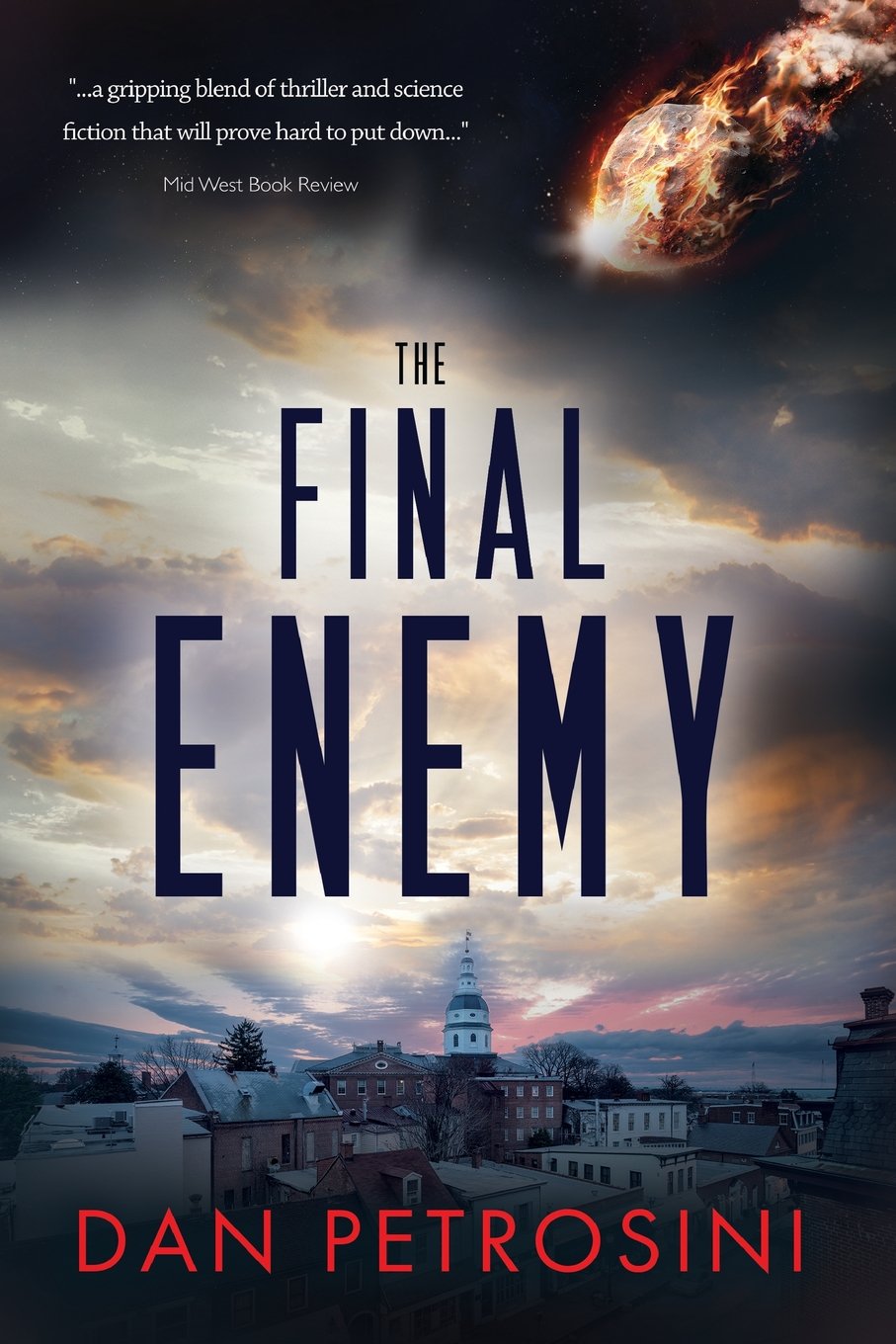
Review: The Final Enemy by Dan Petrosini


That is not dead which can eternal lie. And with strange æons even death may die. —H.P. Lovecraft, quoting "The Necronomicon"

I was very excited by this Kindle Scout offering, in which a Davenport, Ohio, reporter discovers a strange effect emanating from a recently-fallen meteorite. The rock seems to have eliminated death by natural causes, at least within a 15-mile radius of its location. 

What an opportunity to examine the convoluted ways in which human nature and culture is bound up in the eventual demise of each of us!

So even though the book was not selected in the program, I bought it anyway, and eagerly began reading. Alas! The story quickly bogs down in a rush of "things happening." Worse, our reporter, Jack, is strangely unmoved by some of these events, and curiously overwhelmed by others. Instead of getting a look at how he—and we all—might actually react, we are treated to increasingly shocking scenes.

Without death, there is no reason for God, apparently. There is no real exploration of the premise, just a string of church closures and a snubbed pontiff to illustrate the fact.

Without death (and ridiculously soon), there are far too many people for the planet, leading inevitably to cannibalism and chaos. Not to mention a safe-guarded compound, where the government elites and their hangers-on have enough to eat, of course.

There is the deus ex machina way that the meteorite allows the death "by natural causes" from poisoning, but not from starvation or from complications due to age or disease. It also extends this effect only to human animals, and not any of the other beings with which we share the planet.

And then there is the oh-so-Soylent Green solution for producing extra protein, about which I will only say that it is the dietary equivalent of hoisting oneself by one's own bootstraps, multiplied by the supposedly-burgeoning population numbers.

I won't spoil the novel, because it needs all the help it can get. But if you're not disappointed by the ending, let alone the distressingly boring path the writer drags us along to reach it, you are a very different reader than I am.


Liner Notes:

  • The second half of this novel was full of obvious typos and grammatical errors. I suspect the proof-reader had as much trouble wading through it as I did. "Unstainable" for "unsustainable" produced the most hilarious error.
  • The writer made the same wrong turn that the Soylent Green film-writers who translated Harry Harrison's Make Room, Make Room! did, and went for visceral shock rather than reaching for more philosophical depths. Try the original Harrison novel for a slightly preachy, but much more nuanced look at the issues that might rise from overpopulation.

Wednesday, June 7, 2017

Lightweight and Delicious

Brief Review: Time Burrito by Aaron Frale


One of the best things about being a Kindle Scout is the frequent introduction to second-tier (even third-tier) possibilities that turn into first-rate reads.

Like Time Burrito, for example. Let's face it, I probably wouldn't pick this book out of a list as something I might enjoy reading. The cover's intriguing; the title is weirdly promising. Based on that, I might have snagged the book out of a yard-sale jumble, or spent a buck, buck-fifty max, on a library-offsale paperback.

Selecting the ebook from an online list? Likely not.

Fortunately, I got a peek inside, and read just enough of the story to get hooked. I was caught by the concept, a time-traveling loser with a simple, if circumscribed, ambition:  make better burritos. At the beginning, Pete's business is a food truck that provides local students with horrible but cheap burritos. If I could just discover the secret burrito recipe, he thinks, I would be able to make the best burritos in town.

A chance tumble through time, though, will reveal that it's not the recipe he needs, but better ingredients. The rest of this romp is the story of how Pete's peregrinations through time help him overcome his rival for the title of Best Burrito Chef, build a food empire on his secret burrito spice, and find true love. All by making a burrito that is lightweight and delicious.

Just like this novel.

Thursday, June 1, 2017

Princely Kiss Cannot Save This Snow White

Review: Forever Snow (The Everly Girls Book 1) by V.B. Marlowe


At the core of many fairy tales is a witch or two, casting curses and blighting the lives of innocents. For Princess Snow White, the cursing witch is her stepmother. A sympathetic huntsman saves Snow by substituting a deer's heart for hers.

The Everly Girls novels (three so far) take the witch-curse datum from this and other stories' hearts and weave an intriguing structure around it. In the latest iteration of this evergreen tale, Neva Albini (Snow) has been cursed by a coven of witches to live three years of mid-adolescence, over and over again for centuries.

Her curse will only be lifted when she consents to kill another similarly-cursed wight and deliver her still-warm heart to the coven. Beauty, Hansel and Gretl, Cinderella, and others whose encounters with witches brought them similar problems, will need to make their own choices, but each of these other cursed characters is contending for a limited supply of happily ever after. 

And Neva's own heart is a ticket for someone else to escape the curse.

Time is running out for Neva to comply, and all the other problems of adolescence—mean girls and classroom rivalry, teen love long delayed by the fatal-kiss clause of her curse, and dire warnings from one friend that none of her other friends are to be trusted—pale next to this one. If she doesn't make a choice soon, it could mean spending the rest of time trapped in her three-year teenage hell. But choosing to kill another to benefit herself, especially someone suffering under their own curse, is simply a different damnation for Neva.

Marlowe has put a fascinating twist on cursed-child fairy tales, modernized them and intertwined one with another to create a series full of possibilities. While I got this title for free as a Kindle Scout selection, I'll be purchasing each of the subsequent Everly Girls novels as soon as they come available.  (I've already started with Forever Ella.)

Because you can never have enough happily ever after, even if it is only happy enough.


Note: These books are currently only available in eBook format

Wednesday, May 31, 2017

A Tale Retold With Robots

Review: Ensnared by Rita Stradling


Some stories are evergreen: the girl who encounters danger in the woods; the hungry children enticed by the aroma and taste of food where they least expect it; a girl who agrees to live with a beast to save her father from imprisonment.

The girl in the woods need not wear a red hood for us to recognise her. We hold our breath as the children succumb to the lure of sweets, even when they are not gingerbread shingles.

And we recognize the Beast even when he does not wear fur until midnight, and Beauty by her kind patience and willing self-sacrifice.

The clever recasting of this futuristic interation of Beauty, though, is where Ensnared shines. Lorccan Garbhan, the beast of this story, is all too human in his major foible; he cannot abide to be in the presence of a human. His billionaire-brilliant strategy is to commision a high-end AI-driven femmebot to help him reduce his social anxiety.

Rose steps in when her father, unable to deliver the commisioned artifact by the deadline, faces prison for fraud. And romance, or a suitable facsimile thereof, is totally to be expected.

That's if the other robots and AI devices involved don't rat out the human masquerading in their midst!

Friday, December 16, 2016

Post-Brexit Romp

Review: 54th State by Ian Thompson


Start with a now-American rocker named Tristan Beaver, politically and scientifically clueless, with his celebrity space shot. While Mars and the Moon are old-hat destinations on a well-travelled route, Beaver will make a splash with a crew of non-astronaut groupies and a startling destination: Jupiter's Red Spot.

Add a paradigm-busting US president whose idea of a great deal is to purchase new states (most recently, Cuba), plus a hopelessly incompetant British government surviving only by the efforts of mid-level clerk-assistants, with a post-Brexit space program hoping to be revitalized by Beaver's probe—all the elements needed for a romp. 

Okay, Beaver is not a former Canadian (despite the evocative title of the first paragraph: "Rock Stars, Eh?"), but is instead from rural-industrial England. He became an American, we learn, to avoid British taxes. 

And the free-market-dealing US President is a Libertarian—and a one-time member of Beaver's entourage. (Thompson would appear to have been equally taken by surprise by the recent US election results; his clueless Brit politicos refer on more than one occasion to "that lady President" who preceeded the current fictional holder of the office.)

The resulting farce is rollicking, hilarious, and satisfyingly irreverent in the way all good political comedies are. The Brexit result is called upon to explain the dire finances of Britain, and the ham-handed financial finagle of their treasury chief takes care of the rest. The interplay between the Prime Minister, Sir Barnaby Chamberlain, and the actual chief mover of the government, his aide Forbes, parallels that government's supposed philosophical dissonance with the British electorate.

Wrapped inside this satirical goofiness is a serious thread: a terrorist threat, the struggle of the Beaver Probe's crew to survive their ridiculous mission in a sabotaged spcecraft, plus a truly unexpected twist that takes the reader by surprise. It keeps the story from disintegrating into sniggers and stereotypes.

In fact, my next act after finishing this book was to buy Thompson's previous novel, EZICASH (subtitled How to usurp a totalitarian behemoth with a monkey wrench.) At less than a dollar, the purchase was another steal, and I look forward to reading his "satirical look at Health and Safety mixed with greed." 

I'll have to wait for my sides to stop aching from laughter before I undertake the next journey into his hilarious take on British politics!


Liner Notes:


I nominated 54th State in the Kindle Scout program, but since it was not selected, I purchased it for the princely sum of 99 cents. That's US pennies, by the way. Once again the program has introduced me to an author who has joined my "read everything by" list. If anyone wonders how I manage to read 200 to 300 books a year, the Kindle Scout program is a serious factor in feeding my To-Be-Read stack!

Tuesday, November 1, 2016

Magical Moon

Review: Pauper by Jack McDonald Burnett


Burnett's Girl on the Moon (which I reviewed in March 2016 as Private [Starship] Enterprise) was a tour-de-force of hard science fiction. This novel, while still set in Burnett's wheelhouse (private enterprise funding space exploration, US returning to the moon, first woman on the moon), takes a large step away from hard scifi.

There are two moons orbiting Earth, you see. Luna has been explored, although the final expedition was a while ago. The second moon, Pauper, arrived in Earth's skies shortly after the Fall of Constantinople. Smaller than Luna, it shows clearly as an orb. That kick-started science and global exploration earlier than in our world.

And coincidentally with Pauper's arrival, magic came to Earth.

This alternative Earth boasts a US that does not include the southern Confederation states, the separate nation of Florida, nor the territory of the Lousiana Purchase. Mexico (which includes southern California and the four-corners states) and Texas are slave-holding regimes. The Canadian expanse with the northern half of the continent's west coast and Snake River Plain is occupied by the "First Nations." US citizens need a passport to travel to Texas or Florida.

Most politicians are "magikers" because, according to one character, "that's how they can convince people to vote for them." And no astronauts are. The reason is complex: there had been a theory that Luna was the source of magic, but that "disturbing" it by setting foot on Luna's surface would bring magic to an end. That there are still magikers about, after multiple moon-landings, does not negate this theory. Proponents simply point to the decline of magical power in the world since then.

Billionaire Frank Ebersole doesn't believe the Luna-source theory. He thinks Pauper is the source of magic, and to prove it, he puts together a carefully-designed expedition to the smaller moon. His group of "layman astronauts" includes, among others, a woman from the French Midwest L'Empire, an Amerindian US citizen who qualifies to emigrate to Canada, a teenage girl whose family were refugees from the slave-holders in Arizona, and his "bodyman" Garrett.

It also includes, unknown to the others, a magiker whose goal it is to sabotage the mission, lest setting foot on Pauper bring about the feared end to magic.

Ebersole will have to coax, cajole, bully, manipulate and sometimes, outright lie to his crew to bring about his goal. And he may have to extend his efforts to the wider world, because someone in the US government is determined to stop him.
Politics, Garrett thought. Like a food fight without the internal logic.

This was a satisfyingly complex novel, with very human characters. People who have public goals, and private ones that are not always the same. People who are jealous or noble or self-serving, who make mistakes and then struggle mightily to right them again. People who lose or succeed by taking action. People who are petty or generous, methodical or impulsive by turns. And an overall focus on the truly possible, despite the single extra non-science element of the tale.

In short, it was everything I have come to expect from Burnett. That it was a Kindle Scout selection which I nominated, and therefore received a copy for free was an additional benefit. 

I would have happily paid full price. Burnett is now on my "buy anything he writes" list.

Monday, October 24, 2016

Love that Transcends Death

Brief Review: The Rage of Plum Blossoms by Christina Whitehead


The only reviewers making fun of this Kindle-Scout-selected novel's title will be either cold-hearted anti-romantics, or those who have not read it. 

Rage is a normal response when your world has been irretrievably upset, and Quinn Jones Chang has lost not only her husband, but her best friend, her true love, and her sense of place in the community, all at the same time. It does not help that her husband's family and his best friend "from the womb" Harry Chin all believe, like the police, that Jordan Chang committed suicide by diving head-first from their second-floor balcony.

Like the plum, Quinn will persist through the chill of this emotional winter. She will find support from a strange variety of new friends and continue—despite threatenting emails and near-fatal "accidents"—to seek the real reason her husband died, to find his murderers, to blossom in the midst of this icy disaster.

By the way, guys, I offer a warning. This is a novel that drove me to tears, not once, but several times. If you are in a deep relationship, the evocative way Whitehead describes Quinn's loss may overturn your emotions as well. Fathers (and mothers) will also find tear-jerking moments in the story.

There is power in evoking tears, and power in the persistence of Quinn and her posse. It is the power of plum blossoms to promise the triumph of spring in late winter. It is the power of love that transcends death.

Wednesday, October 19, 2016

Breaking the Wall

Review: Matthew Templeton and the Enchanted Journal by Natalie Grigson, Kelpie Dreams by Steve Vernon


One of the hardest techniques for an author of fiction to master is addressing the reader directly. Speaking directly to, acknowledging, or including your audience through the imaginary box of observation is known as "breaking the fourth wall". It takes a very light hand, and is easily overdone. Many readers—myself included—dislike it intensely as an annoying distraction from absorption in the narrative.

It can be done, however. In order to succeed, the narrator must include the reader with asides that share expectations or acknowledge a quiet joke at the characters' expense. It must also be continual; a sudden comment to the reader in Chapter Eight is a jarring occurance, but a string of subtle asides that begin in Chapter One becomes part of the narration. Gentle, quiet, and subtle will be less annoying than sudden, jarring and unexpected. 


Matthew Templeton and the Enchanted Journal

This novel was a Kindle Scout nomination of mine that was not selected. I bought it anyway, intrigued by the concept of a journal that could bring about anything written into it. (Shades of Stranger than Fiction here; I kept thinking of Emma Thompson writing Will Farrell to death.) Matthew's journal is a birthday present from his librarian, Ms. McCaffrey. 

A thirteen-year-old boy might be presumed to be less than delighted at receiving the gift of "a diary", but it beats what Matthew got from his hideously self-centered and mean parents: nothing. Well, nothing except a promise of military academy, despite his intense wish otherwise on his "birthday match". 

Throughout the tale of Matthew, his only school friend Ryan, and the others they collect on their adventures, we are invited to laugh at the folly of the humans, snicker at the petty evil of Matthew's parents, and enjoy the daft way the journal continually skews what Matthew wants by misinterpreting his written words. Ordinarily I would despise such asides, but Grigson has a sweet way with them. They help the reader along rather than breaking the fourth wall.

This is a tale of revenge and murder, treachery and lies, with knights and their ladies fair, lost princesses, evil wizards, montrous wergs, and rebellious villagers. Yet not one of them is what we expect; every character (except Matthew's parents, perhaps) has a unforseen side. The result is a light-hearted, humorous, and thoroughly delicious novel with the promise of a sequel.

I'll be waiting on the other side of the wall, with bated breath, for Grigson to break it again.


Kelpie Dreams

This novel, by contrast, was accepted as a Kindle Scout publication. It had a HOT label on it from the first, and I understood why when I read the concept: a paranormal romance novel (kelpie librarian, 200-year-old sea captain, zombie lighthouse keeper, sea hag villain) for folks who HATE to read romance novels. That's me! I thought, and nominated it. (Besides, I had nominated Vernon's A Blurt In Time, bought it when it was not selected, and enjoyed it a little. Surely I would enjoy this one a bit more?)

I barely read the excerpt, I was so taken with the concept. If I had, I would have noticed the blaring asides, the all-caps shouts. (And paragraphs of hyphenated stuff, breaking oddly due to my font-size setting—I should have remembered them from Blurt.) I was never allowed to simply become absorbed in the tale, but was constantly dragged from my observer's post to get involved in the action. 

Perhaps it would have been less annoying if the asides and comments weren't so crude and gauche. OK, there's a bit of a snicker in someone's mother wanting to name her Hemorrhoid. But:
Can you actually imagine spending your entire lifetime constantly spell-checking your own name? Go ahead—just try to close your eyes and spell out H-E-M-O-R-R-H-O-I-D without having to resort to a discrete peek at a medical dictionary. I dare you.

If that was the only such, I might have forgiven the writer and moved on. But there is scarely a page without a similar observation, blatantly breaking the fourth wall to drag me, the reader, into the character's head. I don't come to discover the main character's motivation, I am drenched in it:
My son had died picking his nose in a stolen neon yellow Audi. Try and think about that, if you will. Let the thought crust and dry, and let it stick to your mind’s finger like a hard and completely unflickable booger of undeniable truth. I had always thought that the word irony was the opposite of wrinkly, but if this wasn’t ironic, I don’t know what else it could be.

OK, I'm not with it. I don't get it. Except occasionally, I do, and then I regret every one of the break-wall asides I got annoyed at when I come upon something really cool and evocative:
I stared right back. I was not going to give the man a single inch of leniency. I mentally tried to evoke a psychic soundtrack of all of the Ennio Morricone background music from all three of Clint Eastwood’s Man with No Name westerns. Ooeeooeeoo . . . wah-wah-wah. Ooeeooeeoo . . . wah-wah-wah.

Eventually, having battled nearly half-way through the up-and-down narrative, I quietly closed the book and abandoned the effort. That was mid-May. I told myself, Steve Vernon shouldn't have to suffer a bad review because of my inability to get past his brittle-wall syndrome. It wasn't until I read Matthew Templeton and the Enchanted Journal that I realized breaking the wall doesn't have to throw the whole labor onto the reader.

Vernon has a readership, and my comments will come late in the stream, easily ignored by them. But this is one time I'm really glad I didn't pay for a book.

Monday, October 17, 2016

A Powerful Story So Seldom Trumps Editing

Review: The City Below by Kevin George

Winner in the category Most words between a character's introduction in the Prologue and his inclusion in the story

I nominated this novel on the basis of a very strong excerpt from the prologue that opens the story. I wanted to read this book; if it had not been selected as a Kindle Scout offering, I would have purchased it anyway.

And while I wasn't disappointed, I wasn't thrilled, either. The intriguing characters introduced in the prologue simply vanish from the tale with the opening lines of Chapter One.

The reason I wasn't disappointed was that the story replacing what the prologue promised is a strong one, also filled with people I want to read about. Dystopian, post-apocalyptic societies are often set in a barren wilderness, or underground. The City Below satisfies both conditions; its tunnels and chambers were carved out below a vast, cold expanse of snow so long ago that only folk stories recount the existence of "white nothingess" and "the great blue above" beyond the underground city.

The next generation of the city's leaders were exposed to these "old wives' tales" through Artie Peters, the scion of the Fifth's leading family. Artie is a complex character, wanting to satisfy his father's stern work ethic, but drawn more to reading and study than the rest of the stoic, hard-working tunneling community of City Section Five. 

Emma Weller is the daughter of the founder Weller family, whose Section Three supports the scholars and engineers of the city. The last generation saw their section's, and the city's, history modified by the city's ruler to remove most references to the Weller family from the account of how the city was founded. 

Emma is less concerned with that and more focused on impressing her crush, Chad Upton, the son of the leaders of Section Two, which grows most of the vegetables and grains for the city. Even so, Chad is as misplaced as Artie; he yearns to build a vehicle he has engineered to explore the little he has learned about the vast space beyond the city's boundaries.

Then there is the ruling section, One, with the best access to the power provided by lava. One, where the principle product is guards and soldiers to suppress and force compliance from the other sections. One, whose ruling Jonas family has the ear of the Lord, styled "King" (and Your Illustriousness) and "Queen," and whose Prince Oliver, Olly to his young colleagues, is equally drawn to the adventure represented by the Great Beyond.

Section Four of the city below has no inhabitants (except, perhaps, ghosts). We learn that they died in the illness that still continues to plague the city. It is a disease that, curiously, has no symptoms until the day the afflicted person is taken into Quarantine by the guards from One. The diagnosis comes from "the Lord and Jonas," the irrefutable source of all policies and commands.

This novel, though powerful and engrossing, needed more editing. For one thing, it is needlessly long. Some topics are beaten to death. Others are repeated until the reader could recite them with the characters who voice them. Emma and Olly are two-dimensional at first, and Emma never gets much more complex. Oliver, however, gradually becomes a more-developed person, even if never as compellingly involuted as Artie or Chad. 

Strangely, the concept that gave such power to the prologue is given short shrift amongst all these words. The reader has almost forgotten it when it is reintroduced, much later. Yet the story is so persuasive, so compelling, that one forgives the technical problems. 

I was left with three massive cliff-hangers, and an immense desire to read Book 2 of the series. Alas, I will have to wait. 

Perhaps I will try George's previous novels, the 12-book Comet Clement series. 

Monday, August 29, 2016

Jumping to Conclusions

Review: Portal Jumpers by Chloe Garner


Where would you go, if you could go anywhere? Portal jumpers are elite folks—young, fit, well-trained, and guided by the best principles of humanity. If you don't believe that, just ask them. The transit technology, the portals, could take them anywhere, but somehow they go to only a selected few places.

Jumpers are few, supported by dozens or hundreds of scientists, analysts and officers in a quasi-military structure. Many of them are like Cassie, aged out, forever barred from the step through a portal to the far side of the universe. Cassie's ability to find the pattern in a stream of events is all that has kept her in the portal program.

She may be too old for jumping, but with her pattern-tracing abilities, she manages to track down the alien Jesse, who has been running the portal police ragged. When Jesse meets the analyst who caught him, he argues her into a contract that binds them both. While on Earth, he will be be subordinate to her, and assist analysts in the various labs with his advanced knowledge of the portal technology. Her commander nearly orders her to take the deal; the scientists are eager to get access to Jesse's expertise. 

Cassie isn't sure she wants to be saddled with the laid-back alien escape artist while on Earth. By the terms of the contract, though, Cassie must accompany Jesse when he transits through the portals, and she will not be required to report on where they go or what she observes. From aged-out and bored, Cassie just landed the plum job of all time: she can jump again!

She'll discover that traveling with an intersteller B-Type personality has its own issues; the worlds to which Jesse takes her seem distressed, even damaged. By the time Cassie identifies the pattern, it may be too late—for the worlds, for Jesse, for the Earth portal base, and even for Cassie herself.

Liner Note:

This was a Kindle Scout nomination that was not selected for publication. I'm glad I took the chance, and bought and read it anyway!

Friday, August 19, 2016

When Home Is Prison (Double YA Review)

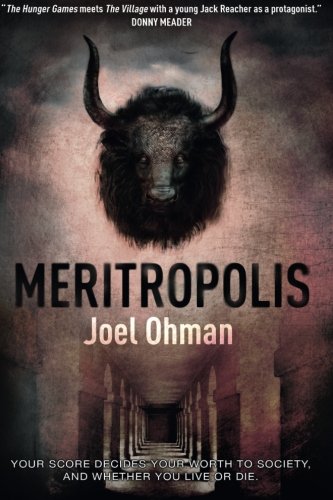
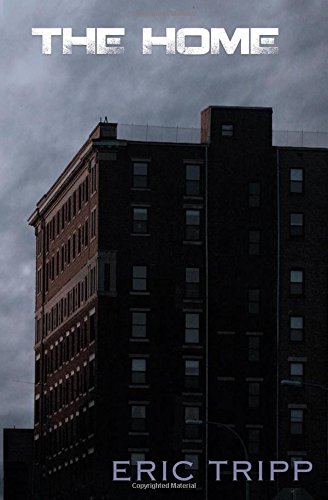
Review: Meritropolis by Joel Orman and The Home by Eric Tripp


Home and imprisonment are recurring themes in YA novels, and so are the concepts of feeling loved and valued. By chance, I purchased two books together that explore these ideas, and since I read them together. I decided to review them in the same post.


Meritropolis

This novel is post-apocalyptic dystopian, set in a world with bizarre and hostile mutations that merge animals in obviously deliberate ways. The bion is a bison-lion combination, for example, a vicious meat-eating, bull-stubborn giant with a devil-red pelt and eyes. The snick is a winged bloodsucker formed from the genes of a snipe and a tick; it flies in flocks and can drain its victims dry. Chimpzelles, merging chimps with gazelles, hunt in tribal groups with primitive hand-weapons, and will devour humans as happily as any other prey.

Holding these hostile hordes at bay, Meritropolis itself is a walled city in which citizens have carefully-defined roles that rise from their measured merit: each citizen receives a periodically-reassessed Score that determines whether they will be permitted to stay in the city. Since it is accepted that being outside the wall at night is fatal, getting a low Score is a death sentence. 

That's what happened to Charley's brother. Charley is stunned by the verdict, especially when his own Score turns out to be high. It has left him burning with anger against the city management, motivated to do well in warrior tests, and questioning the fairness of the whole Score assessment system. In short, he is messed up.

The way Charley fits himself into the system to discover its problems and its value to him is the only way his high Score is obvious; in every other way, his behavior and choices only reveal him as a disturbed adolescent. The flow of the story is not helped by the many other voices sharing its narration, none of which are clearly distinguishable from Charley's. 

Nevertheless, the novel's unrelenting physical and philosphical action, and its high concept and creative world-building, serve to offset these minor issues of technique. It is a very enjoyable read.

Liner Note: The book's title was a tongue-twister until I recalled the Fritz Lang classic film, Metropolis. Suddenly it began to fall more naturally on my reading ear.


The Home

The concept for The Home was promising enough that I nominated it for publishing on Kindle Scout: hundreds of children are tended in a single building by their "Father," who either kidnapped them or coaxed them off the streets as runaways. 

These children don't work like Fagin's crew, nor do they go to school. They seem to spend their time playing video games and earning tokens by doing chores or gambling. The carny atmosphere doesn't disguise the fact that none of them are allowed to leave. Think of boys-becoming-donkeys on Pleasure Island in Pinocchio, and you've got the vibe.

The tale is told by two voices: Bom and Mystic are older children in the Home. Bom is a natural leader, a young man in age, who is being groomed as a sort of deputy-Father. Mystic is a new addition to the ranks—who incidentally, also fills the author's need of a foil for explanations. (In '50s pulp science fiction, for example, this role was filled by a buxom blonde lab assistant.)

In the only subtle concept of the novel, the Home itself becomes a representation of many inner-city societies, with a "welfare class" trapped in sterile leisure by a benign but strict provider, and an upwardly-mobile (or "outwardly-mobile") group seeking a way to live on their own terms. 

By contrast to Meritropolis, this novel was dismayingly simplistic and badly proof-read, with an annoying number of grammatical and typographical errors. The most distressing "typo" left me looking for an escape with the same fervor as Bom and Mystic. The word is in quotes because its near-universal occurrence indicates it was a writer's or proofer's error of knowledge rather than a mistake in typesetting: the omission of commas before every name used as a directed address in dialog. It was never "I was looking for that, Bom..." but Watch out! Duck!:
"I was looking for that Bom..."

About halfway through, I stopped noting error corrections in my Kindle, especially as a frequent use of the wrong homophones made me suspect this was a novel written using speech software. Mispronounced words or sloppy pronunciations might have yielded some of the more amusing choices: "crown" for "crayon" for example.

Since I understand such systems ask the speaker to select among homophones like "you're" and "your" or "rain" and "reign," there was an opportunity to correct it. It is more likely someone simply accepted the most-frequent default without looking at the options. Either way, in writing The Home using speech software, the author made another wrong choice.

Thursday, May 19, 2016

Space Opera Redux

Brief Review: The Counterfeit Captain by Henry Vogel


Captain Nancy Martin expects a lonely death, passing out as her battle-damaged starfighter bleeds the last of its air.

From the first words of its description, this novel's posting on Kindle Scout captured me. After I purchased it, and began to read, I was not disappointed. This is an honest-to-goodness old-school space opera, complete with a Clarke-ian kilometers-long colony ship, Dalek-like evil robots driven by a scheming AI, space pirates and mutineers, enslaved children, primitive cargo-cult villages of humans who think their Ship is the world, and a running battle fought with lasers, blasters and bow-and-arrow through dark passages lined with blinking lights and shadowy machines. There's even a strong modern woman/strong primitive man romance, with a tasteful off-screen consummation.

Hard to imagine that all those elements can come together into an elegant and focused science fiction story, but in a little over 200 pages, it does. Furthermore, it feels fresh and exciting even while it rings all those well-known bells. I enjoyed it from word one, and closed the book on the ending thinking, I wish there was a promise of a sequel.

 Unfortunately, The End... Or Is It? might be the only trope missing from the novel.

Wednesday, May 18, 2016

Love and the Rest of the World Entire

Review: Odd Adventures with your Other Father by Norman Prentiss


In this layered collection of tales, Celia begins with a question: "What are your parents like?" Instead of a direct answer, she shares some of the stories her living father, Shawn, told her about a post-college road trip with his now-deceased life-partner, Jack. These shared tales are wound through Celia's own search for a deeper connection to her family.

Throughout the stories, Celia's and Shawn's, the reader can feel the duality of her relationship with both fathers; she has enormous pride in their love for each other, and yet she yearns for a "normal" family life.

This duality runs deeper in the narrative as well. Each adventure from her parents' youth—their honeymoon trip, as it were—can be read as an allegory of living in a world that is more hostile than it is accepting, or even simply indifferent, to a homosexual couple.

In one twist, for example, Jack finds himself cast in the role of the straight man who wanders unknowing into a gay bar, and is forced to confront his own ambivalent reactions to the behaviors he observes. In another, the two young men casually insult those around them, and must face the consequences when their hurtful conversation is overheard.

Concentrated rather than short, this is a quick read that packs a mighty wallop. And while I might have enjoyed more tales of the "odd adventures," Prentiss has included precisely as many as he needed to power a complex novel about travelling on the fringes where love and family meet the rest of the world—and surviving them heart-whole.

Liner Notes:

I nominated this novel in Kindle Scout and it was accepted for publication, so I received a free copy.