Showing posts with label Not on Kindle. Show all posts

Thursday, April 23, 2020

Piratica: Being a Daring Tale of a Singular Girl's Adventure Upon the High Seas by Tanith Lee


I bought this book to put into my Little Free Library, but wondered where it might fit on the range of age-appropriateness—especially because I intended to loan it first to a neighbor teen. The best way to determine this, of course, was to read it myself.

Surprise! It's a great book, and despite the story line, has little gore, with zero vulgarity and profanity. (Unless you're worried about exclamations like "Great shells!" or "Upon my father's coat!")

The cross-dressing teenage girl Artemisia (Art), who sets out to convert her crew of actors into real pirates, is a genuine sweetheart. The acting troupe she carries along in her wake are truly interesting characters themselves, and the young artist she robs at their first encounter, then later kidnaps to the West (or "Blue") Indies and carries onward to the Southern Indian Ocean's "Treasured Isle" (which may be Île Saint-Paul in our world), is an honestly intriguing figure who refuses to fall into the "true love" trope of any ordinary pirate romance.

The setting is global, but it is not the globe we live on. In Art's world, 1820's "Lundon" is the capital of Free Republican England (which ousted its monarch quite a while ago, erasing all hereditary titles and freeing slaves in all its colonies at the same time). The islands of the "Blue" Indies are still pirates' havens. The ocean south of the east "Africayan" coastal island "Mad-Agash Scar" is named "Capricorn Sea." Even the calendar is different; by Art's reckoning, the year in which the story's events occur is "Seventeen-Twelfty."

Some things stay the same, though. As in 1820, in the "Seventeen-Twelfty's," the same once-hereditary elites mostly remain in power, though with different titles. People are free to starve or freeze to death, though no one we meet does so. And a young woman who has the audacity to wear men's clothing and successfully captain a ship is a criminal because of that, regardless of the theft of ships and booty. It's there, though soft-peddled. For a younger reader than I am, I suspect these disturbing ideas will vanish into the tension of the tale.

I would recommend this seriously twisted plot for the reading pleasure of any advanced middle-school reader or young adult of my aquaintance, and many an adult as well. It will appeal to both girls and boys for its story; adults can enjoy the extra layer of twisted geography and history.

Outstanding!

Thursday, October 5, 2017

The Revolt Against Asimov’s Second Empire

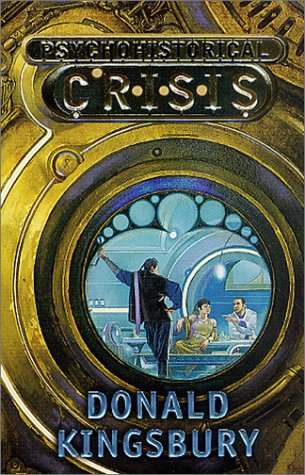
Review: Psychohistorical Crisis by Donald Kingsbury


One of the pillars upon which the giant reputation of Isaac Asimov still rests is the sweeping Foundation Trilogy.


These three novels detail how mathematician and historian Hari Seldon foresaw a 30-millennium-long Galaxy-wide collapse of civilization, and devised a plan to shorten those coming dark ages to a single millennium. Seldon planned an openly-acknowledged path of historical development for the newly-created Encyclopedia Foundation located on a world at the fringe of the Empire whose collapse Seldon predicted. 

Periodically, this Foundation would face a Seldon Event, a psychohistorical crisis, in which a threat to its existence which would constrain the nascent second empire to follow a single, pre-determined, path. To keep the Seldon Plan on track, a second, hidden foundation consisting of heirs to Seldon’s science of psychohistory would act as “wizards behind the screen” to ensure the coming of the Second Empire.

In Psychohistorical Crisis, Donald Kingsbury looks at the re-established Second Empire, over 2700 years after the crafting of the Seldon Plan. In this far-distant future, Seldon’s name is lost in the mists of history, and psychohistory is a occult practice, whose “Psycholars” maintain their Galactic rule by keeping the tenets of their science a deep secret. Citizens of the second empire exist in their complex society only with the aid of a mind-enhancing outgrowth of Asimov’s mind-probe, the quantum-mechanical familiar, or “fam”. On the surface, all is pleasant and peaceful.

Beneath that calm, however, are roiling currents of revolution. And bobbing along, pulled this way and that by these currents, is Eron Osa, a mathematical genius with a modified fam. We meet Osa as he is stripped of his fam for an unspecified crime. Condemned to live without his memories (but warned by the rebel Psycholar Hahukum Konn not to use the “prosthetic” fam supplied by the ruling council), Osa is forced to live by his native wit—even to the extent of actually reading with his eyes (gasp!) a purloined book of the Founder’s lessons as he attempts to recover the science he has lost.

We then flash back to Eron’s childhood, where we meet Hiranimus Scogil, another rebel, who is seeking a brilliant student to place as a sleeper in the Psycholar’s Lyceum on “Splendid Wisdom,” the seat of the Second Empire. Scogil places his student in the hands of Nemia of l’Armontag, who modifies his fam, ostensibly to give him faster access times, but with a longer-term plan to allow the mysterious Oversee organization to activate their sleeper when desired. 

We meet Kikaju Jama, yet another schemer bent on manipulating events by training and releasing agents, the tattooed barkeep Rigone of Splendid Wisdom, and Frightfulperson Otaria of the Calmer Seas, all of whom have designs upon the mind and future of Eron Osa. In deliciously complex inter-woven character histories, Kingsbury examines the human desire to manipulate others, on the personal as well as the Galactic scale.

Wrapped in layers of philosophy, history, metrical science and astrology, Kingsbury has also given us a closer look at the central premise of Asimov’s trilogy: that what men can predict, men can control. He then challenges this premise, exploring themes of free will vs. prediction; the scalability of government styles, knowledge acquisition and knowledge retention; and the quantum-cat nature of both prediction and history.

This is a demanding read, with sly references to a wide range of science-fictional works in addition to its densely-woven core story. You can enjoy the novel as a mystery (why does Eron Osa merit the execution of his fam?), as science fiction (will the various rebels succeed in overthrowing the Psycholars’ rule, and what is the mechanism by which knowledge slides into myth?), or as skillful homage to Asimov. 

However you read it, the book is thoroughly enjoyable.

Liner Note

At the time of this review, the book was not available on Kindle.

Wednesday, October 4, 2017

Light Horror from a Dark Past

Review: The Boys Are Back in Town by Christopher Golden


Like Rod Serling. Stephen Donaldson. L. Frank Baum crossed with Stephen King.” 

Reviewers have struggled to place Christopher Golden’s work into a specific niche of the horror genre, but previous books have defied such placement. The Boys Are Back in Town is no different.

Oh, Boys begins typically enough, B-movie script expectable. Will James is a world-weary tabloid reporter, collecting yet another story before he heads back to the home town for a tenth-year high-school reunion. 

He’s made plans to meet with all his old friends while back home, exchanging eMails and setting up dinner plans with each of them. Aside from Mike Lebo, though, Will hasn’t seen most of them since high school. 

Then he arrives for the reunion, and his innocent inquiries after Mike are met with shocked stares. Everyone else remembers Mike Lebo’s death during their senior year.

As Will examines his memories, a darker history than he recalled before the reunion begins to emerge. There’s a reason he’s not an award-winning journalist. There’s a reason Will alone remembers Mike Lebo alive after graduation. And there’s a sinister reason Mike eMailed him before the reunion.

It’s all tied up with the black magic these high-school friends practiced ten years ago. Will finds his world changing around him as his memories shift. He must travel back in time to undo the disastrous events that have set an entire high school class onto a twisted path.


Golden writes dialogue in a very “new age” style, with the choppy rhythm of eMail, tweets, and voice-mail. Yet he uses a descriptive technique straight out of Dashiel Hammett: objective, blunt and unemotional. The combination works to create a modern atmosphere for some very creepy action.

The novel lightly explores the way our destinies are determined by choices we make, and how our identity is inextricable from our memories. Like most horror novels, the message is superficial. If you’re not looking for anything deep and lasting, this is an excellent choice.

Wednesday, September 27, 2017

Strength of Warped Materials

Review: Stress Analysis of a Strapless Evening Gown, Compilation edited by Robert A. Baker


Anyone who’s had to revise ISO9000 documents, review a prosy thesis paper, or wade through jargon in an industry magazine, will welcome this compilation with heart-felt relief. These selections from the notorious 50s underground publication The Worm-Runner’s Digest are guaranteed to make you smile.

Consider, for example, “Postal System Input Buffer Device” by Joe and Gil Robertson Obsborne. A simple action, putting an envelope into a mailbox, right? Not in formal instructionese, which must specify that to operate such an input device requires:
a) a passenger in normal working condition mounted upright on the front seat or (b) a driver having at least one arm on the right-hand side which is six feet long and double-jointed at the wrist and elbow.

Then there’s F.E. Warburton’s “Terns,” which reliably informs us that because terns have webbed feet, they will be found in the same books as albatrosses and other waterfowl; further that terns won’t eat anything but fish, so “it is no use putting out bits of suet and coconut for them in the winter”. Besides,
Baby terns just a few days old are the cutest, fluffiest little things. They will sit on your hand just as friendly as anything, going “chirp, chirp” and looking at you with their big bright eyes and vomiting half-digested fish all over your shirt.

Two versions of the 23rd Psalm are included. The first, by Alan Simpson and R.A. Baker, commences: “The Lord is my external-internal integrative mechanism, I shall not be deprived of gratification for my viscerogenic hungers or my need dispositions…”. The second, from science fiction writer Lester del Rey starts: “The AEC is my shepherd, I shall not live. It maketh me to lie down in radiant pastures…”.

Hugh Sinclair contributed the brilliant “Hiawatha’s Lipid,” which simply has to be read entire. Sinclair spoofs the classic poem in an effort for which he concedes he “sought inspiration in innumerable manhattans—taken, of course, because they were good for me since the day’s immobility of listening to papers on atheroma and serum cholesterol had no doubt silted up my vessels, and alcohol is one of the few effective solvents.”
From his briefcase Hiawatha / Took his paper for the meeting… / Started on the introduction, / Giving first a brief description / Of the Proto-Keynesian period / When all fats in equal measure / Raised cholesterol in serum…

Berkeley engineer Charles Siem’s paper supplies the book’s title. “A Stress Analysis of a Strapless Evening Gown.” This piece includes a wonderfully evocative figure, Force Distribution of Cantilever Beam, complete with rotational and compressional component—in which the beam’s profile is distinctly mammalian. The critical element of the force diagram is identified, with the caveat:
If the female is naturally blessed with sufficient pectoral development, she can supply this very vital force and maintain the elemental strip at equilibrium. If she is not, the engineer has to supply this force by artificial methods.

Sometimes the bibliography is more interesting than the paper, as R. Arnold Le Win points out in “Logarithmic and Arythmic Expression of a Physiological Function.” In fact, the only thing in this item is the list of references, which include:
7. Shadrach, C., Meshach, H., and Abednego, H. and C.. An anaerobic heat resistant monoflagellate ornithine producing sulfur non-purple bacterium isolated from the rectum of a goat. J.Bact., 70: 1-11,1944.
10. Aschitz, K., and Spitz, G. Urea excretion, growth hormone production, and caudal temperature of the 6-week-old hypophysectomized, adrenalextomized, tonsillectomized castrated albino hamster. Proc.Soc.Exp.Biol.& Med.. 50: 2-4, 1956.
13. Strickstaw, A. The fats of cats. 27.Glycero-1, 4-alpha-feritol, a new liquid component of the milk of the lion. Felis leo. Biochem.J. 73: 108-113, 1946.


I can only excerpt a few high points here. To read the rest will take some digging, since Stress Analysis is, sadly, out of print. A slightly more recent compilation from The Worm-Runner’s Digest titled Science, Sex and Sacred Cows (which I reviewed in Spoofing Science Before the Ig Nobel Prize) is more available, as is The Worm Re-Turns. None are available on Kindle. Yet.

Wednesday, November 2, 2016

Butterflies and Billiards

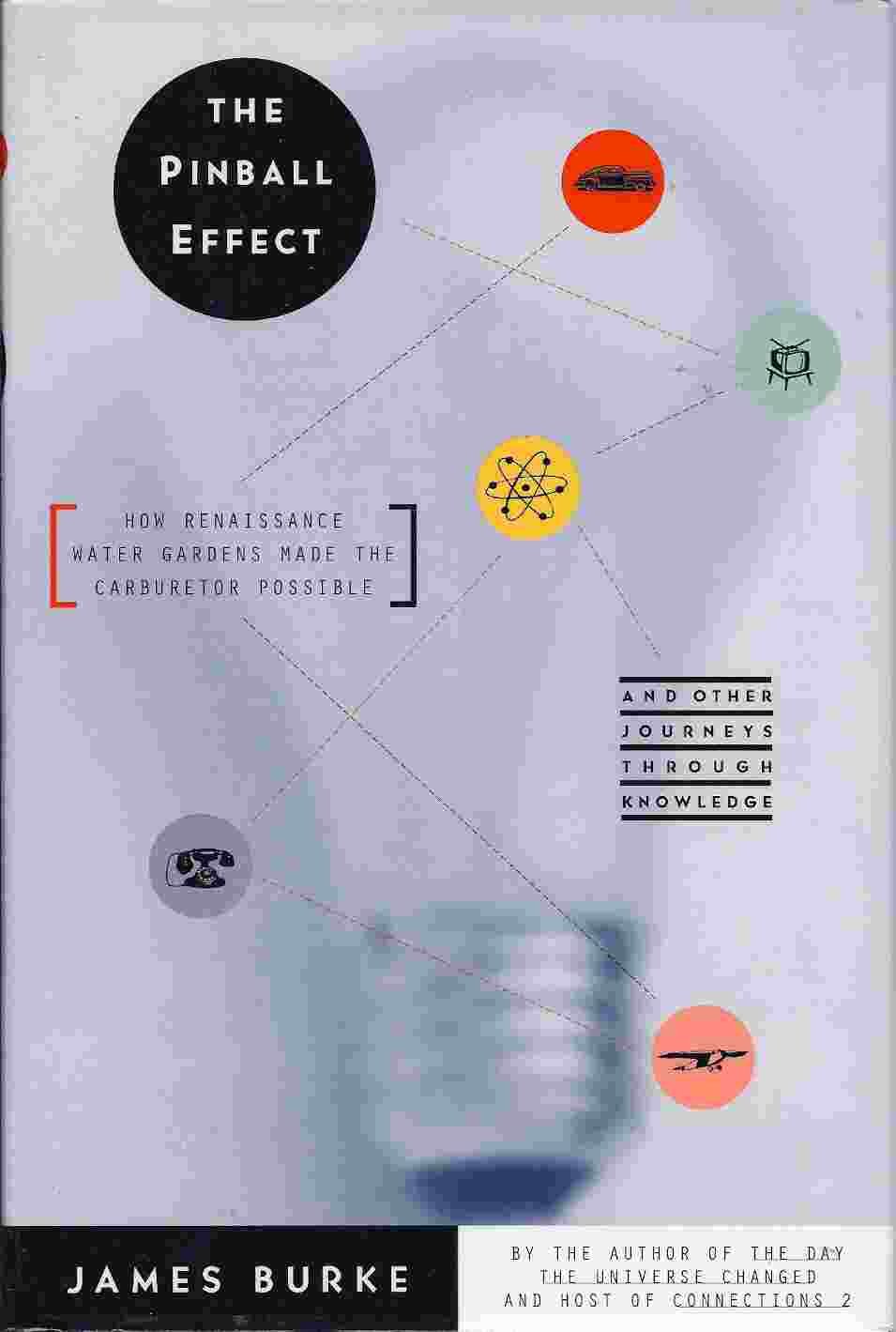
Review: The Pinball Effect by James Burke


James Burke, founder of The Knowledge Web, who hosted TV's Connections and The Day the Universe Changed, brought his view of the interconnected nature of technological change to this collection of essays. With the network of shotgunned factoids that once characterized his TV essays, Burke sets out to reveal once again how one discovery leads to, not another one, but to multiple others.

Supporting this interconnectedness is a hyperlink gimmick, in which footnote numbers refer the us to a link between the current factoid and one buried further along in the book. 

I last saw this technique used in a juvenile "multiple endings" novel.

Some of the connections revealed by following these links are interesting, but others are a bit of a stretch. For example, the imposition of heavy import duties on fabrics by the Sun King's Minister of Finance, Colbert, is linked to Impressionism and the development of the RGB monitor by way of M.E. Chevreul, the head director of dyeing at the Gobelins tapestry factory in Paris.

Many of the capsule essays in the book (as opposed to the wider network of connections) have made their way to TV. "Hot Pickle," for example, details how spices were the driving motivation for the development of smart bombs (via exploration, leading to the need for better fuel and driving engines, from there to air conditioning, Corning glass and fiberglass, and onward to lasers. The Learning Channel produced it as a separate hour-long feature; Hot Pickle ran again just a few weeks ago, and I was reminded of its source.

So while the book is amusing, with a pleasing focus on progress and technological development, it fails to provide a real sense of the history involved. What Burke has done is provide a series of science sound-bites, carefully calculated to keep the attention of those with short spans. "See, here's a pretty fact! Look, how shiny! But now look, look, no, look here..." This cajoling approach to science history does quite well on TV, but fails to entice in book format.

The one place this book works well is the bathroom. As a short-span reader, it equals most editions of Uncle John's Bathroom Reader, because you get a satisfying sense of informing your brain (however shallowly) while taking care of other business. 

Plus, James Burke, so there's that.

Thursday, October 27, 2016

Spoofing Science Before the Ig Nobel Prize

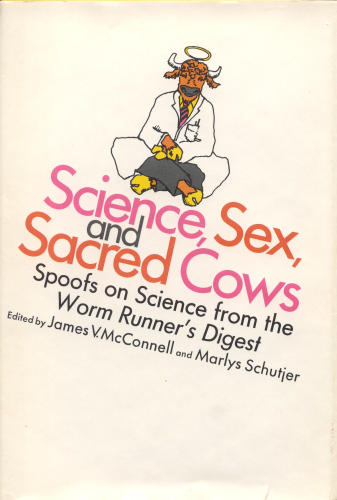
Review: Science, Sex, and Sacred Cows, from Worm-Runner's Digest, James V. McConnell, Editor


The Ig Nobel Prizes, parodies of the Nobel Prizes, can be veiled criticism or satire, but also point out that even absurd-sounding research can yield useful knowledge.

For example, in the early days of exploration into DNA and RNA, the experimental “tool” of choice was the lowly flatworm, Dughesia tigrina. Hardy specimens were easy to obtain, easy to analyze (behaving like organic NOT gates), and capable of regenerating from axial or longitudinal cuts. Even partial cuts would stimulate regeneration, giving rise to worms with two, three, even ten heads.

The excitement in using flatworms was that they could be “taught” to run a maze, then shown (by Digest editor Dr. James V. McConnell in a disputed experiment) to transmit their knowledge to untrained planaria who consumed their chopped-up bodies. Something in the trained worms acted as a knowledge store. This stuff, named “Memory RNA” by its discoverer, prompted hopes of a “Ph.D. pill” in the future.

The maze-running of such animals to create a trained food-source for investigation was so widespread, it gave rise to the quasi-satiric Worm-Runner’s Digest, published at first as humorous entries in the staid Journal of Biological Psychology. When the satirical pieces began to diminish the reputation of his peer-reviewed items, Digest editor James V. McConnell first printed the humor pieces upside down at the end of each volume, then separated the two entirely.

Freed from proximity to the now-waning furor over college-bound planaria, Digest articles eventually covered a multitude of topics, from archaeology to zoophyly. This particular collection is “more than 50 percent planaria by volume.” I hope we can all learn something from its consumption.

From the initial Questions and answers with Grant Swinger (in which the operations of the “Center for Absorption of Federal Funds” are described) to the final Neil Illusions (showing the panicked urge for new optical illusions to which the researcher’s name might be appended), these are iconoclastic articles. Their primary aim is to amuse, but the secondary purpose is to let hot air out of the pompous image of the scientist.

So we have a Handbook of common laboratory diseases, including 'Apparatophilia' and 'Disbursitis'. The professional patient illustrates the arrogance and impatience of some researchers by casting these qualities onto their human subjects. And F.E. Warburton’s classic, The lab coat as status symbol is reproduced here.

Some pieces require a faint familiarity with other classics of literature and science. A singluar case of extreme electrolyte balance associated with folie a deux uses the style of a clinical report to describe why Lot’s wife became a pillar of salt. The fall of the house of Oozer is a wonderful retelling of the Poe story (complete with an inset spoof of The Raven) with flatworms as the main characters. And in three ends to the tale of The blind men and the elephant, we get a capsule description of the errors that rise from all three modes of resolving committee disputes over scientific fact.

I suspect only worm-runners would find sufficient humor in the radio play by 'Tollan Dymas' titled, Under worm wood: a romp for wrigglers. Perhaps my own deficient knowledge of Dylan Thomas’ works was more to blame. But juxtaposed with this is a charming collection of doodle-quality sperm cartoons, showing, for example, the Ph.D. sperm with a tiny mortar-board and the Jester sperm with a minute belled cap.

Smorr Chen tells of a University of Chicago student’s encounter with the pervasive nature of a charming accent, and what happens when he encounters the antidote. How to teach a cow a damn good lesson details the way a new milker is taught which position to take in the milking barn. (Not for PETA or pet-cow proponents, by the way, although the methods described should be understood as outmoded and no longer in general use.)

There’s more here, most very funny. Like A Stress Analysis of a Strapless Evening Gown, this collection shows that, whatever else research writers may be, they are certainly not devoid of a sense of humor.

Saturday, August 6, 2016

Tripping in Post-Jurassic Park

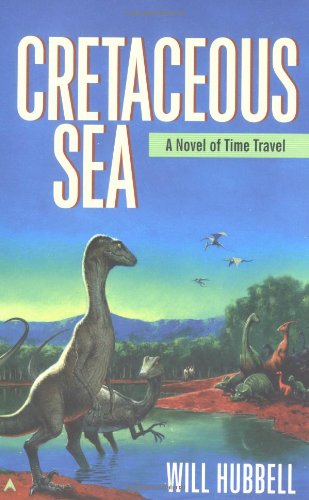
Review: Cretaceous Sea by Will Hubbell 


What would you do if you had access to a time-travel machine? H.G. Wells had his Time Machine traveler go far into the future, returning once to grab a few volumes from his library to help the growth of the society he found there. 


Leo Frankowski scattered generations of a world-wide time-police organization across 2000 years of history to make sure that one man, his Cross-Time Engineer, survived in medieval Poland. 

And L. Sprague de Camp assumed a historian traveling to Imperial Rome would want to prevent that empire's decline, Lest Darkness Fall.

But Peter Green and Ann Smyth, the lucky owners of the time-warp apparatus in Will Hubbell's novel, have a better idea. They'll sell—to multi-millionaires only—the chance to vacation in the "unspoiled, pristine wilderness" of the inland sea that existed in mid-America at the boundary of the Cretaceous and Tertiary periods.

The millionaire backer they've chosen first, Greighton, has good reason to desire an escape from the crowds. His new—young—fianceé has a disturbing propensity for attracting young men and spending his money, and he wants a chance to solidify his relationship with her away from such distractions.

Greighton insists on bringing his spoiled teenage daughter along as well, and Smyth promises him there will be a "staff naturalist" along to keep her out of Daddy's hair. To geologist and fossil collector Rick Clements, it sounds like the perfect graduate-school job. Even though he's not sure he believes the machine can really take them back, he's eager for a chance to collect living specimens of the animals he's only seen immured in rock until now. And Constance Greighton, the "child" he expects to babysit, will not prevent him from making the most of this opportunity.

Perhaps Green and Smyth's skewed view of what to do with such a windfall comes from the source. They are not inventors of this technology. They stole it from the original owner, who (Green surmises) came from a future time when time-travel technology is fairly commonplace. Or maybe it is a result of the disturbing fact that only one time—the Cretaceous (K-T) boundary—and only one place can be reached with their ill-gotten transport. Fortunately for Green and Smyth, they find ready-made living quarters at their proposed resort.

Unfortunately for all of the vacationers, there's more at the destination than a convenient group of summer cottages. It's the usual problem of stolen technology—there's no manual, and an undocumented feature will sometimes crash the system. In their case, the malfunction leaves them stranded on the edge of the Cretaceous Sea, where they will have an excellent view of the meteor that ended the Age of the Dinosaurs.

Hubbell has written a thriller in time-travel guise that mingles just a little geologic and dinosaur fact with lots of adventure. Don't expect it to stretch your brain—this story is time-travel light. It's strictly for fun, and at that, it succeeds very well.


Liner Notes:

  • The sequel to this Cretaceous Sea, Sea of Time, is a much meatier novel. I'm re-reading it now, and will review it when I've finished. 
  • Neither Hubbell novel is available for Kindle, nor is the initial Conrad Stargard story by Frankowski (although many of the later novels in the Cross-Time Engineer series are available in ebook format). Well's Time Machine is free for Kindle, and de Camp's time-travel story is anthologized for that format with several tales by other authors who were influenced by Lest Darkness Fall.

Friday, June 3, 2016

Bloody Erotic

Review: Love In Vein (anthology), edited by Poppy Z. Brite

The collection of erotic tales in Poppy Z. Brite's anthology—subtitled Twenty Original Tales of Vampiric Erotica—is strongly reminiscent of Harlan Ellison's ground-breaking Dangerous Visions anthologies: edgy, uncomfortable to read, but full of images that are hard to forget. 

Brite has collected twenty stories that skirt the perimeter of good taste—and despite the market among adolescents for vampirica, this is not a book for the teenager. Themes range from ghoulish feasting to lesbian revenge, and include references to Wiccan and pagan corn-god blood sacrifices. 

One tale pursues the sad end of Lucy Westenra's blighted love, lighting the shadowy corners of Bram Stoker's story. Another explores the death of Mozart and Van Gogh as the result of haunting by lamia. We have stories of Japanese vampires, of shape-shifters who live on spirit more than blood, of the lost and the arrogant and the brutal and the alien. 

Vampire faces are lovely or haunting or weirdly strange, but always attractive. Of all twenty stories, not one speaks of a repellent blood-drinker. The vampire draws us all, victims seeking to provide sustenance. We may regret that attraction and seek also to destroy that which enslaves us, as does Peter in Mike Baker's Love Me Forever. We may embrace it without reserve, even unto death, as does Satoshi in Nancy Holder's Cafe Endless: Spring Rain or the cowboy Quincey Morris in Norman Partridge's Do Not Hasten to Bid Me Adieu. We may even adopt part or all of the vampire's nature, like Marshall in David B. Silva's Empty Vessels and Alex in Christa Faust's Cherry.

However you relate to vampire stories, though, you will find something in this book that goes beyond simply disturbing, that becomes irrationally upsetting. For me it was Geraldine by Ian McDowell. Perhaps it was the extension of early-term abortion to the spiritual and memory side of the equation; as if the loss of a barely-commenced pregnancy equates to the rejection of both the father and the act of conception.

Perhaps for you, there will be a different story here that crosses the line. Something in the vampire still attracts, despite the smell of the grave that clings to the cape. And something, despite that attraction, repels each of us eventually. You'll find both in this anthology.

It's not for the squeamish. Also, not for the Kindle, alas!

Monday, May 30, 2016

Memorial Day Favorite: A Boy's Memory of WWII in the Pacific

Review: Baby of Bataan by Joseph Quitman Johnson


The WWII memoir of Joseph Quitman Johnson is both unique and commonplace. Joe was 14 years old when he enlisted, 15 when the American troops were fighting the retreat on Bataan. He spent his 16th birthday in a Japanese prisoner-of-war camp on Corregidor, and his 18th birthday on a hellish prison ship en route to Japan. 

As a prisoner in Japan, he was put to work in a mine just outside Hiroshima, then transferred just before Japan's surrender to a second mine—near Nagasaki.

The war was over before Joe turned 21; his age, and his amazing memory (or fabulous evocation) of what happened to him and the other soldiers he encountered make his account memorable. In common with others from this war, he shares the stoic resolve and quiet accomplishment of soldiers who served in every theater of World War II.

The first chapter is a brief picture of Joe as a young boy, giving us a glimpse of why this young man might dare to enlist—before Pearl Harbor—at the tender age of 14. After all, a child of 12 who can hop a freight car to set off in search of his father might certainly become, a scant two years later, that daring teenager.

Joe makes several close friends, Army buddies, first in the Fort MacArthur mustering station in California, and then on board the troop ship that will carry him to Manila. Ray Rico and Dale Snyder come alive for us; we understand why Joe is drawn to these men, and why he is devastated by their deaths at the hands of the Japanese.

Johnson has a wonderful descriptive style that brings us into his adventure. In the telling, his own reactions have certainly been filtered through the memories of the adult, but Joe retains enough of the awkward teen to allow us to sense his bafflement at the suicide of Dewey Holzclaw, or the unearned enmity of Sergeant Dempsey.

The minor characters are also finely drawn. Felicia, the young girl Joe meets at Tang's (a Manila whorehouse), and whom he rescues by paying for her stay at a convent school once he realizes she is pregnant. Frisco Smith, the Manila taxi driver and restauranteur, who helps Joe shepherd the nuns and their charges out of Manila in advance of the Japanese. Big Rotunda, the evocatively-named madam of Tang's house. Pierce Manners, the bugler who "wills" his bugle to Joe when he is rotated home. Red Small, the tattooed man, whose neck reads "Cut on the Dotted Line."

Then there are the Japanese, whom Joe reveals to us in the same deft way. "Cherry Blossom" Watanbe, for whom Joe is a reminder of his own son, saves Joe's life in the first Japanese prison camp by sharing his food with the gaunt young man. Tanaka, a guard at the same camp, teaches Joe some Japanese in exchange for learning the words to "My Blue Heaven." "Babe Ruth," a burly Japanese sailor, chooses Joe and five others from the hold of the prison ship Enouku Maru to stoke the engines.

Joe Johnson earned the nickname "Cockroach" for the way he had of surviving adversity. He spent years in Japanese labor camps, first on Bataan and Corregidor, then in Manila, and finally in Japan itself, working underground in mines that were considered too dangerous for the Japanese miners. He escaped dysentery and malaria, survived starvation, beatings and imprisonment in the torturous eiso, a tiny isolation box that allowed him to neither sit nor stand.

In the end, nothing the U.S. Army nor the Japanese did would suppress his spirits entirely. We like Joe Johnson. He's a good guy.

Excessive indentation and an abundance of widows and orphans delayed my getting into this story—but once I got past the sub-standard typography, Joe's story caught me. Genuine, evocative, tragic and uplifting in turns, Baby of Bataan will provide solid enjoyment for any reader.

Illuminating Unintended Consequences

Review: The Light That Never Was by Lloyd Biggle, Jr.


This novel is a complex story simply told. The artists of planet Donov are all human with one exception (a swamp slug), and they're all hacks nowadays (except the aforementioned slug). Although the classic views are still there, and the incredible light of Donov that once inspired master artists, the scenes are appreciated now only by tourists, and those who paint souvenirs to sell to them. 

But there's a change sweeping the human-settled universe. On world after world, people who had lived in harmony with animaloid sentients suddenly rise up in riots and massacre their non-humanoid neighbors. 

This wave of change sweeps over Donov without effect, for Donov has no sentient animaloids—that is, until Jaward Jorno comes home. Jorno is an incredibly wealthy local who arrives, ready to put his family's large estate to use as a refugee camp for the brilliant mesz, natives of Mestil. And while refugees are not allowed on this world, Jorno learns of a loophole in Donov law that says artists may stay for as long as they like. So 3,000 alien animaloid refugees become artists.

Now that there are animaloids on Donov, will the wave of riots touch this planet as well? Fighting this trend is the World Manager Ian Korak and his lovely grand-daughter Eritha, Korak's First Secretary Neal Wargen (who is secretly the head of the Secret Police, and not so secretly in love with Eritha Korak), and Arnen Brand, who provides a home for the slug and sells its artwork to finance a little refugee work of his own.

Biggle uses the concepts of art well in his work. This novel explores the urge to create, the pain of knowing one's work to be second-rate, the difference between creating art and "putting paint on canvas", and the role of the art critic. 

The artistic topics are background, however, to the detail of this particular painting. One of the characters is a tragically flawed personality, acting in ways that have doomed dozens of worlds. Minor accents illustrate the spiteful sterility of bigotry and the liberating effects of tolerance. But the major theme of this artwork is even more sweeping: 
Is it enough to do Good Works? Or must one actually accomplish good?

There are books that are worth rereading, whose stories remain fresh. Like a great painting, they reward the viewer each time they are approached. Biggle's novel is a Goya, at least. Perhaps even a Hieronymus Bosch.

Wednesday, March 30, 2016

Six New Entries to the Invisible Library

Review: Heroics for Beginners by John Moore


The invisible library is "a collection of books that only appear in other books. Within the library's catalog you will find imaginary books, pseudobiblia, artifictions, fabled tomes, libris phantastica, and all manner of books unwritten, unread, unpublished, and unfound."

John Moore has given us not one, but six new entries with this novel, a romping spoof and a quick read. Robert Taylor's 
The Handbook of Practical Heroics, like his other work, is part of a medieval "...for Dummies" genre. (Other practical handbooks cover fly-fishing, gardening, antique refinishing, and—my favorite—dragon slaying, followed by burn and wound dressing.)

The heroics advice is brief, to-the-point and imminently practical, exactly the kind of invisible library fodder a medieval hero would want to check out!
When a wise old sage tells you not to let a magical talisman fall into the wrong hands, take him seriously. Do not laugh it off until the object is stolen and the Forces of Evil are unleashed. —HANDBOOK OF PRACTICAL HEROICS, Robert Taylor

Kevin Timberline, Prince of Rassendas, has a problem. Actually, he has several problems, including finding an acceptable nickname, so he doesn't wind up like his father, King Eric "Not Eric the Good, But the Other One." But he loves Princess Rebecca of Deserae, whose hand has been promised to Prince Logan, providing he retrieves the Ancient Artifact (model seven, and brand-new) stolen by Lord Voltmeter (He Who Must Be Named). 

Inspired by the handbook given to him by Princess Rebecca's father (who thought it was the fly-fishing guide), Kevin decides on a preemptive crusade to storm Lord Voltmeter's Fortress of Doom, and earn the princess' hand for himself.
...the sunshine fell upon a shelf stacked with circular black objects. Kevin moved in for a closer look, then picked one up. It was a coffee mug, cheap black ceramic with the words FORTRESS OF DOOM painted in large red letters. Underneath was the slogan ENSLAVE THE PLANET. And then he understood where he was... He was in the Fortress of Doom gift shop.

This book succeeds in spoofing a genre with light touches of laughter. There's an Evil Assistant whose costume is a running gag. There's a chain-mail bra that turns out to have been a Pretty Good Idea, even if the fur thong briefs were not. And there's an old seeress whose prophesy on Kevin's heroics is ominous—and too bad that he didn't get some tips on the stock market while he had the chance!

You'll like the way Moore has written a real sword-and-sorcery story within the parody, and how the humor actually makes sense in the context of the tale. It made me want to get another Moore novel, like maybe Slay and Rescue, which is a similar spoof of fairy tales. 

Alas, of all the Moore spoofs, only The Lightning Horse is currently available for Kindle.

Liner Notes:

  • Voltmeter's nickname is the only Harry Potter reference. 
  • The Handbook of Dragon Slaying was described as "co-written with Holly Lisle".
  • Arguably the most famous book in the invisible library is The Necronomicon

Saturday, March 26, 2016

Real Warming vs. Hot Air

Review: Carbon Dreams by Susan Gaines

In the earliest stages of the global climate-change debate, Susan Gaines used the topic to fuel an intriguing tale of how science theory is used (and abused) by policy-makers. Whatever your personal stance on the issue of human-driven climate change, there is sufficient real information on human-driven policy change (let alone data change) to spice the arguments pro and con.


Carbon Dreams is fiction, with just enough real science, culled from Gaines' extensive background in chemistry and oceanography, stirred in to make it believable and exciting. The fictional nature of her story allows us to suspend disbelief and simply enjoy.
[In organic geochemistry]... we use organic molecules the way a geologist might use a rock, or a paleontologist a fossil—as clues to the age of a sediment, what kind of organisms existed, what the ecology was like, the climate... I found a group of lipids that contain the imprint of seawater temperature in their structures. They come from microscopic algae that no one even knew existed until last year.

Dr. Tina Arenas is a organic geochemist working on the leading edge of the science at Brayton Institute of Oceanography, BIO (a loosely-disguised Scripps Oceanographic Institute). What Tina wants is to try her proposed method for determining paleotemperatures from marine sediments on the second cruise of the "big drill" science ship Explorer. She agrees to let her friend Katherine, who is already invited, game her theory to the ship's director, Sylvia Orloff.

Before she can find out if Katherine has been successful, Tina's advisor, Garret Thomas, informs her that her grant application has been refused, and she will need to divert her work into a field that can get funding—perhaps oil exploration. Without this grant, she cannot participate on the exploration cruise even if she is invited. With Thomas' help, they massage her grant application to focus on a possible "petrochemical application" in her original thesis, and succeed in getting funding based on that adjustment. (Although Tina feels that this is slightly underhanded, and takes her research in a direction she hadn't intended to go.)
"I went to a seminar... in the geology department. The geologist presented a model that used the thermal history of a rock to tell if the conditions had been right for petroleum formation...¹ They got into this big argument in the middle of the guy's talk. Apparently there isn't any way of knowing the thermal history of these rocks..."

In the meantime, Tina has a life outside the lab, a very spicy love affair with the landscaper for the BIO grounds. As an agriculturist, Chip has a different take on Tina's "misuse" of the grant process—his is the ecological voice in the novel, and as Tina becomes more involved with him, her views coincide more and more with his.

Almost as fascinating as the human characters are the scientific theories Gaines peppers liberally throughout the story. Tina's advisor theorizes about the origin of life in structured clays, and the erudite debate between them occupies the first part of the tale. Theories about ancient climate changes fuel the current-day science, and the novel does a good job of presenting these theories in context (with their authors disguised) to underpin the search for causes.
Maitland's was provocative, as usual... He'd explained why CO2 wasn't lower during the interglacial, but not why it was higher by fifty percent... Maitland postulated that phytoplankton had played a major role; even though most of the organic matter produced was quickly oxidized back to CO2 by bacteria, this occurred after it sank out of the surface waters, effectively pumping CO2 into the deep sea and out of contact with the atmosphere.²

Gaines has avoided the B-movie cliché of presenting scientists as naive or focused solely on their science. Her scientists are human, with foibles and ambitions like people in any other endeavor. And while some readers may be uncomfortable with the conclusion of the story, it's best to keep in mind that this is fiction. Informed fiction, but still fiction.
But the majority of scientists are saying that global warming is inevitable. Oh, sure, they'd use words like 'probably' and 'maybe,' but a few are starting to concede that we should do something. This Cox is a dissenting opinion. ... Sometimes the dissenting opinions are the important ones.

And sometimes truth is found in fiction.

Liner Notes:

  1. Deriving biofuel (essentially, distilling petroleum fractions) from algae was already theoretically possible when Gaines' novel was being written. Today, there are multiple companies profitably producing fuels of various types, including jet and rocket fuels.
  2. Reading about Maitland's theory in this novel, I was reminded about the vast amounts of methane trapped in marine clathrates that played a major role in John Barnes' Mother of Storms.

Tuesday, September 1, 2015

Awash in Conspiracies Real and Fictional

Review: Secrets of the Widow’s Son by David Shugarts

The philosophical foundations of the American Revolution—and in fact, the high ideals of rationalism, science, separation of church and state, the wonders of nature—were reflections of the foundations of Freemasonry. Hunting for the Fundamental Themes, David Shugarts

Dan Brown’s fictional mystery, The Da Vinci Code (DVC), spawned a storm of controversy, examination, and imitation. The tale of a “symbologist” caught in a complex plot of conspiracy, codes, and religious mystery excited readers who had never encountered the concept of a female apostle, or the disturbing idea that Jesus had children, whose descendants might still be found today.

One of the “decoding” books that came out in the wake of DVC‘s storm was Secrets of the Code, edited by Dan Burstein. Burstein's Secrets examined the real history, cryptography and symbology used by Brown in the novel. Burstein wrote the introduction to this book, Secrets of the Widow’s Son, to introduce David Shugarts, as much as his writing.

You see, Shugarts noticed a code in the cover text of DVC that indicated the theme of the next Dan Brown mystery: a string of letters that formed the question, “Is there no help for the Widow’s Son?” Based on this clue, Shugarts made a prediction for the sequel to DVC. It would, he thought, be based on the “conspiracy” of Freemasonry, perhaps including the Mormon/Mason connection, and probably based in Washington, DC. It would certainly involve one or more of the Founding Fathers.

A few weeks later, when Dan Brown made his announcement that a DVC sequel, The Lost Symbol, would be set in DC and focus on Freemasonry, Shugarts’ guess was confirmed.

Secrets of the Widow’s Son is not a spoiler to the novel—since Dan Brown writes fiction, Shugart can hardly predict plot twists and fictional characters. But he can, and does, explain the history and symbology that permeates the founding of the United States, and make clear the intricate connections of the Founders with Freemasonry.

If you read DVC with a perplexed sense of missing half the story, chances are good the clues were historical, religious, or mythological. What Widow’s Son promises is a legend for the map of history Dan Brown has indicated will be used in the sequel to his blockbuster. But even without the lure of The Lost Symbol, this is an important book. In a time when religious symbols in public places come under increasing fire, it is important to understand how many public buildings in our nation’s capital are adorned (or even structured) with religious symbols.

Shugarts goes beyond a simple listing of names and symbols, to tie in the themes of previous Dan Brown novels with the probable theme of The Lost Symbol. As he does so, we learn how many of the signers of the Declaration of Independence were Freemasons (9 of the 56 were known Masons), Presidents who have been Masons (starting with George Washington), the Mason’s plea that saved Paul Revere’s life on the night of the “Midnight Ride,” and the masonic connection between Benjamin Franklin and Voltaire.

He also examines other “conspiracies,” including the Illuminati (the real and the mythical orders), the Rosicrucians, fraternities like the Dekes and the Skull and Bones, the Boy Scouts… The Boy Scouts!?! Yes, one of the more surprising notions was the deep connection between scouting organizations and Freemasonry.

I admit here that I haven’t read The Da Vinci Code. I read Holy Blood, Holy Grail long ago. But I enjoyed every page of Secrets of the Widow’s Son. Armed with what I’ve learned, I’m ready for Brown’s sequel.

If I ever decide to read it, that is.

Monday, June 29, 2015

This Is Your Brain on Beer

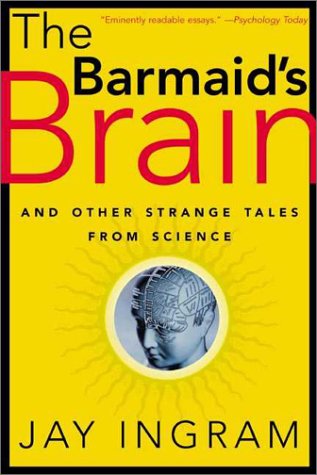
Review: The Barmaid’s Brain, And Other Strange Tales from Science by Jay Ingram


Jay Ingram has collected in The Barmaid’s Brain 21 essays concerning human behavior, curiosities of life, science and history, natural battles and how things work. Each of them approaches a topic with the same left-field perspective. 

For example, the barmaid of the title is able to remember 95% to 100% of a 15-drink order given to her out of sequence in the noisy environment of a busy bar. The essay The Barmaid’s Brain explores not only that we evidence these feats of memory, but why and how.

The Invention of Thievery looks at the way a learned behaviorin this case, birds removing foil caps from milk bottles to get at the cream—can spread through a population. The Vinland Map examines how we decide that a contended datum has been proved, especially when there is a strong belief structure in place to dispute it. An Uneasy Bargain probes the relationship between gene mapping (knowledge gathering) and genetic engineering, and asks the potent question, “Once we know that a mutant gene is the cause of a disease or condition, do we have a responsibility to eliminate it?"

The essays are written in an easy, approachable style, with a minimum of jargon, statistics or abstruse footnotes. If they lack some of the weight they might otherwise bring to some very weighty subjects, at least they may lead you to do the research on the questions you find intriguing. This is a great bathroom or coffee-table book—pick it up, read a few pages, put it down.

Even if one day scientists completely understand the wiring and chemistry of the human brain, it will still be difficult not to be amazed by an organ that can memorize the lyrics to all the Spice Girls’ songs after one hearing or conjure up the equations describing the origin of the universe. Even more amazing is that the same brain can do both…

If you enjoy reading The Barmaid’s Brain, you’ll want the second book in Ingram’s series, The Velocity of Honey. Sadly, neither is available for Kindle.

Friday, June 12, 2015

Deeply Mystical, And Obviously Not Science

Review: Crossroads to Cure by Nicola Henriques


I don’t have any argument with one basic premise of homeopathy. Complementary Medicine, the treatment of a whole system of patient and body rather than treating a symptom in isolation, makes sense to me. But as Nicola Henriques makes clear in Crossroads to Cure, homeopathy goes far beyond this foundation, drifting into areas that cannot be supported by the science.

Henriques is a former journalist from Britain, with other nominally health-related books (Menopause, The Woman’s View and Hysterectomy, The Woman’s View) to her credit. She has been a teaching professor of homeopathy, and a practitioner in California. 

This book is the first of a proposed series of three books aimed at consumers and practitioners of homeopathy. (Two and Three are still not available even 17 years after the first was published.) One would expect her to be a valid source of information about the practice of homeopathy and its underlying philosophy.

When she explains that homeopathy rejects the germ theory of disease, and instead ascribes illness to “miasms,” an individualized reaction to the environment described by homeopathy’s founding guru, Samuel Hahnemann, I begin to cringe. The practice of naming these miasms after recognized diseases (typhus, cancer, syphilis, leprosy) is even more disturbing—a cancer miasm, for example, might be cited, and treated, as the cause of Obsessive-Compulsive Disorder, or even of “ambition,” as much as for a malignant tumor.

It should be noted that not every homeopathic practitioner subscribes to the miasm theory. Henriques does, however. She also re-words Hahnemann’s highly-controversial process of compounding homeopathic remedies—the materia medica—from Succussion and Dilution to “Dynamicization and Attenuation.” Apparently Henriques feels (like many practitioners today) that the central controversy between homeopathic treatment and conventional pharmaceuticals can be dismissed by this sleight-of-word.

Naturally, her text does not discuss the attenuation of homeopathic materia medica beyond the point where any material ingredient might still exist in the materia. The whole concept of “potentisation” relies on something non-material being released to “dynamicize” the materia.

Once I got past this background in Chapter 1, her presentation appeared less deeply mystical. Couched in the most-clinical phraseology, Henriques gives advice to the practitioner on such topics as “The Second Prescription” (the correct response to the patient’s altered condition after the initial remedy), “What to Look for at the Follow-Up,” and “The Golden Rules.” The meat of the book, though is “Crossroads to Cure,” a text flowchart to guide the practitioner to the correct response.

Unfortunately, Henriques had lost me at the beginning. By failing to step away from “preaching to the choir,” she lost an opportunity to present a reasoned argument for the fundamentals of homeopathy. I had hoped for a discussion of the basics. Instead, the assumptions go unchallenged and largely unstated, as the author launches into a guidebook for the converted.

Unless you are already a member of this particular congregation, I cannot recommend the book.

Liner Notes:
  • “DrPat” is just a nickname. I am neither a medical doctor nor associated in any way with the pharmaceutical industry.
  • The linked reference page for Homeopathy in Wikipedia contains disputed information.
  • I am still looking for a reasoned argument for the basic premises of homeopathy. Recommendations are welcome.

Wednesday, June 10, 2015

A Light Chinese Meal

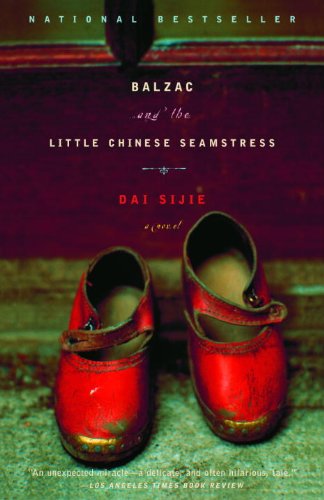
Review: Balzac and the Little Chinese Seamstress by Dai Sijie


The princess of Phoenix mountain wore pale pink canvas shoes, which were both sturdy and supple and through which you could see her flexing her toes as she worked the treadle of her sewing machine. There was nothing ordinary about the cheap, homemade shoes, and yet, in a place where nearly everyone went barefoot, they caught the eye, seeming delicate and sophisticated…

Thus Dai Sijie introduces the pivot of the eternal triangle in Balzac and the Little Chinese Seamstress. Her sewing machine (which the narrator breathlessly informs us, was Made in Shanghai) is equal to her capable feet in their pink shoes in attracting Luo and the narrator, two young men who occupy the other points of the triangle.

References to shoes and feet are everywhere in the book. Luo convinces the little seamstress in their first meeting to remove a shoe, revealing that, like his, her second toe is longer than the first. At one point, the seamstress suddenly changes her footwear from pink canvas to tennis shoes, “white as chalk.” A suitcase which turns out to contain the treasure of banned books is described as “soft, supple, and smooth to the touch… [making] me think at once of a lady’s doeskin shoe.

Luo and his narrator friend have been exiled from the world of books and education which they have just begun to taste. Maoist reeducation sent thousands of high school graduates and university students to live in peasant villages, forbidding them books other than the little red book of Mao’s sayings. As they struggle to adapt to the bleak life of work, they yearn for the freer life of the imagination.

The young intellectuals are not the only Chinese with these yearnings. When the village headmaster discovers Luo’s ability to relate a story, he decides to send the two each month to the cinema, so that they can bring the stories back and perform them for the village. The narrator can play the violin, and even convinces revolutionary inspectors that Mozart was a fine revolutionary thinker, suitable for village ears.

But eventually, in their rivalry for the little seamstress, they woo her with stories gleaned from the pages of Balzac and Dumas. They believe they are seducing the seamstress to accept one of them. The poignant result of this effort is both delightful and unexpected.

At 184 pages, the book is a novella in length, entirely suitable for a long evening by the fire, or to while away time on a plane or train trip. I recommend it to anyone who is horrified at the idea of exile in a desert of no books.

Saturday, May 16, 2015

Reality on Redial

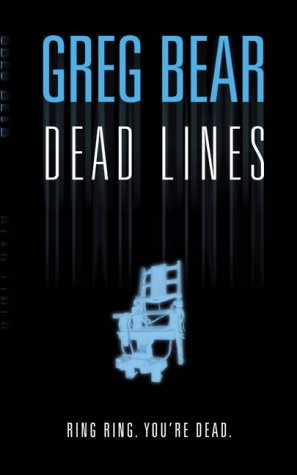
Review: Dead Lines by Greg Bear


For those who would dine on old, dead dreams of glory, Hollywood is always willing to set a place at the table. In his house in the Glendale Hills, Peter Russell has been dining for years on his defunct dream. 

A one-time creator of “nudie films” and Playboy cartoons, he planned novels, plays, short stories that somehow never were completed. Peter’s creative stream was first diverted by the easy sex of his heyday, and then dammed up by the murder of one of his twin daughters.

Now he retains just enough charm to get by. He provides the likable “face” of business for a misanthropic millionaire, and charms the trophy wife of his employer, his remaining daughter, and just about every woman he meets (except his ex-wife). And even though he is not in the movie business anymore, he does still have connections.

Those connections bring him an innovative new cell phone, a hefty commission check, and an exciting chance to get back in the game. He will create a complete marketing campaign for the Trans, an eerily clear communication device that, according to the inventor, taps into a space “below our world, lower than networks used by atoms or subatomic particles, to where it is very quiet.”

What if some of the things you see every day aren’t really there? What if they just look normal? You seldom compare notes with anybody, do you? You don’t bring along a video camera and record every minute of your daily life to see what you might have seen that wasn’t there after all.

Even as he dreams of revived glory, the spirit of Rod Serling is waiting to detour him into nightmare. Peter’s “signpost up ahead” is a phone call to let him know his best friend is dead. After that call, his life becomes more like a Twilight Zone episode with each passing day. His dead daughter, his deceased friend, and a host of other “ghosts”, living and not, begin to haunt his life.

Peter’s efforts to understand these things take him from one memorable extreme to another: he consults a charismatic psychic, takes a funereal road-trip to San Francisco to dump his friend’s ashes in the sea, and visits a famous prison-turned-office bloc where the death chamber is now the server room for a telecommunications startup. Phone calls from Prague and an invisible chess opponent come to seem equally mundane in Peter’s new world, as the tale moves in increments from creepy understanding to real horror, ending in a crashing climax of fire and discovery.

Greg Bear’s Dead Lines is truly spooky, in the way ghost stories seldom are after we enter our cynical middle years. Peter, like most of Bear’s readers, does not believe in psychics, ghosts or paranormal powers. He may not be happy, but at least he is content with his life and himself. The power of Bear’s story is that we understand how Peter loses both that easy contentment and his disbelief.

We travel with him on his downhill path to the queasy realization that Hamlet was right. There are more things in heaven and earth than are dreamt of in our philosophies. And if we’re lucky, none of them have our cell phone numbers.

Thursday, April 16, 2015

The Hole Truth

Review: A Field Guide to Desert Holes by Pinau Merlin


We often walk through the world blind and ignorant, oblivious to the burgeoning life all around us—unless, of course, we take our walks with a Field Guide. A second-edition hardbound copy of Peterson's A Field Guide to Western Birds resides next to my bay window, because I want to know what that dickey-bird out there is named. My spouse says, “If it’s blue in a tree, it’s a Stellars Jay, if it’s brown on the ground, it’s a towhee.” 

But I want the expert's nod to reassure me, yes, that’s a towhee.


I’ve purchased more than my share of “roadside geology” books, too. These guides combine geology and history for a locale, telling the casual tourist, "The streak of pale yellow you see on the hillside is quartz, which was mined by the Spanish as they came through the area." Of course, the tourist is looking in the wrong direction, so he confidently informs his family that the large yellow letters painted on the rocks to celebrate a local high-school graduation are “made of Spanish quartz.” (This actually happened onceI was able to gently redirect their attention to the correct hillside, telling them, "If they are, it was mined from over there.")

Now those field guides, useful as they are, can just move over on the shelf to make room for a new king. Pinau Merlin's Desert Holes guide shows you how to spot the living quarters, larders and shady retreats of desert animals. Let’s face it—in the daytime, when most of us go for a walk in the desert, these holes are the only evidence of the abundant desert life.

Like many field guides, this book uses description as the primary mode to convey the shape, size and usual location for these holes. I would have loved to see a set of color plates to illustrate holes, such as I have in my Petersen’s Guide to Rocks and Minerals. Too often, I simply couldn’t visualize the hole shape Merlin was describing. (There are some lovely ink sketches, but far too few.)

The most impressive thing about the guide is the sheer number of holes Merlin describes. Even if you read it, as I did, in the air-conditioned comfort of an urban food court, you will get the sense of life that would be hidden all around you as you stroll through a daytime desert. I even got excited to retroactively identify (from a sketch) the burrow of a spider seen in Death Valley more than two years ago.

Desert walkers and armchair wanderers alike will find items of interest in this guide. In paperback at 132 pages, it’s not too heavy to bring along.