Thursday, September 28, 2017

Great Book, Appalling Movie

Original DVD Cover Image, 1998

Review: Starship Troopers with Casper van Diem, Michael  Ironside vs. Starship Troopers by Robert A. Heinlein


Challenged to name a movie that fell disappointingly short of its source, my first reaction is Starship Troopers, out in a 20th anniversary edition this month.

Two decades ago, I was tremendously excited when I learned they would make this book into a movie, even as I doubted they would capture its flavor in full. The problem is internal dialogue. Truly interesting books take us into the inner life of their main characters; in revealing those meditations and self-recriminations, they expose their souls. 

Without that insight, fictional characters are as intellectually interesting as rock-em-sock-em robots.

Typically, movies substitute external dialogue and narrative for these inner debates. An example of this done well can be seen in the 1984 version of Dune. Without the narrative voiced by Gurney Halleck (Patrick Stewart) and Princess Irulan (Virginia Madsen) in that film, its story would be impenetrable. With it, and by dint of voicing much of the book’s mental dialogue, it succeeds as an adaptation.

So I knew it would not be impossible to capture the philosophy- and social-commentary-laden substance of Heinlein’s novel. Then I saw it in the theatrical release, and was sorely disappointed. This is simply not Heinlein’s story.

Oh, the bugs are there. The sneak attack by this alien hive-dwelling race that wipes out Johnny Rico’s home city is in the movie. The Mobile Infantry are there, with their armored suits complete with heads-up displays, pocket nukes and jump jets. What didn’t survive the cut? Only the reason why Johnny joins the service in the first place.

Heinlein’s novel hinges on two social differences in the world of Starship Troopers. First, only veterans—those who have chosen to place their lives “between their loved home and the war’s desolation”—have the right to vote. Civilians do not have that right, and neither do serving troopers. Heinlein justifies this very succinctly:
Suddenly he pointed his stump at me. “You. What is the moral difference, if any, between the soldier and the civilian?” ”The difference,” I answered carefully, ” lies in the field of civic virtue. A soldier accepts personal responsibility for the safety of the body politic of which he is a member, defending it, if need be, with his life. The civilian does not.”

Second, it is anyone’s choice to enlist at any time after their 18th birthday. The services will find something for the enlistee to do, to allow them to earn the franchise. But if they then go AWOL, resign, or are drummed out for any reason, they never have the opportunity to try again. Politicians from dogcatcher to President must, under this system, be veterans, and there are no “reserves”.

The movie barely mentions either of these two critical concepts. Worse, the main source informing Rico’s choices, his high school “History and Moral Philosophy” teacher, Col. DuBois (who pointed his stump at Johnny in the quote from the novel), is barely there in the first scenes, and not mentioned again. These ideas are presented in hit-and-miss fashion, as if they are part of the recruit training after enlistment, instead of why recruits choose to enlist in the first place.

Moving the important motivation to enlist into the recruit training has another consequence—we do not get a real sense of the conflict between Rico and his father. As a result, his reaction when his home city is attacked is shallow. He’s now an orphan, okay, move on. This robs the viewer of one of the most poignant scenes Heinlein has written, when as an officer, Rico is relying on his master sergeant.

Lieutenant Rasczak (Michael Ironside) is given most of the lines that Col. DuBois has in the novel. So we get a tepid, PC-diluted “Violence has resolved more conflicts than anything else. The contrary opinion that violence doesn’t solve anything is merely wishful thinking at its worst,” instead of
Anyone who clings to the historically untrue—and thoroughly immoral—doctrine that “violence never settles anything” I would advise to conjure the ghosts of Napoleon Bonaparte and the Duke of Wellington and let them debate it. The ghost of Hitler could referee, and the jury might well be the Dodo, the Great Auk and the Passenger Pigeon. Violence, naked force, has settled more issues in history than has any other factor, and the contrary opinion is wishful thinking at its worst. Breeds that forget this basic truth have always paid for it with their lives and freedom.

If this was the only shortcut, I would not complain. It is not. Sergeant Zim is another crucial character whose best lines from the book are given to Lt. Rasczak, or simply omitted. Rico’s relationship with training sergeant Zim is formative for him. Again, the movie simply ignores this part of the story.

In addition, the movie completely omits Juan Rico’s choice to go to officer training, and how this perspective changes his assessment of his life and responsibilities. I can see leaving this out to save time (and provide grist for a sequel). I suspect, however, that the movie’s creators were simply in a hurry to confront Rico with the alien bugs.

The other changes are minor, and do not, in my opinion, ruin the story. In Heinlein’s novel, women do not serve in the Mobile Infantry; Heinlein was a product of his time and served as a Naval officer in the 40s. He does give women a unique role that men cannot, for the most part, perform as well. In addition, Johnny’s best friend Carl does not end up as a commanding colonel in the novel—to describe where he does would be a spoiler. But these are minor changes, and I can roll with them. 

What I miss are the thoughts about why defensive war is necessary, and how best to conduct a war once one is begun. Once again, the words are those of Col. DuBois:
If you wanted to teach a baby a lesson, would you cut its head off?… Of course not. You’d paddle it. There can be circumstances when it would be just as foolish to hit an enemy city with an H-bomb as it would be to spank a baby with an axe. War is not violence and killing, pure and simple; war is controlled violence, for a purpose. The purpose of war is to support your government’s decisions by force.

Dune has been remade, and the second version has qualities that the first did not. I cling to the hope that Starship Troopers will be remade by someone with the vision to see past the great special effects opportunity to create a movie worthy of the power of Robert Heinlein’s novel.

In the meantime, skip the movie. Read the book.

Wednesday, September 27, 2017

Strength of Warped Materials

Review: Stress Analysis of a Strapless Evening Gown, Compilation edited by Robert A. Baker


Anyone who’s had to revise ISO9000 documents, review a prosy thesis paper, or wade through jargon in an industry magazine, will welcome this compilation with heart-felt relief. These selections from the notorious 50s underground publication The Worm-Runner’s Digest are guaranteed to make you smile.

Consider, for example, “Postal System Input Buffer Device” by Joe and Gil Robertson Obsborne. A simple action, putting an envelope into a mailbox, right? Not in formal instructionese, which must specify that to operate such an input device requires:
a) a passenger in normal working condition mounted upright on the front seat or (b) a driver having at least one arm on the right-hand side which is six feet long and double-jointed at the wrist and elbow.

Then there’s F.E. Warburton’s “Terns,” which reliably informs us that because terns have webbed feet, they will be found in the same books as albatrosses and other waterfowl; further that terns won’t eat anything but fish, so “it is no use putting out bits of suet and coconut for them in the winter”. Besides,
Baby terns just a few days old are the cutest, fluffiest little things. They will sit on your hand just as friendly as anything, going “chirp, chirp” and looking at you with their big bright eyes and vomiting half-digested fish all over your shirt.

Two versions of the 23rd Psalm are included. The first, by Alan Simpson and R.A. Baker, commences: “The Lord is my external-internal integrative mechanism, I shall not be deprived of gratification for my viscerogenic hungers or my need dispositions…”. The second, from science fiction writer Lester del Rey starts: “The AEC is my shepherd, I shall not live. It maketh me to lie down in radiant pastures…”.

Hugh Sinclair contributed the brilliant “Hiawatha’s Lipid,” which simply has to be read entire. Sinclair spoofs the classic poem in an effort for which he concedes he “sought inspiration in innumerable manhattans—taken, of course, because they were good for me since the day’s immobility of listening to papers on atheroma and serum cholesterol had no doubt silted up my vessels, and alcohol is one of the few effective solvents.”
From his briefcase Hiawatha / Took his paper for the meeting… / Started on the introduction, / Giving first a brief description / Of the Proto-Keynesian period / When all fats in equal measure / Raised cholesterol in serum…

Berkeley engineer Charles Siem’s paper supplies the book’s title. “A Stress Analysis of a Strapless Evening Gown.” This piece includes a wonderfully evocative figure, Force Distribution of Cantilever Beam, complete with rotational and compressional component—in which the beam’s profile is distinctly mammalian. The critical element of the force diagram is identified, with the caveat:
If the female is naturally blessed with sufficient pectoral development, she can supply this very vital force and maintain the elemental strip at equilibrium. If she is not, the engineer has to supply this force by artificial methods.

Sometimes the bibliography is more interesting than the paper, as R. Arnold Le Win points out in “Logarithmic and Arythmic Expression of a Physiological Function.” In fact, the only thing in this item is the list of references, which include:
7. Shadrach, C., Meshach, H., and Abednego, H. and C.. An anaerobic heat resistant monoflagellate ornithine producing sulfur non-purple bacterium isolated from the rectum of a goat. J.Bact., 70: 1-11,1944.
10. Aschitz, K., and Spitz, G. Urea excretion, growth hormone production, and caudal temperature of the 6-week-old hypophysectomized, adrenalextomized, tonsillectomized castrated albino hamster. Proc.Soc.Exp.Biol.& Med.. 50: 2-4, 1956.
13. Strickstaw, A. The fats of cats. 27.Glycero-1, 4-alpha-feritol, a new liquid component of the milk of the lion. Felis leo. Biochem.J. 73: 108-113, 1946.


I can only excerpt a few high points here. To read the rest will take some digging, since Stress Analysis is, sadly, out of print. A slightly more recent compilation from The Worm-Runner’s Digest titled Science, Sex and Sacred Cows (which I reviewed in Spoofing Science Before the Ig Nobel Prize) is more available, as is The Worm Re-Turns. None are available on Kindle. Yet.

Tough-Guy Tango with Tolerance

Review: Flawless with Robert DeNiro and Philip Seymour Hoffman


I’ve learned over the years that any Robert DeNiro movie role will have much in common with other characters he’s portrayed in his distinguished career—not to say he is limited, but in every role, we see the real DeNiro shining through from beneath. He shares that quality with other icons. Think John Wayne or Al Pacino.

So the first time I watched it, I was a bit tentative about the story in Flawless, a 1999 film in which he starred opposite the late Philip Seymour Hoffman. I hadn't seen it for a while, but when I caught the film in a cable rerun last night, I was struck again by that ineffable quality.

DeNiro plays Walt Koontz, a tough-guy retired fireman who works as a security guard and lives in a seedy walk-up apartment across the airshaft from a room that always seems filled with flamingly-gay drag-queens. The film quickly establishes Koontz as physically-oriented (he dances Argentine Tango with a woman he regards as a girlfriend, but pays as a hooker), and more than slightly homophobic.

Thus far, classic DeNiro. Then, in responding to a shooting in the apartment building, Koontz suffers a stroke that paralyzes his right side. This strong, self-sufficient man is reduced in an instant to a dependent cripple. He can’t work, he can’t dance. His speech is slurred to the point of incomprehensibility. He can’t bear to have his friends learn of his disability. Recommended to get singing lessons as an aid to speech therapy, he reluctantly decides to take up an offer for lessons from the gay singer who lives opposite him. DeNiro’s portrayal of the loneliness of stroke-victim Koontz, and his struggle to return to his former ability, is flawless.

And for once, the DeNiro beneath the role is harder to discern. He’s still there, but Koontz is more apparent than DeNiro.

Hoffman, a standout in a secondary role in 1992’s Scent of a Woman, had already had experience holding his own opposite a screen icon—Al Pacino, who starred in that film. (Interestingly, Pacino also danced Argentine Tango on screen in that film.) Hoffman’s performance as Rusty Kimmerman, a pre-surgery transsexual who leads DeNiro’s crippled cop to understand that attitude and character are more important than superficial perfection, is nuanced, understated—
flawless.

The two work together, not only to help Koontz recover some of his pre-stroke grace, but also to discover the murderers who shot up the apartment house the night of Koontz’ stroke. Touches of buffoonery and sexual innuendo offset the violence of those killings to provide a flawless balance.

Each time I watch this movie, I see more of value in its story, and in DeNiro’s performance. It’s definitely worth adding Flawless to your movie library.


Liner Notes:

Philip Seymour Hoffman played an another, far more subtle gay character in The Talented Mr. Ripley. Hoffman blackmailer Freddie Miles was a match in petty villainy to the whining schoolboy he played in Scent of a Woman, but each role was clearly a different persona. Contrast that with the gentle, and completely hetero, writer Joseph Turner White in 2000's State and Main, or the all-but-closeted gay writer of Capote.

Monday, September 25, 2017

Fun from the Vaults

Review: Joe Bob Goes to the Drive-In and Joe Bob Goes Back to the Drive-In by Joe Bob Briggs


Bad satirists are left alone; it only hurts when it’s good.
—Stephen King, reviewing Brigg’s movie commentary.

Before you can write a review, you need some standards by which to judge your target. For Joe Bob Briggs, who admitted in 1990 to having watched “more than 23,000 drive-in movies,” the standards are: Blood, Breasts and Beasts. Using these criteria, he has rated movies for The Movie Channel, the Dallas Observer, syndicated radio and newspaper columns, and in his own one-man touring show. 

He has put his eyes and soul on the line for us guys, telling us the Ten Best Flicks to Get Nookie By, and why Arnold Schwarzenegger is the No. 1 Drive-In Actor in the World.

Briggs, whose real name is John Bloom, is not afraid to rate films highly—even when “the entire Motion Picture Industry and Critics Galore” are in opposition. Consider the 1985 remake of Bride of Frankenstein, The Bride with Sting as the eponymous Doctor, and Jennifer Beals as his creation. Briggs’ bottom line for this film:
Excellent monster fu. Four breasts, but I’m gonna count em as eight, cause they’re these humongous fat-lady circus breasts that are the biggest breasts in the history of breasts. One gallon blood. Two beasts. One head rolls. Midget trapeze. Gratuitous Geraldine Page. Monster hangover. Crypt. Boneyard. Haunted mansion. Stake through heart. Four dead bodies… Four stars.

Some amateur critics agree with Joe Bob, by the way. Amazon's ratings of the movie give it a solid 4.5 our of 5, although that may be because it came out before Sting got political.

You have to understand, though, that Briggs is not just a movie critic. No, Joe Bob believes in things. Things like First Amendment rights, and anti-Communist activism. He even paid—″two bucks… it was the principle of the thing”—to verify that his First Amendment rights had been violated.

Bubba looked up the Second Amendment, and:
...it said I have the 'right to bare arms.' A lot of people don’t understand the US Constitution, and so they read that and they say, “All that means is you can wear muscle shirts to a Neal Diamond concert.” These are what is known in America as stupid people… Course, you know what happens ever time a drive-in movie critic gets assassinated. Somebody starts screaming for gun control.

And lest you dismiss this as the egotist’s version of political rectitude, in which only Joe Bob’s rights are of concern to him, there are the multitude of Communist Alert! items in the book. An eerie echo of today’s politically-correct, terrorist-fear-driven climate is found in the costume-party faux paux of Texan Russell Scott, who showed up dressed in a turban, with unlit road flares strapped to his chest—and this was years before 9/11.

The Travis County Sheriff’s department 
… arrested him while he was buttering a potato for impersonating an Arab Terrorist, ripped the road flares off his chest, cuffed him, threatened to arrest two other people who intervened, took him to jail, charged him with “possession of a hoax bomb,” left him in a cell with a guy charged with pushing heroin… We’re talking [Idjits] with Badges.

No, Joe Bob Briggs continues to do us all a cardinal service by pointing out the hypocrisy and cynicism rampant in movies. And by telling us which of those movies have great views of breasts.

Liner Note:

The (1985) winners in the three Joe Bob categories were…
  • Blood: Four hundred thirty-five gallons (in George Romero’s Day of the Dead)
  • Breasts: 16 (in Hellhole)but two of them may have been Mary Woronovski's (Aside mine)
  • Beasts: Forty-five, “auditioning for Empty-V” (in Mad Max, Beyond Thunderdome)

Friday, September 22, 2017

An Institution More Peculiar than We Knew

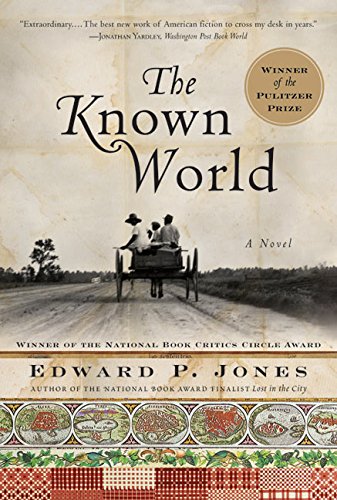
Review: The Known World by Edward P. Jones


Edward P. Jones’ Pulitzer Prize-winning novel The Known World is powerful not because it tells the story of a black man, a former slave, who is himself a slave owner. Its power comes from the way it makes us see how the “peculiar institution1” warps human emotion, and restricts the possible self-definitions available to owner and slave alike.

In that sense, the “known world” of the title is this circumscribed sense of what is possible to a man. Ex-slave Henry Townsend defines himself based on his observation of and relationship with ante-bellum slave owner William Robbins.

Robbins has a black wife, and also a black mistress who was once a slave. Townsend sees his power, and desires that entire world for himself. For his part, Robbins genuinely seems to like this freed man, and acts as his mentor in many ways, drawing Townsend inextricably into the bonds that slavery places on the slave owner.

When Townsend dies, another slave, Moses, schemes to step into his shoes by seducing his widow Caldonia. Unfortunately, Moses is already married, so he convinces his wife to run away, then follows her and his son into the woods and kills them. In a telling sequence, Caldonia’s white advisor Counsel Skiffington "…considered Caldonia. He had heard of that white woman in Bristol who had slept with her slave. Bad business. But what the coloreds like Caldonia and Moses did among themselves was no crime in itself. Killing a slave for no reason was always a crime before man, before God." [Emphasis mine.]

Even the minor characters are complex, and each serves his purpose to define this twisted world, from the slave-takers Darcy and Stennis who kidnap Henry Townsend’s father Augustus back into slavery to the Cajun Broussard whose foreign accent is the direct cause of his conviction and execution for murder.

In addition to the complex story, Jones’ writing is lucid and evocative. Two examples:
…After the Richmond evening when Robbins hit her, Philomena Cartwright would not see the city again for many, many years. Her jaw did not heal properly and she could never eat hard food on that side of her mouth. The one time she threatened to flee and return to Richmond, Robbins told her he would sell her back into slavery. “You can’t,” she said. “You can’t, William. I got my free papers.” He told her that in a world where people believed in a God they could not see and pretended the wind was his voice, paper meant nothing, that it had only the power that he, Robbins, would give it…”
And:
…[Counsel Skiffington] thought of the men in the large family Bible in the destroyed library who talked the way he was talking now. Sometimes God heard and acted, took pity on his creations, and sometimes he heard and ignored the creations talking to him. His daughters had liked the stories in the Bible, the Bible with their names and the days of their births written large and in ink the general store man had said would last for generations. “First,” the man said,”the ink will note your children’s birthdays, and then it will note their marriage days. The ink will outlast you, Mr. Skiffington.” Counsel went on talking to God, and the buzzards came down and joined the flies, all of them feasting on the horse and ignoring the man who still had some life in him.

The Known World is engrossing, enlightening and altogether enjoyable.

Liner Notes:

  1. The phrase "peculiar institution" is used extensively as a euphemism for slavery, notably in the speeches and writings of John C. Calhoun: Nullification, Secession, and John Caldwell Calhoun: The Philosophy and Thought Which Led a State and John C. Calhoun: Speech on the Reception of Abolition Petitions. In neither quote of John C. Calhoun’s words is the phrase set in quotations, but he does seem to expect that "peculiar institution" and "peculiar domestic institution" will be understood to mean slavery, so he may have been quoting someone before him. Maybe it’s as simple as a popular politician, John C. Calhoun, using the phrase “this peculiar institution” with its general meaning applied to the specific “peculiar institution”, and the specific meaning subsequently infecting the general as a meme that found fertile ground.
  2. The Pulitzer Prize organization’s website quotes the book’s cover text. 
  3. Jane Chord: Evening yet.

Wednesday, September 13, 2017

Breathtaking, Brutal—and Brilliant

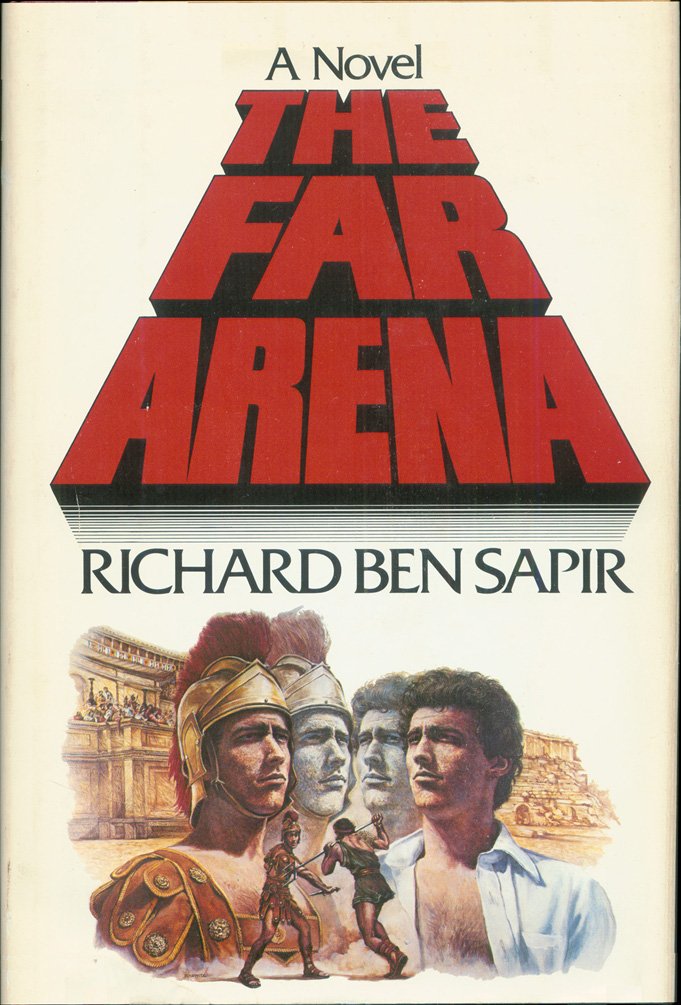
Discussion: The Far Arena by Richard Ben Sapir


There are books I've read so often, I can no longer really review them. The Far Arena has been on my every-few-years list for over 30 years. Something about the Cold War revival of a frozen Roman gladiator by an American oilman, a Soviet physician, and a Norwegian nun just draws me back, time and again.

I first encountered the novel in a friend's collection in 1985 or '86. Rarely had I been so tempted to a five-finger discount! I borrowed it again every few months for a while until I had memorized several passages—when he moved away, I knew I had to find my own copy. 

I almost walked past it in a second-hand bookstore, because the cover was so different. Another publisher, plus an artist (or marketing department) that did not read past the opening chapters, lead to cover art that focused on "John Carter" buried deep in the ice.

What caught my eye, in fact, was a cover-quote from Howard Fast, author of Spartacus. "Breathtaking," it said, "you must read it." I had just re-read Spartacus, and the name grabbed my attention. Voila! I had my fix.
Even if Publius had my speed and strength and my perfect weapons and I but a club, still I would emerge alive. I had walked on arena sand, and Publius had not. ("Eugeni", Lucius Aurelius Eugenianus)

Over several moves, I lost and replaced the novel several times, most recently to add it to my Kindle. Each time, I dove into the story, rapt in a tale that addressed much more than the real life and culture of Rome, as seen through the eyes of a half-Greek slave rising to arena stardom in Rome. 

Each of the other three, modern protagonists has a similar journey to make, from their first innocent encounter with the gladiator, to their struggle to understand what they really want from him, to a final arena, with a battle that will cost each of them something very precious. 

Of the three, I most identify with Lew McCardle, the Texas petroleum geologist, promoted to Vice-President on the strength of his discovery in the ice. Again and again, his musings reveal a kindred spirit trapped by the Peter Principle in a conflict even his decades-past experience on the gridiron has not prepared him to face.

First, the naïve, focused engineer:
[H]e knew that good engineering did not have right angles in pipes.
Then the isolated husband wondering why he had chosen his wife, instead of a hookup girlfriend from his distant past:
She had everything to recommend her but a heart. And yet that is the last thing a young man looks at.
And the chip he carries on his shoulder, which may bring him down under its weight:
Oil men did not particularly like people who read books, nor did they trust them. Somehow Lew’s size, and his origins in a backwater Texas town, compensated for his reading.

The Cold War had yet to begin its thaw, with Soviets in Afghanistan, Reagan and Thatcher—and Gorbachev—still on or below the horizon, when Sapir was writing this novel. Many of Eugeni's reactions to modern life, his observations about the East/West conflict, rang solidly true to the readers who would soon sweep those politicians into office:
Why is it people think the authorities are some form of gods with either great justice or great, cunning evil, rather than the same plodding fools they see in their daily lives, and most of all in their mirrors?
And:
The purpose of an authority is to remain an authority, not dispense justice.

Re-reading it today, I find equally-cogent statements about the resurgence of Socialism and Communism, as well as identity politics:
You call people ‘masses’ when you treat them as a lump, as a hundred slaves more or less, as an army if you will. Nobody ever knew a mass or loved a mass or even paid the respect of hating a mass.
Because, Eugeni muses near the end of his story: 
...a man was a man because he thought, and all the cheers and all the illustrious parentage could not add one whit to any of his meaning.

It is not what one is, but what one thinks, that matters in the meaning of life. If one thinks.

Friday, September 8, 2017

Women on His Mind

Review: Lois McMaster Bujold's Penric & Desdemona Novels


Early in the novel Penric's Demon, a gormless young man pauses on the way to his arranged wedding to help an old woman at the side of the road. Unfortunately, she is inhabited by a demon, which jumps to young Penric when she dies, bringing along the memories and personalities of everyone possessed previously... all women.

As if being possessed by a demon weren't bad enough, Penric must now contend with the curious attention of a dozen women—many of them elderly—watching and criticizing his every move.

It's not all bad news, though. Penric acquires the powers of his ancient demon, whom he names Desdemona, along with the inescapable company of the clique of dames residing between his ears. And if their advice ruins his morning self-embrace, it saves him embarrasment far more often, and provides short-cuts to the scholarship he needs in order to be a competant sorcerer.

This book borrowed from world-building Bujold had already done for the Chalion fantasy series, although it is set in a different time in that world. The second two books of the Chalion trilogy are echoed in Book Two of this series, Penric and the Shaman. "Shaman" is the animal-bolstered equivalent of the sorcerer, so Inglis is, to some extent, Penric's peer. I was intrigued to see a different fantasy construct, the were-wolf, incorporated into the "paladin of souls" concept in Penric's world.

You can read these novels in any order you like, but I find they work best read in numeric order, 1-5. Further paragraphs may contain spoilers, so if you haven't read any of them yet, please stop here!

Book 4, Penric's Mission, came out before Book 3, Penric's Fox, was available for Kindle, so I orginally read them out of order. The third novel's story rises naturally out of the second, though, since it concerns a demon who has jumped, not to a human, but to the nearest creature available, a fox. It is also the closest to a murder mystery I have read from Bujold's pen. Desdemona really comes into her powers here, lending all her various riders' knowledge to the task of rescuing the lost demon.

Mission, on the other hand, is about Penric rising to the use of his powers, coordinating everything he has learned with the sorcerer's abilities to rescue General Arisaydia and his sister from an oppressive government. There is almost an engineering quality to his use of Desdemona's powers. (This is nothing more than I would expect from Bujold; my first encounter with her work was Falling Free.)

Book 5 is the first that doesn't feature Penric in the title. Mira's Last Dance has one of his embedded personalities, a courtesan with a predatorial way of controlling men, take center stage in the effort to enroll General Arisaydia in Penric's sponsor's cause (the escape that began in Mission). 

Not only does Penric's mission continue in Book 5, but his developing relationship with the sister does also. The convoluted way in which his female inhabitants inhibit this blossoming romance is a delight to read, conflict being the principal driver of good fiction! Throughout the series, in fact, I was reminded of the conflicts between Johann Smith, Eunice Branca and Jake Saloman (all residing in Eunice's head) in Heinlein's I Will Fear No Evil.  


Liner Note:

Amazon lists these books as novellas. At around 100 pages, four of them are definitely short enough to class as novellas, but Penric's Mission is 224 pages. Further, all five read as novels, with lots of action (mental and physical) to reward the reader.