Reading Kindle Scout novels from brilliant new authors can be a mixed blessing. Yes, these are books I got for free by nominating them (if selected), or for a tiny price (if not), and the writers are very good, so I definitely got a great deal. But still... Reading a successfully written, published novel wakes the monster in my head, the one with green eyes and green warts. I cannot help being jealous of the writer who has reached this goal that I still struggle toward. This monster has teeth, too. They eat at my confidence, make comparisons with other author's work as I read, always to my detriment. I try over and again to slay the jealous monster, but somehow it survives each attack. I don't want this poisonous comparison to spoil my reading, nor to defeat my determination to write. But more and more, I have scars from the green monster's bites. Perhaps I can use Charli Mill's Carrot Ranch Flash Fiction Challenge prompt this week to pull the monster's teeth: March 9, 2016 prompt: In 99 words (no more, no less) write a monster story. You can pick any perspective, even that of the monster. It can be literal or symbolic; it can be heroic or realistic. Think about the shifting roles of what is a monster and who is a monster-slayer. Consider how easily we give the label to others or to fears we can’t name. My monster deserves no consideration. It must die! _________________________________________
Green Monster
The monster has teeth that tear at me in the dark. "You're obviously missing something the successful writer needs, or you'd have a dozen books on Amazon now, instead of three partly-finished novels and a co-written memoir, half outline and half disorganized notes in a file-cabinet drawer." Plugging my ears doesn't help. I close my Kindle, and it hisses again. "That last book was a good one, wasn't it? We especially liked that last phrase you highlighted. Genius, really. Not at all like your stuff." Only one way to slay this monster: finish the fiction, polish the memoir, PUBLISH!
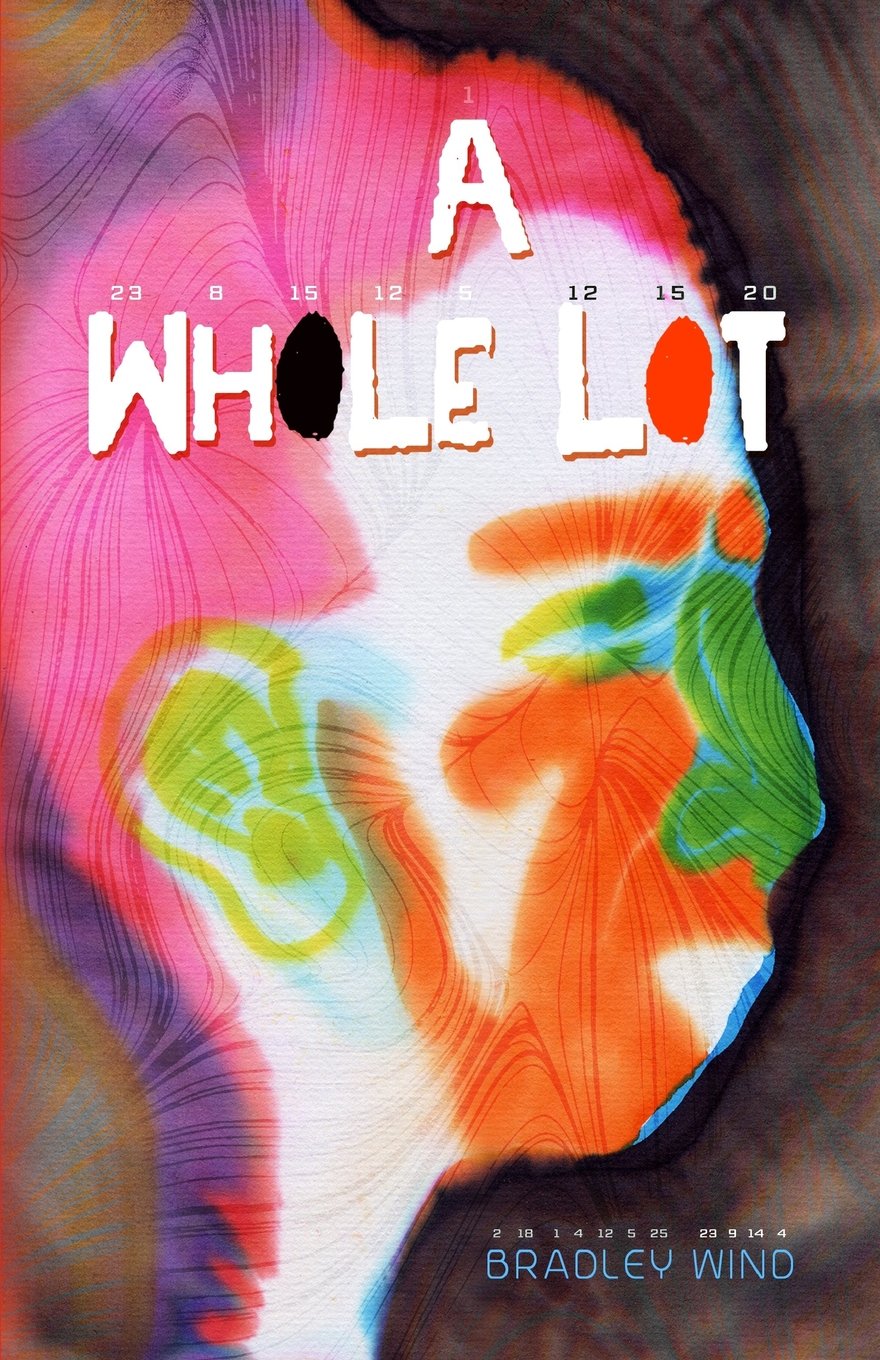
Once in a while, a book introduces us to an entirely alien point of view. In A Whole Lot, we meet the savant Abel Velasco, an early-teen boy with an incredible memory, and the ability to see patterns and solve advanced mathematical puzzles. Unless you yourself are an Aspergers-afflicted savant, Abel's concept of the world he lives in is weirdly distorted. (But if you did have Asperger's Syndrome, you would not be likely to be reading fiction, anyway.) There are echoes here of other fictional savants: Abel's interaction with his high-school AP math teacher has an eerie similarity to Matt Damon's easy solution of the hall blackboard problem in Good Will Hunting. His strained relationship with his aunt and older sister and the open ease of his friendship with the black garage owner have a distinct flavor of the real and illusionary characters who lived with (and in) John Nash in A Beautiful Mind. And Abel's obsessive numbering of letters and inability to cross a lawn unless he can step in dog piles is reminiscent of Christopher Boone, the autistic boy-detective in Mark Haddon’s novel The Curious Incident of the Dog in the Night-Time. In addition to the fascinating glimpses into the extremes of high-functioning autism, the story presents an intriguing mystery with a twist: will the numbered Hebrew Bible Abel finds in the local "haunted house" provide a clue to the deaths of its occupants? In his quest to solve the puzzle, Abel must step away from his familiar routines and places, stretch his mind, and open his world in amazing new ways. Bradley Wind researched the topic of autism at various functional levels, and chose an atypical case to write about:
Dr. Darold A. Treffert, author of "Extraordinary People," consultant for the movie "Rain Man" and expert on savant syndrome wrote to me: "Savant syndrome typically is present from birth as a part of some developmental disorder, including autism. But there are also cases of what I call "acquired savant" syndrome following head injury. The Acquired Savant raises interesting questions about the little Rain Man that might reside, perhaps, within us all."—Notes from the Author, online, emphasis mine
Liner Notes:
Each chapter begins with a "numbered conversation" that provides a running puzzle through the book, separate from the mystery Abel is trying to solve. I have to admit, the chapter puzzle has defeated me so far. Obviously, my own "little Rain Man" lies too deep inside me to assist me with its solution. (Wind has requested, if you do solve it, not to share the solution online. I might be simply complying with his request. But I'm not; I really haven't been able to read the message.)
This is a book I got free from Kindle Scout. This is like a crowd-funding site where "pledges" are paid for by your nomination of up to three books at a time. If your nomination is selected for publication, you get a free copy.
We had stars in our eyes in those days. Mercury had flown; we knew man could reach space. The Telstars could be seen on clear nights; like rocket boys for Sputnik in the 50s, we watched for them and dreamed of space. In middle school, I had just encountered real astronomy, and I had been introduced to science fiction by the Tom Corbett novels by "Carey Rockwell" in the town library. Our library had all eight books, but I had finished them, and was wandering along the same wall of bookshelves. I turned the corner and... Sighted Telstar! A series of paper-bound manuals detailing the launch procedures and equipment for the Mercury capsules lined a lower shelf in a protected nook. To this day, I have no idea how these beauties wound up in my small-town library. I was thrilled beyond belief.
They were marked as reference books. Under an ancient India-ink hand-printed label, "Bell Labs Library," they were stamped "Not To Be Removed From Library." No problem: I sat right down on the floor in easy reach of the pale blue line, and began reading. I can still remember my struggles. I was accustomed to reading easily, but I had not been challenged before. This was my first encounter with engineering bureaucrat-ese. NASA had already developed a corporate style and language, and I had no translating dictionary. No problem: I was not going to give up, even at such a wall. For weeks I haunted the library. I went straight there from school. On at least one occasion, my mother called the library to be reassured that, yes, I was there. She feared I had fallen in with a "bad crowd" from the high school. No, I had fallen in with a worse crowd from NASA. I had been bitten by the engineering bug; although the infection smoldered in me, it would burst into full fever pitch late in my high school years. All the rest of my life would have been so different if those innocuous blue paper-bound manuals had not been donated to the rural library. The prompt for theCarrot Ranch Flash Fiction Challengethis week immediately brought that thrill of discovery to mind: March 2, 2016 prompt: In 99 words (no more, no less) write a story that includes a library. You can honor the libraries in your own experience, dream about libraries of the future or explore a community without one. Bonus points for discovering something you didn’t know your library offered. In my long-ago library, I checked a shelf I had never noticed before, and found the first key to my life. My flash fiction* answers the question I asked then, and now: How did they come to be here?
_________________________________________
The Call of Telstar
James lay cooling in the bedroom as his children argued in the kitchen. "You can have the tools from his workroom, Leo, I don't want them!" Laurel's voice was thick from weeping. "I only want the china." After the funeral, she packed fragile dishes between layers of thin technical paper pulled from the shelves in the study, sandwiching plates between Mercury manuals, wrapping cups in drawings of world-breaking electronics, swaddling soup-bowls in maps of coastal dunes and Western Australian desert. Once unpacked, Laurel donated her impromptu padding to the small local library as a last legacy from her father. _________________________________________
*Yes, it's fiction:
James Early was a pioneer in transistor performance, whose work at Bell Labs made possible the development of the Telstar satellites' communications packages.
He was not directly involved with the planning of Cape Canaveral nor with NASA's tracking station in Carnarvon, Western Australia.
Early famously burned his collection of neckties when he retired, saying he was "done with the instrument of torture."
He had eight children, none named Leo or Laurel.
He died in 2004, long after my library treasure was donated.
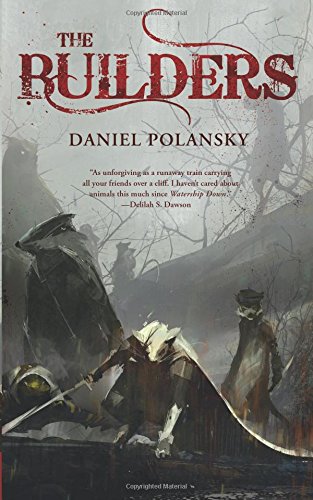
I have never said to myself in a moment of quiet introspection: "What I really need to read is a novel about anthropomorphic animal revolutionaries." So when I first saw this book touted as such in my Twitter feed, I ignored it. It kept coming back. Each day I would see another retweet of the cover, or a remark about the characters. ("One pales to think how Gandalf would fare in a Polansky book...") People I trusted had read this book, and were talking about it. And though it was $13 in print, it was less than $3 in Kindle format. I bought it and began reading, right in the middle of a comic mil-SF binge (Asprin's Phule's Company, etc.). The dissonance between this darkly wry fantasy and the wildly comedic pun-fest that is an Asprin novel made the first third of The Builders hard going. I put it down a lot. And I kept coming back. Neither Disney cute nor morally uplifting, The Builders is essentially a brutal tale of killers finding a way to do what they do well. Usually, novels about animals are really about people. I'm sure you can think of exceptions, but I would be hard-pressed to do so. Once in a while, as with Kia Heavy's Domino (which I reviewed in Defending the 'Hood), each character's animal nature is just as important to the plot as the clues about human society. More typically, the animals in such stories are loosely-disguised humans, and you can ignore the form of the creature for its actions. The latter is the style of The Builders. Close one eye, and the Captain is not a mouse, but Yul Brynner in The Magnificent Seven. Boudica is no 'possum sniper, she is Charlize Theron in Aeon Flux. Bonsoir the Frenchman-stoat walks a James Coburn line through a Duck, You Sucker! maze, complete with treasure vault at the end. Indeed, even the villains of the piece do not need rat, skunk, snake, or toad personas to be relatable as humans. The crew the Captain is assembling has tried and failed to foment revolution once before. Defeated by a traitor within, they have scattered to the winds. And yet, for each the Captain poses a undeniable challenge: Can you bear not to be involved as we try again? For Barley, the pacifist badger, he offers the opportunity to use his beloved machine gun. Cinnabar the salamander yearns to prove his quick-draw speed once more. Elf the crippled owl wants revenge for a lover's betrayal. The flavor is spaghetti-western, bad-guy vs. bad-guy. The plot has more twists than a killer roller-coaster track, and is just as thrilling. And if you tell me you foresaw the ending, I'll simply reply, you lie.
The earth shivered again in California last night. Shallow quakes, a storm of them around 1.5 to 2.5 Richter magnitude, shook the coastal mountains between my city and the Pacific. Most were centered around Cobb, a town in Lake County several hours north of San Francisco, which is home to a number of hot springs. We didn't feel them in Santa Rosa. My spouse and I haven't always been so lucky with earthquakes, though. There were a number of shakers while we lived in Southern California, not as low in magnitude nor as shallow, not hot-spring-triggered. One that rattled me thoroughly came around 6 AM, while I was at work on the third floor of an office building, the only person in the building at that hour. Another time, we and some friends were watching a Los Angeles evening news broadcast when the desks, lights, and equipment on the TV screen suddenly began to swing wildly. Like some do with thunder, we began counting seconds: "One-a-thousand, two-a-thousand...." The count told us when to expect the earth-wave to hit central Orange County and us. Quakes usually provide no warning. One second the ground is solid; the next, it is a quivering, heaving uncertainty beneath your feet. When you expect it, you can ride the wave like a surfer, balancing over its crest. But more commonly, it destroys your balance and ruptures your sense of rightness. The earth shouldn't gallop like a horse, darn it! When I read the prompt for this week's Carrot Ranch Flash Fiction Challenge, I knew that however much "a gallop" means horses to others, for me, it bringsto mind an earthquake's motion: February 24, 2016 prompt: In 99 words (no more, no less) write a story about galloping. It doesn’t have to be about horses. Is galloping a burst of energy, a run for freedom? Or is it a sense of urgency that borders on anxiety to get tasks accomplished? Explore the motion in different ways — a galloping stride, a galloping relationship or a galloping mind. ______________________________________
California Night Mare
Deep in sleep, I am enjoying a pleasant dream, galloping down a beach, bareback on a white horse with a scarlet mane. The slow-motion rhythm of its pounding hooves speeds up suddenly, bringing my heart to a matching gallop. With a start, I bounce from the dream to irritable semi-consciousness. The horse's hoof-beats have transformed into the rattle of the bed's bookcase headboard against the wall. "Darn it, hon," I grumble, eyes still closed, "Can't you just slide into bed instead of bouncing around?" Distant from the doorway, a shaky voice answers. "I'm not in bed. It's an earthquake!"
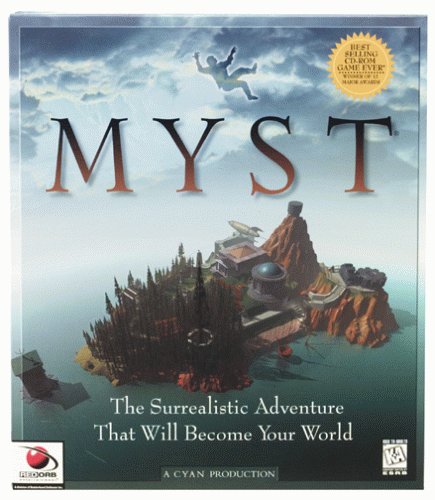
Almost thirty-five years ago now, Rand and Robyn Miller and the folks at Cyan Worlds began work on Myst, a ground-breaking computer game with no guns, no aliens, and no power pills. The brothers Miller were no strangers to breaking new ground; their initial effort for the fledgling company they founded was The Manhole, the “first entertainment product ever on the new medium of CD-ROM.” But with Myst, they truly broke free of the shoot-em-up actioners, war-strategy boards and computerized table-games that had been the norm before this game debuted.
The story-line is simple, but—when had a game ever had a story-line before? With this one departure from the norm, the Millers might have had a hit. But they added artist Chuck Carter and audio engineer Chris Brandkamp, and funding from Sunsoft of Japan, and set out to make a CD-ROM game create an absorbing environment, complete with brooding music, nearly-real video clips smoothly integrated into the artistic backgrounds, and a stunningly-smooth interface that let the player easily immerse into the series of nested puzzles that is the game.
In this last, Myst most closely resembles another classic computer game, Colossal Caves. The challenge in Caveswas to map a vast, mostly-underground structure, based on clues from the text descriptions. Younger players may never have worked around the frustrations of the “maze of twisty passages, all different”—but they have probably (if worldwide sales in the region of over 12 million units are any indication) mapped the dark Selenitic subway of Myst.
Many have written before of the spell cast over them by this game. Hint- and cheat-sites are everywhere, and dozens of forums support players who still want to talk about, consult over, and dissect the play of the Myst worlds, even decades after its initial debut.
When a fried sound-card removed me from the ranks of computer-video users dozens of years ago, I wasn’t worried—I had very little reason to use the sounds of my computer, and I happily crossed that off the list of “necessities” for replacement. A brand-new PC, however, meant I needed to check the sound, so I popped my 10th-anniversary Myst DVD into the tray. “Just going to test the audio levels,” I told my patient spouse. “I’ll be in to bed in a minute!”
Four hours later, I acknowledged I was hooked all over again. Myst had reached out of my computer and seized me by the brain. Half-remembered solutions from my decades-past original play of the game teased me, remaining just out of mental reach. I had to raise the sunken ship on Myst Island, had to solve the sound puzzle of the Selenitic Age, had to find the elevator into the trees on Channelwood. The only cure was to play on.
Later games in the Myst cycle, like Riven, Myst III: Exile, Myst IV: Revelation, and Myst V: End of Ages, may have that same power to entice me anew. The bad news is, I have them all on DVD. The good news is, I know better than to install them on my computer! (At least until I have a month or so to devote to them.)
The final version of the game is titled “The End of Ages.” Perhaps the spell-binding properties of Myst have even begun to trouble the folks at Cyan?
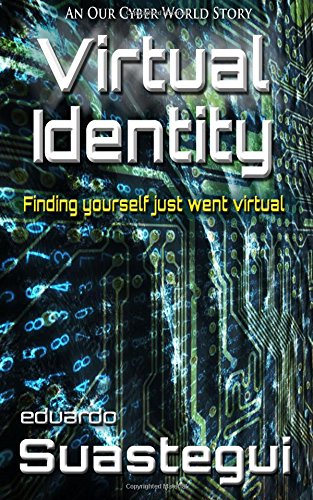
Remember at the end of eXistenZ, the 1999 movie starring Jennifer Jason Leigh and Jude Law, walking away from that final scene being unsure if it was yet another stage in the virtual reality presentation? Jude Law's character, the "virtual reality virgin" Ted Pikul, was pulled and shoved from one insanity to the next by his ignorance of whether he was in a real world or in the virtual reality game. The entire story of Sandra Tomek and Rodrigo Ochoa in Virtual Identity has that same "still in the game" flavor. You know the queasy thrill when the dead Brian O'Blivion showed up for a TV interview in 1983's Videodrome with Debbie Harry and James Woods? The appearance of the virtually-real, yet physically-deceased professor marked the point in the movie when what you knew was real started to spin out of your grasp. In Virtual Identity, that point occurs somewhere around the middle of Chapter Two. The James Woods character in Videodrome, Max Renn, at least has his Harlan, with a condescending "Patronne," to tell him why he has lost the boundary between reality and television. Sandra Tomek has no such clue; she has slipped from a real existence to the shifting sands of virtual reality with scarcely a murmur of explanation. In fact, the core story-line of the novel seems to be her search for any stable, truly-real place to stand. Is Rod Ochoa an antagonist? a reluctant co-conspirator? a boyfriend caught in the same sting as Sandra herself? Is Sandra herself the villain, a terrorist-traitor selling secrets, or the innocent pawn of a cloned virtual self? Perhaps she is something entirely unsuspected, defined by shadowy "others" who have trapped her in this VR simulation. Each new turn in the tale brings Sandra closer to madness, insanity of the kind that Max Renn or Ted Pikul would well understand:
It made her think about who she was, or thought she was, or believed she ought to be, or others expected her to be. Could she or anyone else identify the real Sandra? Did such a person even exist?
The ongoing confusion about what is real and what is part of the VR simulation,for the reader no less than for Sandra, draws you along. You want to resolve the mystery. You want to find the edible core of this artichoke you are peeling leaf by pointed leaf, but each new layer reveals only another spiny conundrum. At one point, Sandra expresses her frustration with the impossibility of recognizing "real" reality while still wrapped in the haze of virtual-reality madness. What's wrong? she asks Rod. How would we even know? This is Volume 9 in the Our Cyber World series, and it includes characters we've met before. The focus is so inward, though, that you scarcely need to be familiar with them to be enmeshed in Sandra's internal quest for identity. In the end, she may find a place to be herself. How real that terminal identity may be, however, is left as an exercise for the reader.