Showing posts with label Flash Fiction. Show all posts

Saturday, May 28, 2016

Rescued (Carrot Ranch Flash Fiction Challenge)

Depression is a real thing. I've had one battle with it, and never understood until I did how hopeless it can make the entire world appear. I was fortunate; my depression was simple and temporary. It passed by itself. 

But I was changed by its passage. Afterward, I was never quite as sure of my abilities. 

I had lost that innocent confidence we all possess until we encounter something that rubs our noses in powerlessness. 

Some who are depressed can relieve the symptoms by literally moving past them; they begin running or swimming or walking, and their bodies supply the mood-lifters they need. Others require chemical intervention to return to the forward pace of their lives. 

For the fortunate few like me, the trigger that blasts away the fog is a single uplifting experience, as simple as an unexpected smile from a loved one—even from a stranger. Without realizing why, the corners of the mouth rise in response, and so does the heart. The grey goes away.

I had written a short poem following my single bout with the grey monster, and it needed only a few additional words to qualify for the Carrot Ranch Flash Fiction Challenge this week:

May 24, 2016 prompt: In 99 words (no more, no less) write a story that changes with a smile. It can be a character, tone, setting or any creative use of smile. You can go deep and consider motive and influence, or you can light up the world with a brilliant flash (of teeth as well as fiction). And smile, because your writing matters and is not hostage to your level, experience or circumstances.


I send this thought out into the world, with my smile attached, and my hope: May it find anyone who is frozen, weary, defeated, or depressed, and may it be the required rescue.

___________________________________________


Rescued

Grey is the sky and grey my heart,
Frozen, for all I might do.
Long road.
I cannot find a way to start
or stop, or yet continue.

Lost in a maze of 'must' and 'shall,'
I have no true desire.
Weary road.
Grey is my life and dim, and all
The art that I might aspire

Is shades of grey and strains of lust.
Twisted and incomplete.
Endless road.
It tastes of mold, is sad with dust.
I trudge with sour defeat,

To find at the end of a dreary mile
Sunrise and hope, and your sweet smile.

Thursday, May 19, 2016

Thorn and Rose (Carrot Ranch Flash Fiction Challenge and New Cat #3)

Squirrels and Oaks go together—and Cats, not so much!
Our new cat Sherbet is fascinated with the life in the heritage oak tree outside the window of her staging room. We have set her up with a "kitty TV," a window opened a tiny crack to allow the full outdoor sensorium to enter, with a wide, cushioned ledge at the level of the sash for her to perch on. She spends hours there, watching the birds and squirrels intently.

Remember, this is the new cat that "needs" to be outdoors—yet she is perfectly content with her window on the world. Two days ago, my spouse was doing some gardening on the hillside below her room. She watched every move. The hard metallic chirps of the California towhees sound just like one of her toys. She watches, alert, as the birds flit from the deck to an over-hanging branch, then she will go and drub the toy, which she can reach.

The first day in her new house, she was terrified of the sound the squirrels made as they jumped from the over-hanging oak limbs to the roof over her head.

It wasn't until she began "following" the distinctive sound of their walk, jumping up to the "TV" window just in time to see them leap across to the tree-trunk, that her tension began to ease. For Sherbet, the squirrels and towhees became part of her new environment, just like my spouse and me, her new toys, and the scents of our other cats.

Charli Mills has been promising (or threatening) a "squirrel prompt" for the Carrot Ranch Flash Fiction Challenge, and this week, she made good:

May 18, 2016 prompt: In 99 words (no more, no less) write a story that features a squirrel. It can be about a squirrel, for a squirrel or by a squirrel. Think nutty, naturalistic, dinner or ironic. Go where the prompt leads and don’t forget to twirl with imagination.

Squirrels running across the roof used to wake my late father-in-law, Ben, whose bedroom now serves as our guest room-slash-cat staging room. It was Ben who described the squirrel's walk with a line from an early-1900s child's chant: "The squirrel runs lipperty-lipperty-lip." I borrowed his experience to describe the elderly Rose in my flash fiction, and her similar problem with the squirrels.

_____________________________________


Thorn and Rose

Rose tsked in irritation as the squirrel-tail flirted against her window. 

He skittered along the eave over her window, with the "lipperty-lip" footsteps that identified his kind—vision wasn't sharp anymore, but nothing was wrong with her hearing. Rose tsked again, and that thorn-in-her-side squirrel chittered back. His fluffy tail metronomed as he gathered himself to launch across to the adjacent oak.

Rose spotted the target of his squirrel-talk: a female. Frisking squirrels in spring promised a new generation of Thorns to wake her. 

Sighing, Rose curled her tail over her pink nose, and sank back into her morning catnap.

Monday, May 16, 2016

Unloading the Toe (Carrot Ranch Flash Fiction Challenge)

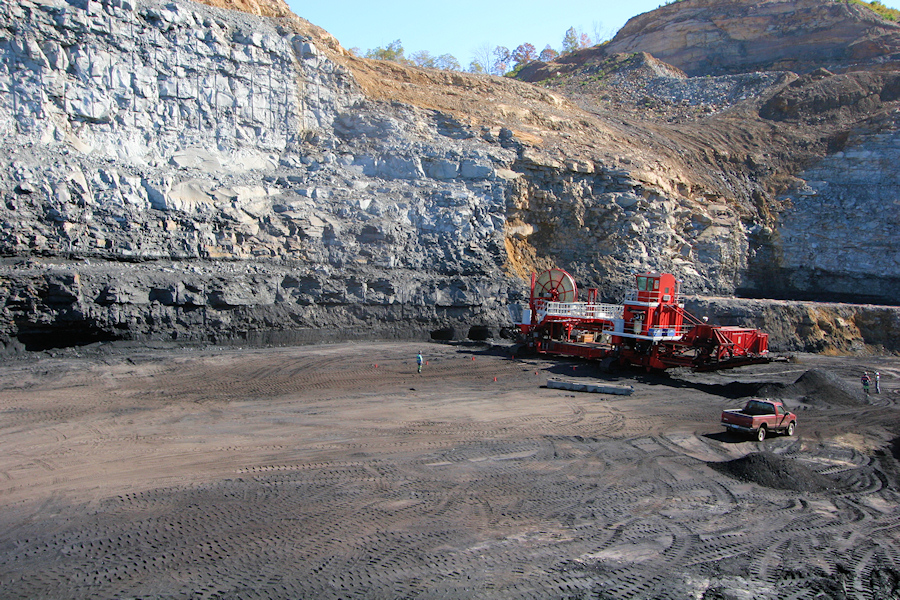
Mining coal below a highwall. via Kentucky Coal Education
In any industry, there is a body of knowledge (and often a jargon as well) that serves to separate those who know whereof they speak from the clueless. 

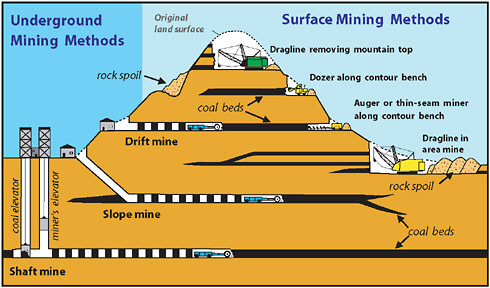
Much of what I learned in my Mining Geology classes at Mines was how to avoid exhibiting a lack of such bona fidesThe most-memorable story was of a civil engineer, already in-country, whose American employer re-purposed him as a mining engineer and sent him to solve a problem at a bench-mining operation. The mine removed overburden to expose a coal seam, which they then mined from a contour bench below a steeply-sloped highwall.


Mining Methods, via The National Academies Press
It seems they had a very tight profitability margin, which was being eroded by loss of equipment and access due to landslides. The steep slope above the contour bench kept slipping down into the mining area, blocking the seam and damaging men and machines below the highwall.

The brash civil engineer barely listened to the explanation at the site before he told the men working there that the answer was simple: "Just load the toe of the slope!" (Pile material at the base of the highwall to reduce its slope.) He was certain this would resolve the landslide problems.

It would have, too. Except that wasn't the problem they were trying to solve. They needed access to the coal seam at the base of the highwall. The civil engineer was sent back to building roads, and the company brought in a real mining engineer to fix the issue. (The solution involved removing just enough of the overburden above the bench to reduce the slope of the highwall.)

Erosion—in its most continuous form, mass wasting—is an ongoing issue that engineers of all stripes are trying to solve. But it isn't only engineers who are challenged when the earth moves downhill, as you can see in my response to Charli Mills' prompt this week for the Carrot Ranch Flash Fiction Challenge:

May 11, 2016 prompt: In 99 words (no more, no less) write a story, using the power of erosion. It can be natural, cultural or something different. Is the force personified or does it add to the overall tone? You can use the word in its variations, or avoid the word and write its action.

Erosion can be subtle or drastic. And often, our initial response is not the whole solution.

______________________________


Unloading the Toe

I realize I am lucky as I breathe dust. Only the edge of the landslide still raveling downhill had caught me.

My rucksack is just under the rubble. A quick tug on an exposed strap frees both it and a large rock. The rock goes bounding down the slope, triggering mini-slides in its wake. I slap the ruck to lose most of the dirt, and swing it onto my back.

Several steps down the trail, I remember I had my car keys in my hand, ready to use. Now they are somewhere under the tumbled earth.

Time to dig.

Monday, May 9, 2016

Before Flash Fiction, There Was Feghoot

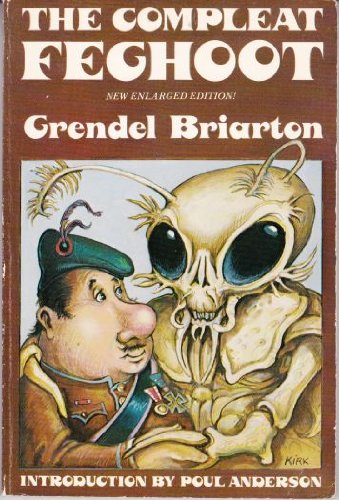
Review: The Compleat Feghoot by Reginald Bretnor (writing as Grendel Briarton)


Have you heard the one about the guy who planted kitchen herbs in his creek to make it run uphill, because "dill waters run steep"? 

No? How about the news headline announcing the court's judgement re: a thief who had waited out the statute of limitations period for his crime in a time bubble: "A niche in time saves Stein." 

Or a vulture carrying two dead raccoons, turned away by the stewardess as he goes to board the plane, because "only one carrion is permitted per passenger."

These are classic "Feghoots," a genre of super-short (science-)fiction story—today we would call it flash fictionthat usually featured space-and-time traveler Ferdinand Feghoot, and always ended with a terrible pun. They appeared in many of the early science fiction magazines. Reading the name of the main character, Feghoot, was enough to provoke an anticipatory groan for the pun we knew was coming.

Most of these stories were written by Reginald Bretnor under his anagrammatic pseudonym, but the ideas for them were often suggested by other sci-fi writers of the time. Isaac Asimov wrote one on his own (the "niche in time" cited above). Thomas Pynchon included a Feghoot-less incident in Gravity's Rainbow. It ended with "For DeMille, young fur-henchmen can't be rowing!" (Forty million Frenchmen can't be wrong.)

Have a good groan today: read a Feghoot and celebrate the endless ways we twist clever words to make a story come out "right."

Liner Notes:

  • There are several Feghoots included in the The First Reginald Bretnor Megapack if you cannot find The Compleat Feghoot in your second-hand bookstore.
  • The Second Reginald Bretnor Megapack not only includes another Feghoot, but also the Papa Schimmelhorn stories and the classic Gnurrs Come From the Voodvork Out.
  • My own copy of The Compleat Feghoot resides in the john, where it is available to enliven those "idle moments."

Saturday, May 7, 2016

Surveying Skeeters (Carrot Ranch Flash Fiction Challenge)

For most of us, disasters are rarities. Rather, we build our positive or negative memories upon mounds of tiny successes or clouds of nagging defeats. We go camping, and take home a bright image of a tasty fish caught and grilled for supper, or we recall only the battle to defend our ankles from the bite of ticks and chiggers.

I recall one spring, when we were searching for an appropriate place to hold a human-powered vehicle speed challenge in the Western Rockies. Our two-man team went out to survey roads in Colorado. We were hunting a paved surface with a specific slope (0.66%), 200 meters for the timed stretch, with a gentle catenary curve leading down to it, and as few bumps as possible. How hard could it be, after all?

It would have been a pleasant outing, with wonderful scenery, and purposeful work to survey our candidate roadsexcept for the biting insects. Deer flies, gnats, and the never-sufficiently-to-be-damned mosquitoes were out in force, and I was the best buffet they had available. 

In the prompt this week for the Carrot Ranch Flash Fiction Challenge, Charli Mills asks us to include insects in a story. Yet these pests need no invitation; they show up for dinner, and, if we let them, ruin the party!

May 4, 2016 prompt: In 99 words (no more, no less) include insects in a story. Periwinkles, bees laden with pollen, ants building hills. What can insects add to a story? Do they foreshadow, set a tone, provide a scientific point of interest or a mystical element? Let you inner periwinkles fly!

In the end, if you are wondering, we did find a downhill run that met our parameters, and the four-cyclist engine powered their Pininfarina-designed vehicle to just short of a record. Nowadays, these runs are made in Nevada. I fortunately have no idea what pests wait for surveyors in that dry environment!

_______________________________________

Surveying Skeeters

A spring somewhere uphill feeds a soggy ditch paralleling the road. Every road we've surveyed seems to have its own mosquito bog. I squint downhill through the transit to the rod my partner holds, and, jotting the numbers, spot the blood-sucker on my hand. 

Whap! My notebook serves a second function as a skeeter-swat. I turn the transit to the back-line and spot the previously-sited stake. Wiping my sweaty forehead, I dislodge a team of gnats. My hand comes away adorned with another mosquito.

That night, doing calculations from my surveyor's notes, I find more dead mosquitoes than numbers.

Friday, April 8, 2016

Sense of Space (Carrot Ranch Flash Fiction Challenge)

I am a strange mixture of fear and delight.

One of my favorite situations, where I am at ease and can shine, is speaking in front of a crowd. I even volunteered to teach senior driving classes after retirement so I could keep doing it. 

But get me into the middle of a crowd of milling strangers, just one of the herd, and I come completely unwrapped. I have left parties early because there were too many guests, and I never visit the cinema in the first few weeks of a new movie's release. They're just too crowded.  

That's why this week's prompt from Charli Mills for the Carrot Ranch Flash Fiction Challenge gave me a little shiver: 

April 6, 2016 prompt: In 99 words (no more, no less) write a response to an agoraphobic moment. Does your character see the shadows or the light filtering through? This can be used as a character trait or as a moment that causes an anxious reaction. Explore the character’s discomfort — embarrassment, indecision, feeling trapped. The scene can be direct or overheard. Is there a solution when fears are faced?

I've tried many tricks to overcome the fear of the madding crowd, but phobias are hard to banish from the inside. It often takes an outsider's eye to spot the patch of blue among the clouds.

_______________________________________

Sense of Space

Travis swallowed, his throat dry. Panic rolled in his gut as a crowd of children surged past. Disneyland was a scary place for him!

His therapist's voice cut through his fear. "Look around, Travis," she said. "What do you see when you look down?"

"Kids. Lots of kids." The words escaped past gritted teeth. 

"Okay, Look farther out; what do you notice?"

Travis shook. He was going to lose it! "Their parents." Then, "Too many people! Too many!"

"Okay," came her quiet reply. "Now look up."

Above him, the endless sky brought him the sense of space he needed.

Friday, March 25, 2016

Resting On Her Laurels (Carrot Ranch Flash Fiction Challenge)

DC-Powered Mine Locomotive (Photo courtesy Ken C.)
British mountaineer George Mallory, who famously said the reason for anyone to want to climb Mount Everest was "Because it's there," was once cornered by a gushing fan, who asked him how he came to have so many adventures. 

"I do not have adventures," was his icy reply. "I plan too well."

Mallory may have planned well, but his third and final attempt on Everest ended in misadventure. He and his partner Andrew Irvine were last seen in 1924 while they were still on their way to the summit. 

Mallory's remains were finally discovered in 1999, after multiple expeditions who climbed Everest to search for his body, "because it's there."

Certainly the most exciting things that have happened in my life came from a deep well of ignorance and a failure to plan ahead. Often the excitement was in retrospect, as we realized what might have happened, had we been just a tiny bit less lucky. Yet in talking about our experiences, it is the white-knuckle stuff that captures the audience's imagination.

I'm not alone, as many of the stories from Ken Cummings' memoir, Meant To Be Here, attest. Here is one from time he spent as a student working in a CONSOL coal mine in the thick "Pennsylvania" coal seam under West Virginia:


The locomotives in the 
Blacksville #1 mine were electric-powered, from a DC circuit of 600 volts and several hundred amps. The positive line was a thumb-thickness copper bar fastened to the roof four to five feet overhead. Return current moved through the steel tracks under the locomotive. The locomotive's pick-up, a spring-loaded arm,  touched the copper bar to complete the electrical connection. Its springs pressed it against the exposed copper powerline overhead, letting it slide along the contact surface as we moved. 

Unfortunately, whenever there was a joint or bump in the copper bar, the pickup mechanism would bounce away from it, and break contact with the copper. The pickup was still close enough to the powerline for the high-amp current to jump the resulting gap. The arc of DC electricity vaporized some of the copper with a vivid green flash whenever it occurred, and it happened frequently enough to make me very nervous. 


I was lucky, though; the sparks never caused a fire while I was there.

Back at school in the year after I was at the mine, I needed to contact CONSOL for some reason. They were very slow responding, and at last I learned the reason for the delay. The east end of the Blacksville #1 mine had exploded and burned, killing a work crew I'd spent a few days with while I worked there. The day of the explosion, the crew had been trying to get a continuous miner onto a sled to be dragged elsewhere by the attached locomotive, when there had been a ground fault from the power supply to the rails. BLAM!

When the recovery crews finally reached the site of the explosion, many weeks later, all they found was a high-alloy belt buckle that had been worn by one of the men. The rest was ash.

To this day, what makes my skin crawl is the memory of the time I had worked with this now-deceased crew, when they were trying to move the 
continuous miner in the same way—unsuccessfully because the power kept tripping out. 

I was at the rear of the continuous miner as they tried to shift the massive machine one last time before they gave up. I saw a fat arc jump between the machine and a rail, tripping the circuit. I was witnessing the exact same thing that would kill nine men a year later. 

The only difference was, the day I was there, there wasn’t enough coal dust in the mine to make the BLAM happen.


This week's prompt for the Carrot Ranch Flash Fiction Challenge reminded me of the trade-off between excitement and danger, between the chance of having a great story to tell afterward, and having no afterward in which to tell it:

March 23, 2016 prompt: In 99 words (no more, no less) write an adventure, experienced or witnessed. Explore your own ideas about what makes an adventurous spirit. Is it in the doing? Does standing witness count, and if so, how? Be adventurous!

The Chinese made it a curse: May you live in interesting times. Me, I'll settle for a little less adrenaline in my current life. It can stay in the anecdotes. It seems Granny Marta agrees.

___________________________________________


Resting On Her Laurels

"Tell us about flying the plane, Granny!" Marta sighed, gathered the youngest into her lap.

She began, "I was a passenger on a little airplane, nineteen, flying off to college. I thought that was the real adventure, you know..., Anyway, something happened to the pilot. They called from the cockpit, can anyone fly a plane? I had flown Pa's crop-duster. No one else volunteered, so I did."

"Were you scared, Granny?"

Almost to death, she thought. "A little," she admitted, "I just did whatever they said."

The memory still made her queasy. Any crash would have been my fault.

Thursday, March 17, 2016

Stepping Up (Carrot Ranch Flash Fiction Challenge)

When I was still in my 40s, the first steps were taken in a new movement to use the unique skills of retired persons. "The greatest generation" certainly deserved their retirementbut many, it became clear, did not want to lay down the tools they had honed and perfected throughout their careers.

They sought a platform to continue contributing. Mentoring, advising, lending their experience to those in need, they volunteered or worked part-time at a far smaller salary than they had commanded before retirement. By the time the baby-boomers, my generation, began to retire, this was an accepted practice.

I think sometimes (often as I prepare for my own senior volunteer job) about those first volunteers, whose age did not stop them from stepping up to fill the need they saw.

Charli Mills talked about the first person to step up in the Carrot Ranch Flash Fiction Challenge this week, and prompted us to write about it:

March 16, 2016 prompt: In 99 words (no more, no less) write about the idea of “just one.” If all it takes is just one, what is the story? Explore what comes to mind and go where the prompt takes you. Bonus challenge: eat cake while you write, or include cake in your flash.

Yes, it takes just one person to step up. But far more important is the response of others who also step up, giving support to that brave first volunteer. Never far from my heart is the topic of libraries, books and librarians, the seed for my response to the prompt this week.

_________________________________________

Stepping Up

Late! Myrna ignored the glares from the group of retired librarians, hitting the restaurant buffet first for tea and a slice of cake.

"Sorry!" she breathed, sinking into place at the large table. "What did I miss?"

Her fork halted halfway between plate and mouth at the answer. "The city voted last night to defund the neighborhood libraries program. They don't have enough money to staff them AND the Metro library downtown."

Myrna ate her bite of cake, said, "We'll be staffing the neighborhood libraries, of course."

One member looked at another, startled. Several seconds passed, then, "Of course!"

Thursday, March 10, 2016

Green Monster (Carrot Ranch Flash Fiction Challenge)

Reading Kindle Scout novels from brilliant new authors can be a mixed blessing. Yes, these are books I got for free by nominating them (if selected), or for a tiny price (if not), and the writers are very good, so I definitely got a great deal. But still...

Reading a successfully written, published novel wakes the monster in my head, the one with green eyes and green warts. I cannot help being jealous of the writer who has reached this goal that I still struggle toward.

This monster has teeth, too. They eat at my confidence, make comparisons with other author's work as I read, always to my detriment. I try over and again to slay the jealous monster, but somehow it survives each attack.

I don't want this poisonous comparison to spoil my reading, nor to defeat my determination to write. But more and more, I have scars from the green monster's bites. Perhaps I can use Charli Mill's Carrot Ranch Flash Fiction Challenge prompt this week to pull the monster's teeth:

March 9, 2016 prompt: In 99 words (no more, no less) write a monster story. You can pick any perspective, even that of the monster. It can be literal or symbolic; it can be heroic or realistic. Think about the shifting roles of what is a monster and who is a monster-slayer. Consider how easily we give the label to others or to fears we can’t name.

My monster deserves no consideration. It must die!

_________________________________________


Green Monster

The monster has teeth that tear at me in the dark. "You're obviously missing something the successful writer needs, or you'd have a dozen books on Amazon now, instead of three partly-finished novels and a co-written memoir, half outline and half disorganized notes in a file-cabinet drawer."

Plugging my ears doesn't help. I close my Kindle, and it hisses again. "That last book was a good one, wasn't it? We especially liked that last phrase you highlighted. Genius, really. Not at all like your stuff."

Only one way to slay this monster: finish the fiction, polish the memoir, PUBLISH!

Thursday, March 3, 2016

The Call of Telstar (Carrot Ranch Flash Fiction Challenge)

We had stars in our eyes in those days. Mercury had flown; we knew man 
could reach space. The Telstars could be seen on clear nights; like rocket boys for Sputnik in the 50s, we 
watched for them and dreamed of space.

In middle school, I had just encountered real astronomy, and I had been introduced to science fiction by the Tom Corbett novels by "Carey Rockwell" in the town library. Our library had all eight books, but I had finished them, and was wandering along the same wall of bookshelves. I turned the corner and...

Sighted Telstar! A series of paper-bound manuals detailing the launch procedures and equipment for the Mercury capsules lined a lower shelf in a protected nook. To this day, I have no idea how these beauties wound up in my small-town library. I was thrilled beyond belief. 


They were marked as reference books. Under an ancient India-ink hand-printed label, "Bell Labs Library," they were stamped "Not To Be Removed From Library." No problem: I sat right down on the floor in easy reach of the pale blue line, and began reading.

I can still remember my struggles. I was accustomed to reading easily, but I had not been challenged before. 

This was my first encounter with engineering bureaucrat-ese. NASA had already developed a corporate style and language, and I had no translating dictionary. No problem: I was not going to give up, even at such a wall. For weeks I haunted the library. I went straight there from school. On at least one occasion, my mother called the library to be reassured that, yes, I was there. 

She feared I had fallen in with a "bad crowd" from the high school. No, I had fallen in with a worse crowd from NASA. I had been bitten by the engineering bug; although the infection smoldered in me, it would burst into full fever pitch late in my high school years. 

All the rest of my life would have been so different if those innocuous blue paper-bound manuals had not been donated to the rural library. The prompt for the Carrot Ranch Flash Fiction Challenge this week immediately brought that thrill of discovery to mind:

March 2, 2016 prompt: In 99 words (no more, no less) write a story that includes a library. You can honor the libraries in your own experience, dream about libraries of the future or explore a community without one. Bonus points for discovering something you didn’t know your library offered.

In my long-ago library, I checked a shelf I had never noticed before, and found the first key to my life. My flash fiction* answers the question I asked then, and now: How did they come to be here? 


_________________________________________


The Call of Telstar

James lay cooling in the bedroom as his children argued in the kitchen.

"You can have the tools from his workroom, Leo, I don't want them!" Laurel's voice was thick from weeping. "I only want the china."

After the funeral, she packed fragile dishes between layers of thin technical paper pulled from the shelves in the study, sandwiching plates between Mercury manuals, wrapping cups in drawings of world-breaking electronics, swaddling soup-bowls in maps of coastal dunes and Western Australian desert.

Once unpacked, Laurel donated her impromptu padding to the small local library as a last legacy from her father.

_________________________________________


*Yes, it's fiction:

  • James Early was a pioneer in transistor performance, whose work at Bell Labs made possible the development of the Telstar satellites' communications packages. 
  • He was not directly involved with the planning of Cape Canaveral nor with NASA's tracking station in Carnarvon, Western Australia. 
  • Early famously burned his collection of neckties when he retired, saying he was "done with the instrument of torture." 
  • He had eight children, none named Leo or Laurel. 
  • He died in 2004, long after my library treasure was donated.

Thursday, February 25, 2016

California Night Mare (Carrot Ranch Flash Fiction Challenge)

The earth shivered again in California last night. Shallow quakes, a storm of them around 1.5 to 2.5 Richter magnitude, shook the coastal mountains between my city and the Pacific. Most were centered around Cobb, a town in Lake County several hours north of San Francisco, which is home to a number of hot springs. 

We didn't feel them in Santa Rosa.

My spouse and I haven't always been so lucky with earthquakes, though. There were a number of shakers while we lived in Southern California, not as low in magnitude nor as shallow, not hot-spring-triggered. One that rattled me thoroughly came around 6 AM, while I was at work on the third floor of an office building, the only person in the building at that hour.

Another time, we and some friends were watching a Los Angeles evening news broadcast when the desks, lights, and equipment on the TV screen suddenly began to swing wildly. Like some do with thunder, we began counting seconds: "One-a-thousand, two-a-thousand...." The count told us when to expect the earth-wave to hit central Orange County and us.

Quakes usually provide no warning. One second the ground is solid; the next, it is a quivering, heaving uncertainty beneath your feet. When you expect it, you can ride the wave like a surfer, balancing over its crest. But more commonly, it destroys your balance and ruptures your sense of rightness. The earth shouldn't gallop like a horse, darn it!

When I read the prompt for this week's Carrot Ranch Flash Fiction Challenge, I knew that however much "a gallop" means horses to others, for me, it brings to mind an earthquake's motion:

February 24, 2016 prompt: In 99 words (no more, no less) write a story about galloping. It doesn’t have to be about horses. Is galloping a burst of energy, a run for freedom? Or is it a sense of urgency that borders on anxiety to get tasks accomplished? Explore the motion in different ways — a galloping stride, a galloping relationship or a galloping mind.

______________________________________

California Night Mare

Deep in sleep, I am enjoying a pleasant dream, galloping down a beach, bareback on a white horse with a scarlet mane. The slow-motion rhythm of its pounding hooves speeds up suddenly, bringing my heart to a matching gallop.

With a start, I bounce from the dream to irritable semi-consciousness. The horse's hoof-beats have transformed into the rattle of the bed's bookcase headboard against the wall. "Darn it, hon," I grumble, eyes still closed, "Can't you just slide into bed instead of bouncing around?"

Distant from the doorway, a shaky voice answers. "I'm not in bed. It's an earthquake!"


Monday, February 15, 2016

Dinner Dance (Carrot Ranch Flash Fiction Challenge)

Surveying in Colorado can take you into some very wild spaces, indeed. I did a lot of rock and glacier climbing during my summer field course in geology, back at Mines, for example. 

I never encountered quite the blend of furry and feathered critters, though, as Ken Cummings did while surveying in Yankee Boy Basin in the Sangre de Christos on the western front of the Rockies. He shares one story from Meant To Be Here:

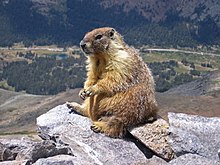
All through the wintertime, marmots ("whistle-pigs") would burrow into the old timber- and earth-covered powder magazines for the Idarado and the Camp Bird mines and various other smaller operations. They did this not only to find shelter, but also to satisfy their craving for the salty flavors of certain explosives. Replacing explosives lost to the rodents’ appetites was a standard budget item for local mines. We would joke about their explosive potential whenever we saw some tourist swerve to try to hit one of these prairie-dog-sized animals as they scurried across the Million Dollar Highway between Silverton and Ouray.

Whistle-pigs were also a real problem with the work I was doing, staking claims to areas over the Idarado workings that had been missed in the original survey. My sweaty partner and I would drive a big wooden stake into the ground, then nail a can to the post to hold the mimeographed claim-papers. The only thing marmots liked more than the sweat-streaked wood of the claim stake was the rich ammonia of the claim-papers. 

The can may have protected the paperwork from the elements and from casual theft by tourists or mice looking for nesting material, but it was short work for the larger marmot’s rodent teeth. Whenever we revisited a claim, the post was usually down, with the sweat-soaked edges gnawed off, and the can had been ripped open with its chemically-treated papers completely consumed.

Posting the claim papers was a formality that had to be done, but the real record of the claim was filed by the mining office with the Bureau of Mines. In following the standard practice, all we were really doing was distributing treats for the marmots.


Charli Mills' prompt this week for the Carrot Ranch Flash Fiction Challenge made me remember this tale of explosive-munching marmots:

February 10, 2016 prompt: In 99 words (no more, no less) write a story about wild spaces. Is it a wilderness or a patch of weeds in a vacant lot that attract songbirds. What is vital to the human psyche about wild spaces? Bonus points for inducing something cute and furry.

For this flash, I take the marmot's point of view of all the surveying work.

____________________________________________

Dinner Dance

Salt on the wind. And something richer, more aromatic, delicious: a promise of oils and esters unknown in the world before men came to my mountain vale.

Secure in my rock bunker, I watch them perform their inexplicable dance. It echoes against my walls: their cries, flat percussion of stone against stake, tinny rasp as the hull of their peculiar seed is fastened into place.

My mouth waters; I taste the core of that seed again in my imagination. It fills my mouth with its alien tang.

As soon as they leave, I waddle downhill to claim my prize.

Thursday, February 4, 2016

Killer Instinct (Carrot Ranch Flash Fiction Challenge)

Sometimes the flash challenge from Charli Mills at Carrot Ranch happens to coincide with a topic I'm already writing about. Sometimes it hooks onto an idea I'm already pursuing. Rarely, it hits with a bolt of sizzling light that turns me around and sends me in a completely new direction.

Whenever I participate in the Carrot Ranch Flash Fiction Challenge, and however it strikes me, I get the chance to practice writing in a very specific way, reaching for something that is almost poetic in structureonly the needed words, only the best words to convey the thought. The 99-word restriction means that a story must be edited drastically.

And since my major task in January and February is editing the work that was written last year, this week's challenge linked into that process quite nicely:

February 3, 2016 prompt: In 99 words (no more, no less) write a story that explores the question, “What good is power?” Is it a story of empowerment, or a story of a dictator? Poke around power and go where the force takes you this week.

Like any creative activity, writing lets you invent endlessly, generating something that never existed before you wrote it. Editing, while destructive in a narrowest sense, allows you to polish what you've created, leaving you with a finer product than you had before it began. It is an essential part of that creative process.

And whether you are writing or editing, your power over the world you're creating is absolute.

____________________________________________


Killer Instinct 

Benny drew a careful line through three names in his notebook, muttering to himself, "You're history, Jeff. You're outta here, Mike. Adios, Linda." 

They were as good as dead. Benny had total power over their lives.

It was only fair; he had created them in the first place, word-generating additions to the world he was building for his novel. But something told him the story didn't need them. His gut said he should do away with them.

They wouldn't be the only victims of his edits, either. Benny sharpened his red pencil and went back in for the kill.

Sunday, January 17, 2016

Bedtime (Carrot Ranch Flash Fiction Challenge)

After a long day that ended with a late exercise class at the gym (because I couldn't drag myself out of bed this morning to make the 6 AM class), I reflected on the days of childhood. That was when bedtime was not a welcome relief, but something to resist with subterfuges like requests for another drink of water or a bedtime story.

Now my bed is something I must resist falling into until the day's work is done.

Even then I relish a bedtime story, although now I must read it to myself. A few pages (chapters, books) read after I climb under the covers, and I'm ready to give myself up to slumber.

So the Carrot Ranch Flash Fiction Challenge this week prompted me with thoughts of bedtime stories and that long-ago desire to stay up late:

January 13, 2016 prompt: In 99 words (no more, no less) begin a story with, “Once upon a time…” Where you take the fairy tale is entirely up to you. Your character can break the traditional mold, or your ending can be less than happy. Elements of fairy tales include magic, predicaments, villains, heroes, fairy-folk and kingdoms. How can you turn these elements upside down or use them in a realistic setting? Write your own fairy tale.

Grampa Ray is a wise man, but not quite swift enough to head off his grand-daughter Mary's stay-up-late argument.

_________________________________


Bedtime

"Once upon a time," Grampa Ray began.

"Wait, Grampa! Why it is always 'once upon a time'?" Mary wriggled under the covers with the urgency of her question.  "Why do bedtime stories begin that way?"

"I don't know..." Her grandpa scratched his head, then his chin. "Maybe it's like, 'And now, the news.' Just a way people have of telling us that whatever follows is either real or make-believe."

"Oh." Mary thought for a moment, then said, "Once upon a time I wanted to watch TV until 10 o'clock and my mom said I could stay up late tonight."

Tuesday, December 29, 2015

A Little Light Reading (Carrot Ranch Flash Fiction Challenge)

Kathryn Hepburn, Desk Set (via reel-librarians.com)
Spider Robinson taught us that "Librarians are the secret masters of the universe. They control information. Never piss one off.

I wouldn't dream of it. For me, and I suspect, for most dedicated readers, Robinson's Secret Masters are the root and core of our reading history.

I set out in this flash intro to explain why the topic of "spreading light" always inspires me to talk about librarians. I've known four that prodded me along my path, never letting me drop into easy, thoughtless reading habits. They challenged me with genres and authors who were then unknown to me, but who would become my friends and partners in life.

They really did have those old-fashioned names. Furthermore, all four were single when I knew them, though I have learned that Winston later married (at the ripe age of 58.) All four had tales to tell of their own introduction to the deeply magical world of books, with their own Secret Masters to be thanked in later life.

So I honor and memorialize my seminal librarians for the Carrot Ranch Flash Fiction Challenge this week:

December 16, 2015 prompt: In 99 words (no more, no less) write a story about “spreading the light.” You can use it to honor or memorialize a loved one.

None of my Secret Masters are still in this world. Perhaps you can let yours know, before it is too late, what a difference they made in your life.

____________________________________________


A Little Light Reading

They wear old-fashioned names: Hildegard, Charlotte, Winston, Arabella, and the light they spread is second-hand, but it is brilliant and up-to-date.

It pours in gentle beams from Sigrid Undset and Taylor Caldwell, or shines through harsh desert illuminations by Zane Grey and Tony Hillerman. Bob Shaw's light of Other Days shields us Against the Fall of Night. The undersea twilight of H.G Wells gleams for 20,000 Leagues. They gave me Light Music on the Dark Side of the Moon. I had All the Light We Cannot See.

I can always count on a librarian to bring me to the light.

Monday, December 14, 2015

Looking Around a Blind Curve (Carrot Ranch Flash Fiction Challenge)

As a student at Mines, I was pleased to learn that my new spouse shared a love of road trips into the mountains, especially as I did not have a driver's license then. We would rent or borrow a car, take off from campus, and enjoy the "Rocky Mountain's majesty" just a few minutes from the borders of Golden, Colorado.

One memorable incident (that made me very happy I was not behind the wheel) occurred as we drove a rented car to Frasier, Colorado, during the ski season. The road led through the Winter Park ski area, a popular destination for students in the Denver area. Winter Park's lifts were just down a snowy slope from the highway.

My spouse had years of experience driving in snow and on the mountain roads, and was a careful operator of any car, but especially in a rental. Even so, the packed, icy condition of the road was a challenge.

We would be indebted to the looky-loo behavior of a truck driver, driving toward us on the same road, who had more visibility of what lay ahead than we did, and who was willing and able to warn us. But it was my driver's split-second response to the situation, and driving skills, that saved us all.

I share it with you for the Carrot Ranch Flash Fiction Challenge this week:

December 9, 2015 prompt: In 99 words (no more, no less) write about a looky-loo. It can be in the general term of “looking around” or it can be a nosy neighbor kind of tale. You can also go deeper into the prompt and have a looky-loo at another culture (or your own).

I've often wondered what the skiers' laundry looked like that night when they got home!

_________________________________________


Looking Around a Blind Curve

The snowy curves of the Frasier road were packed slick.

Far ahead, a semi-truck blew his horn urgently, heading into the same blind hairpin we were approaching. "What's he honking about?" I asked. 

My savvy driver replied, "I'm not sure, but I think I'll slow down!"

Around the corner, some skiers skipping the tow fees were unloading from a car parked inside the curve. Our skid took us 360 degrees, halting on the steep road-edge. The semi barely missed us, passing with its horn still blaring.

The panicked skiers loaded back into their car and left without a word.

Saturday, December 5, 2015

(Yo) Ho Ho Ho (Carrot Ranch Flash Fiction Challenge)

You know when you drop a handful of change or a couple of bills in the red Salvation Army pot that the money is going to a legitimate charity. The donation box at your church is not likely to be a scam, either.

But it seems every business has a gift collection out for its customers to contribute during the holiday season, and not all of them are as well-intentioned as the Santa-capped bell-ringers on the street corner downtown.

While the spark for the Carrot Ranch Flash Fiction Challenge prompt this week may not have been tide of giving that surges each year in December, it ran into my own suspicions about a charity program I saw last week in a shop:

December 2, 2015 prompt: In 99 words (no more, no less) write a pirate story. It can be about pirates or piracy; modern or of yore. Swashbuckling, parrots and rum can be involved or maybe you’ll invent details beyond standard pirates.

Charity is an important civic virtue; you need not have a particular religious belief to see its value to your community or yourself. But the people who take advantage of our charitable urges are no less thieves than those who plied their trade on the high seas.

_________________________________________


(Yo) Ho Ho Ho

The donations in his coffee-shop "Christmas Gift for Africa" box kept mounting. Each time Jeremy checked, the colorful poster behind it with its soulful photos of needy children had garnered more money.

So far, this particular holiday drive was doing better than the "Relief for Earthquake Victims" and "Kids With Cancer" combined. It seemed it would be a very merry Christmas indeed. For Jeremy.

Going with the theme, Jeremy ordered a rum-raisin muffin to go with his espresso, connected to the coffee-shop's WiFi, and prepared to spend his stolen gains online, where all the best pirates hang out nowadays.