Wednesday, June 8, 2016

Shoddabags and Esteefee

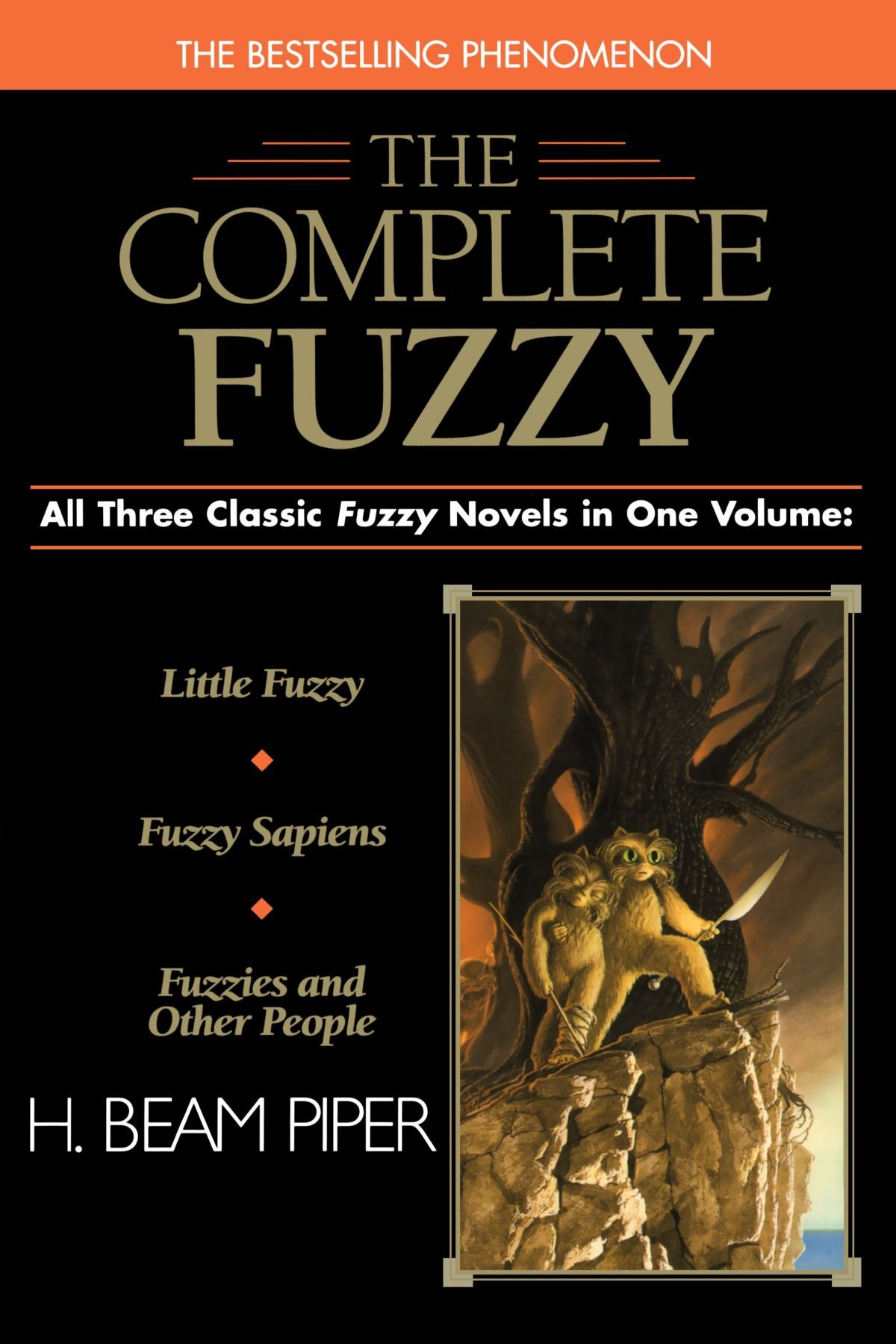
Review: Little Fuzzy by H. Beam Piper


H. Beam Piper's output of science fiction includes three highly successful series, and two well-beloved novels: Lord Kalvan of Otherwhen and Little Fuzzy. Piper himself, however, believed he was a failure; he committed suicide barely 14 years into his writing career.

Little Fuzzy is the tale of an endearing creature encountered on a mining planet by Jack Holloway, a somewhat reclusive sunstone miner. Holloway recognises the intelligence of this little guy, especially when he happens to slow down a recording of the "Yeek!" noises that Little Fuzzy makes. 

That's how Holloway discovers there are discrete words in that high-pitched yeek—and "Pappy Jack" sets out to learn Fuzzy speech, as Little Fuzzy begins to learn English.

Navy emergency rations (ST3) are a big hit with Little Fuzzy, so much that he brings a few fuzzy friends to get them from Pappy Jack. All the Fuzzies want shoddabag (shoulder-bags made from old cartridge cases) and esteefee (the "wonderful food," as they refer to the Navy rat-bars.)

When more new Fuzzies show up with a wealth of sunstones to store in their new shoddabags, Holloway has a mystery to solve. Are the Fuzzies thieves? Even if they are, are they competent enough to be charged uder the law? Holloway's investigation pits him squarely against Victor Grego's Zarathustra Sunstone Mining Company, which has a monopoly charter to buy sunstones on the planet.

Holloway realizes that the Fuzzies' presence on the planet may mark the end of Zarathustra Company's charter, and that someone in the Company may be trying to eradicate all the Fuzzies before that can happen. The thrilling climax of the story pits Pappy Jack and Little Fuzzy against Grego and the Company in a court of law.

The story is charming, sweet enough that we do not notice how many serious themes are being presented. Guns and hunting, "appropriate technology," merchantile monopoly, faginy and the "legitimate" exploitation of minors, self-rule, and the rule of law are all tackled as Little Fuzzy and his champions establish Fuzzy sapience. You can thus read Little Fuzzy as a tale about cute little smart beings or as an allegory for conservative values.

Either way, Little Fuzzy is a book that ought to be on the shelf of any self-respecting science-fiction reader. 

Liner Notes:

  • I recommend it in the printed collection, The Complete Fuzzy, which includes the other two Piper Fuzzy novels, Fuzzy Sapiens and Fuzzies and Other People. 
  • A new version by John Scalzi (author of the Old Man's War series), Fuzzy Nation, retells the story of Pappy Jack and the Fuzzies. Piper's original may be a bit too saccharin and simplistic for modern tastes; Scalzi's Fuzzy has more kick and conflict. Perhaps both should be in your library.
  • Available for Kindle: Little Fuzzy, Fuzzy Sapiens (Piper); Fuzzy Nation (Scalzi)
  • Not on Kindle: The Complete Fuzzy, Fuzzies and Other People

Tuesday, June 7, 2016

Life on the Edge... of Elfhome

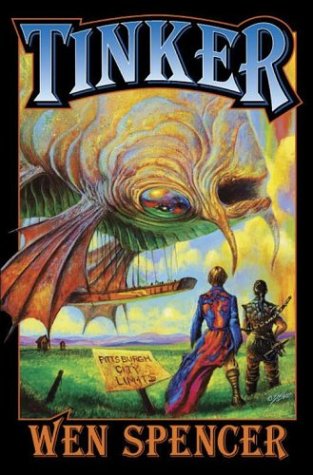
Review: Tinker by Wen Spencer


I'm not usually a reader of sword-and-sorcery fantasy. Maybe I don't have the D&D gene, or perhaps I just miss the internal consistency of reality-based fiction. This novel is an exception.

Start with the accidental translation of a chunk of American city into a parallel universe. For 20-plus years, part of Pittsburgh has been rotating for 29 days out of every 30 into Elfhome, where passenger pigeons exist side-by-side with leg-chomping wargs and flesh-eating willows.

Add in the Elfin Interdimensional Agency, charged with insuring that only adult residents of Pittsburgh and their dependents may remain in the city as it returns to Elfhome. Toss in two minors, Tinker and Oilcan (not their real names, of course), orphans who have held on to their home despite the death of their grandfather. Stir in a soupçon of elven politics, and a dash of nasty orc-ish oni villains, and the stew is bubbling.

Did I say Tinker is a girl, a genius who owns a scrapyard? Anyone with that much cold iron is a force to reckon with in fairyland. And Tinker has the opportunity to save the life of an elven lord fleeing a pack of wargs when he runs into her scrapyard. Tinker teeters from rescue to rescue, managing to set the entire Elfhome world on its ear as she goes.

Like Tinker the genius girl, Tinker the novel is consistently delightful, and internally consistent as well—you won't learn anything special from this book, but it is a lot of fun.

Monday, June 6, 2016

Power Sheets: Solar Paper

Review of Solar Paper by YOLK


I was intrigued by this product on Kickstarter, but reluctant to back it as it was first described. Instead, I began asking questions of the developers. (The first was: "Could it power my Kindle?") 

I was pleased with the answers, especially as it was not just yes/no, but a complete description of what level I would need to back in order to receive a product that would meet all my needs. ("Aha!" I thought, "this bodes well for future tech support questions!")

So I backed Solar Paper, and in due time, I received the product from my pledge: three "sheets" for solar generation that link together with magnets rather than frangible hinges. Folded up, the whole set is thinner than my Kindle, and about the same width. 

I was so excited when it arrived, despite the fact that three weeks of cloudy, rainy days followed it. The first sunny afternoon, I had it out to charge and quickly saw how easy it is to set it up, use it, and stow it away again. It charges our Kindles beautifully, keeping well ahead of discharge during use. It also charges my Incipio iGO power-block, so I have multiple ways to stay empowered! 

I expect it will become a permanent resident in my travel bag, ready to supply me with power directly on the sunny days, and via the iGO on cloudy ones.

Saturday, June 4, 2016

God in a Fungus

Review: The Three Stigmata of Palmer Eldritch by Philip K. Dick 

Dick is renowned for his strangely compelling stories, but this is certainly one of his strangest. Set in a future that takes elements of 1950s cocktail-party morals and Minority Report precognition, mingled with a global-warming meltdown expected a scant 50 years in the future; Palmer Eldritch then takes a nose-dive into the 1960s’ to find salvation and damnation in an alien mushroom.

Barney Mayerson is a fashion pre-cog, working for Leo Bulero, the head of “Perky Pat Layouts.” Perky Pat and her “boyfriend” Walt are dolls whose materialistic lifestyle is supported by fashionable miniatures of cars, stereo systems, furniture, clothing, and everything desirable to the teeming millions who live on Earth.

The problem is, there are too many people on Earth to allow everyone to have this abundance for real, so random people are “drafted” to become colonists on Mars. There, they use the illegal drug Can-D to become, temporarily, Perky Pat or her boyfriend. The quality of this experience (the only escape available to the colonists) is believed to be dependent on the up-to-date fashion of the miniature layouts they create for their Pat and Walt dolls.

Belief is an important factor in this equation—in fact, religions have grown up around the drug experiences of the colonists. Some believe that the Can-D “translation,” the apparent entry of the women into Pat, and the men into Walt, actually takes them to an Earth before the time when it was suicide to be outside in the unshaded noontime sun, or to a less-than-eternal Heaven. Some liken the taking of Can-D to the wine and wafer of communion; the men commune together in the persona of Walt, the women in Pat. A few cynics believe neither, but welcome the easing of restrictions. After all, it’s Pat’s body that joins with Walt’s, so it can hardly be adultery, right?

The acquisitive, free-love society that has ruined Earth is thus miniaturized on Mars. The other requisite element in this scheme, the drug Can-D, is also manufactured by P-P Layouts (quietly, as contraband), and sold at top dollar to the colonists. Colonial authorities look the other way, because without the drugs, colonies quickly descend into cabin fever, then flash over into murder and mayhem.

As the story begins, Palmer Eldritch, legendary explorer to Proxima Centauri, has returned to the Solar System, bringing with him a new drug, an alien fungus marketed as “Chew-Z.” Unlike Can-D, Chew-Z needs no layout. And its translation brings the user into a world that seems really eternal, Heavenly—complete with an audience with God. The only problem is, sooner or later God, and all the other characters everyone encounters in the Chew-Z universe, take on a distinct resemblance to Palmer Eldritch.

When Barney Mayerson is drafted to Mars, he plans to ingest the new drug along with a toxin supplied by P-P Layouts, then sue Eldritch to convince the authorities that this new drug is worse than Can-D. As a pre-cog, though, he knows that his boss, Leo, will be charged with killing Palmer Eldritch in the near future. And neither Barney nor Leo realize that, once you’ve taken Chew-Z, Palmer Eldritch resides in your mind.

The tone of the story is psychedelic, with confusing chronology and a distorted sense of wonder and awe. Elements that seem to be important to the tale as it begins are abandoned, without apology, when something newer comes along. Earth’s ecological disaster is implied, but never explored; the aliens of Proxima are discussed once, then dropped. Can-D religions are sketched in the barest terms sufficient to contrast them with the Chew-Z experience.

In the end, The Three Stigmata of Palmer Eldritch feels something like a drug trip; one is left with the sense of having had a revelation, but its details are lost in the haze.

This is one Dick novel that will never be made into a movie. I hope.

Friday, June 3, 2016

Cultural Genetics

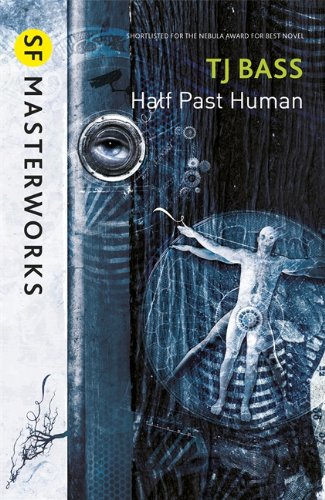
Review: Half Past Human by T.J. Bass


Few science fiction readers "of a certain age" have not read this dystopian novel. The peculiarly ecological vision of Bass found expression in only two books (Godwhale is the other), and echoed contemporary fictions of future societies—Orwell's 1984, for example, and Huxley's Brave New World— in its view of human society as doomed to dark collapse under a weight of population and totalitarian control.

In a far-future Earth, our distant descendants have been altered genetically to allow them to live in ultra-crowded hives. The genes that code for aggression when people are pressed too closely together turn out to be linked to the gene for five toes, so the Nebish people are four-toed and complacent. They fill their dark underground warrens in their billions, despite another genetic shift (and social mores) that limit reproduction.

They are also cannibals. Unapproved children are allowed to exist until they begin to walk and talk. Then they are thrown into the "patty press," producing "flavors" for the Nebish who reports them. Other flavors come from rats and Nebish corpses tossed into the patty press. Aside from the taste of flesh, Nebish society is fed by the world-covering gardens of algae, and the lack of protein in their diet makes them weak and soft-boned, prone to die after only 25 to 30 years of life.

Within the Nebish genome, though, the five-toed gene still thrives. Occasionally, children are born with all five toes, or with "the bud of a fifth toe." These children are allowed to mature, because the hive needs their mechanical skills, but they are not allowed to procreate.

Without help, the Nebish are neuter. This gives Earth Society (the "big ES") control over reproduction, for in all except a few Nebish, hormone therapy is required to "polarize" into male or female. Tinker, an ingenious Nebish mechanic, has been authorized to produce a clone-type bud-child of himself, and is polarized male. He finds his attitudes about other Nebishes and life in the hive changing drastically; he fixates on the female, Mu Ren, who was assigned to carry his bud to term, and instead gets her pregnant with a hybrid child. Their child is born with five toes.

To save their child, Tinker and Mu Ren must escape the hive, and join the savage wild humans who live on the surface and steal from the world garden. Once there, they encounter a host of curious characters: the ancient human Moon and his equally antique dog Dan, the spear-shaped robot Toothpick, a liberated mechanical harvester, the wild human shaman with his cybernetic Ball, Moses the escaped hive pipe-master, and Nebish Val the human-hunter.

Bass gives us a chilling view of the future of humans under the foot of the Big ES, but also offers hope. Olga is coming, and her purpose is to save the five-toed humans from the Big ES. But what shape will that salvation take?

This is a classic novel that ought to be in every thinking reader's library, and studied along with Burgess and Orwell, Huxley and Harrison. If you've read it once, it's time to read it again, especially now that all these novels are available on Kindle.

Bloody Erotic

Review: Love In Vein (anthology), edited by Poppy Z. Brite

The collection of erotic tales in Poppy Z. Brite's anthology—subtitled Twenty Original Tales of Vampiric Erotica—is strongly reminiscent of Harlan Ellison's ground-breaking Dangerous Visions anthologies: edgy, uncomfortable to read, but full of images that are hard to forget. 

Brite has collected twenty stories that skirt the perimeter of good taste—and despite the market among adolescents for vampirica, this is not a book for the teenager. Themes range from ghoulish feasting to lesbian revenge, and include references to Wiccan and pagan corn-god blood sacrifices. 

One tale pursues the sad end of Lucy Westenra's blighted love, lighting the shadowy corners of Bram Stoker's story. Another explores the death of Mozart and Van Gogh as the result of haunting by lamia. We have stories of Japanese vampires, of shape-shifters who live on spirit more than blood, of the lost and the arrogant and the brutal and the alien. 

Vampire faces are lovely or haunting or weirdly strange, but always attractive. Of all twenty stories, not one speaks of a repellent blood-drinker. The vampire draws us all, victims seeking to provide sustenance. We may regret that attraction and seek also to destroy that which enslaves us, as does Peter in Mike Baker's Love Me Forever. We may embrace it without reserve, even unto death, as does Satoshi in Nancy Holder's Cafe Endless: Spring Rain or the cowboy Quincey Morris in Norman Partridge's Do Not Hasten to Bid Me Adieu. We may even adopt part or all of the vampire's nature, like Marshall in David B. Silva's Empty Vessels and Alex in Christa Faust's Cherry.

However you relate to vampire stories, though, you will find something in this book that goes beyond simply disturbing, that becomes irrationally upsetting. For me it was Geraldine by Ian McDowell. Perhaps it was the extension of early-term abortion to the spiritual and memory side of the equation; as if the loss of a barely-commenced pregnancy equates to the rejection of both the father and the act of conception.

Perhaps for you, there will be a different story here that crosses the line. Something in the vampire still attracts, despite the smell of the grave that clings to the cape. And something, despite that attraction, repels each of us eventually. You'll find both in this anthology.

It's not for the squeamish. Also, not for the Kindle, alas!

Thursday, June 2, 2016

Bodacious Brews

Free popcorn, delicious beer, and a good mil-SF novel... Sweet!

Review: The Henhouse Brewing Company, Tasting Room in Santa Rosa, CA

I'm not so fond of beer. You'd never have known it when I was a student at CSM, doing my p-chem and calculus homework in the I-Club with a pitcher of beer and a dime basket of popcorn on the table, but now it's rare that I drink an entire glass. I am usually content with a sip or two of my spouse's.

Yesterday, I had three glasses of Saison de la Cruse at The Henhouse Brewing Company tasting room in Santa Rosa. 

This delicious verjus-infused "sour beer" is made by combining Chardonnay juice from Cruse Wine Company in Petaluma (where Henhouse began in 2011) with the Saison-yeast beer, aged in wine barrels. The fruits of the vine meld agreeably with the fruity esters of this yeast to produce a perfect sip for a hot summer's day.

I might have never tried the beer at all, except that Carly behind the bar cocked an knowing eyebrow at me, and when I told her I wasn't "so much into beer," said "I'll bet you're a wine drinker, right?" She was right, and she poured me a taste of each of three different beers she thought I might enjoy. The third was the Saison de la Cruse. It hit all the right notes on my palate, and I surrendered immediately.

To share the brewers' description of the process and product:
...we blended the oak-aged beer with an all-lactobacillus fermentation [of Chardonnay juice] to bring down the oak and bring up the acidity. The result is a tart and effervescent saison with all the fun melon and apple of the grape juice, some slight vanilla and spice oak action, and long funky finish.

I don't know about funky (not a beer person, remember?), but the fruits and spice were definitely discernible. It makes me so grateful to Billy Henderson and a chance meeting with him at Chick-fil-A that opened our eyes to this local gem. We'll be back, and next time, I'll bring along some Alouette Smoky Jalapeño cheese and Milton Crackers to extend the enjoyment.


Liner Notes

  • Free popcorn beats the dime baskets at the I-Club!
  • A local food truck from Sebastopol's Red Horse Pizza is there on the weekends, and other days you are permitted to have food delivered.
  • Picnic tables outside are shady and inviting, and reportedly popular since the tasting room opened in March 2016. On Wednesday afternoon when we were there, the crowd was content to be inside, in the cool.

Address: 322 Bellevue Ave, Santa Rosa, CA 95407 
Phone: (707) 347-9211
Open: Wed—Friday, 4—9 PM; Sat & Sun, 11 AM—9 PM