Wednesday, November 30, 2016

Story: 10, Grammar and Punctuation: 2

Review: Born a Witch, Drafted by the FBI! and Conjuring Quantico by T.S. Paul


The first two offerings in the Federal Witch series by T.S. Paul will likely be the only ones I buy. Despite an admittedly great story with an intriguing, vaguely alternate-history, plot-gimmick, I can't force myself to wade any further through the extremely poor editing.

I might have been warned by the cover composition, and the fact that these books are only available in e-format.

The concept is a good one: magic users (Paranormals) are a sizeable group in every country, and have been at the center of each historic conflict since the Great War (WWI in our history), which they call the Great Purge. Because the Allied victory in this war involved killing off the vampire clans in Europe (including neutrals, and those allied to Britain), the paranormal community is extremely leary of cooperating with government agencies like the FBI.


Born a Witch

Agatha Blackmore is not only a witch, she is the most powerful witch of her generation. She is also a loose cannon with a tendency to commit wild magic with unintended consequences. Who better, then, to finally step up to work for the FBI? If her magic goes awry, as expected, at least she'll not be anywhere near the witch community.

This prequel tells Agatha's back-story: the "incident" when she was six that terrified her widowed mother and her aunt, and brought into her life the familiar Fergus, a My-Little-Pony-sized unicorn that talks—and cusses. The story reveals her strong bent toward law enforcement, and provides some reason to why she would comply with her family's desire to have her out of the community.

It also establishes the bias and bigotry of the FBI Academy's director and staff, not only toward Agatha, but toward other paranormals like her Were roommate Cat. The characters each have their own voice and set of quirks, including the politically-incorrect Fergus.

The novella would have been an enjoyably quick read if I hadn't spent so much time documenting the dauntingly numerous instances of apostrophe-abuse and number disagreement. What writer old enough to have a wife, as T.S. Paul's bio indicates, does not know that plurals do not have apostrophes, and possessive nouns (except pronouns) do? I reported dozens of such errors from this short 55-page novella.

Paul is lucky I ignored the apparent inability of the author to use commas; I would have still been reporting them if I had not. Leaving them out makes the reader work so much harder to figure out who is speaking to whom.


Conjuring Quantico

Agatha Blackmore and her roommate Cat are both accepted to study at Quantico. I didn't expect to find a close match with actual FBI Academy practices in a novel about witches and were-cats, so I wasn't disappointed when I didn't. It felt more like the movie Feds: cute girl roommates and a dweeby guy form a pact (or in this case, a Pack), and triumph as student-agents by using teamwork. 

In this iteration, however, they're pitted against a team of powerful demons instead of clueless fellow students.

Here again, the story and character development rates a 10, but the apostrophe-abuse continues. And Paul adds a new issue: rampant capitalization. Random nouns are "properized" by capitalizing them. "Were" (a shape-shifter Paranormal) is proper in one sentence, and uncapitalized "were" in the next, and "were-cat" is just as likely to be rendered "Were-Cat" or "Were-cat." (It doesn't help that the Were Cat is a were-cat.) 

I finally blew my stack when "Dike" and "Sill" (the igneous geologic structures) were properized.

I was sensitized by the time I came across two instances of blatant number disagreement. "There was two..." and "There was several..." made me see red. And don't get me started on the author's blatant disregard for the proper use of commas. "See Cat being a natural leader..." is just not the same thing as "See, Cat, being a natural leader..."


I wanted to love these books. I really did. I'm angry that the abyssmal editing prevented me from doing so, and even more incensed that I spent my own money to experience such a disappointment.

I can't recommend them to anyone else.

Double WriMo!

Final Validated Word Count: 102,421


Late last week, I looked at my per-day stats, and realized I was within shouting distance of a WriMo Double: not 50,000 words written in November, but 100,000. The story was coming easily, and even though a good chunk of it may vanish in editing, that is a concern for December, or next year.

Now the story is finished, and only the editing is left. 

And I'm not the only one. My region, California, Sonoma County, has a large group of WriMos who've obviously been cranking out words as well.

Collectively we're closing in on 5 million words written in November.

We're writers. The great thing about NaNoWriMo is that it shows everyone willing to try that writing is a simple task. It doesn't require talent, skill, or genius, only perseverance.  

Publishing? Well, that's a different kettle of fish entirely. To be an "author," you must publish. To be a writer, on the other hand... typing, handscript, or Dragon dictation is all you need.

In order to write, you just do it.

Saturday, November 26, 2016

Aiding Liberty

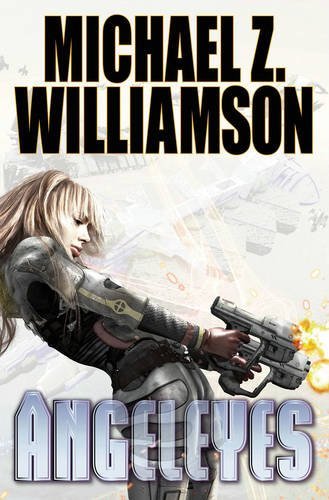
Review: Angeleyes by Michael Z. Williamson


Williamson's work can be described as mil-scifi with more than a slight libertarian twist. As such, it belongs in the same genre as Heinlein's Starship Troopers, or L. Neil Smith's Probability Broach series. 

Angeleyes, the latest in Williamson's outstanding Freehold series, looks at an unusual Freeholder. "Angie" Kaneshiro is a rolling stone, a spacer with multiple skills whose primary lifestyle is "moving on." After Earth's crackdown on its former colony of Grainne, Angie lists her origin as "Caledonia," because as Earth ships and uniforms become increasingly prevalent, new regulations tighten down on travel for all, but especially Freeholders.

Blessed by her parents with an opaquely-spelled name (Aonghaelaice) and the right to return to her real homeworld of Grainne, Angie prefers to camp with a series of friends, or kip in the odd spaces of habitats and stations until she can find a berth on a ship going somewhere—almost anywhere—else. She has a talent for spotting those unused, unmonitored spots in the interstices of her stop-over worlds. These are places she can live free, if with little comfort, until it is time to move on. She's made a life out of living briefly in such places before she ships out again.

When war actually begins, Angie realizes that her knowledge is vital to her homeworld. She contacts a Freehold Special Ops base, and volunteers her expertise. The rest of the story is a delicious sequence of sneaky maneuvers, sabotage, and mayhem centered around Angie's teammates, with Angie supplying the hideouts and cultural data to prevent their discovery by the Earth forces arraigned against them.

The most intense part of the story, which like Freehold, is definitely not suitable for young readers, is when Angie is seized as a spy, and tortured by her captors. Readers of the earlier books in this series will recognise Williamson's unwillingness to "prettify" warfare. We know Angie doesn't die, but there are no guarantees about any other character in the novel. 

This is fiction at its closest approximation to real life. You could believe this action and these people taking life in any setting of current day or history, anywhere on Earth. That it is set in space simply leaves us free to notice how well the reasonable libertarian society functions despite its philosophical enemies.

It is not for the squeamish, nor the statist.

Friday, November 25, 2016

Post-Apocalyptic Networking

Review: Web of Everywhere by John Brunner


The societal consequence of instantaneous matter transportation is a recurring science-fiction theme. No one has ever done it better than Alfred Bester in The Stars My Destination, though many have tried. (Or have not tried, as with the inconsequential matter transmitters of Star Trek.)

John Brunner came closest to out-Foyling* Bester with this little-noticed novel. Unlike Brunner’s The Infinitive of Go, published six years later, WoE concentrates on the social and political implications of a matter transmitter called a “Skelter.” In the mid-70’s, with the horror of the Tate-LaBianca murders still fresh in everyone’s minds, the name was evocative. 

And like the “helter skelter” cult, the result of the Skelter technology’s free access to everywhere was murder, plus explosive plagues, terrorism dwarfing 9/11, and the collapse of civilization. A “puerperal fever” kills 80% of the world’s women, leaving many of the rest sterile. Only the invention of the “privateer,” a method to lock the Skelter doors against uninvited guests, and a strict law against using unauthorized Skelter codes, has managed to salvage what remains of civil society.
Theseus / Blinded by the dark / Followed Ariadne’s clew of thread.
Ariadne / Has ceased her spinning / And all doors lead to the Minotaur.
—Mustapha Sharif

Hans Dysktra is a deeply unsatisfied man. He is married (a rarity in this post-Skelter world), but his wife is shallow, vain, stupid, and fat. He works exploring the nuclear-ravaged Skelters of Europe under the aegis of a world-wide government headed by the inventor of the privateer, Chaim Aleuker. But secretly he explores unauthorized locations, documenting the state in which he finds these abandoned houses and the restorations he applies. His secret work, he tells himself, must not be revealed until after his death.

His partner in these efforts is Mustapha Sharif, a blind poet with a method for discovering Skelter codes. Sharif is the opposite of Dykstra in many respects; he lives calmly in a non-Skelter community, he is respected, even revered by many of the world’s leaders, and he deeply appreciates what he has. Despite Sharif’s disability, it is Dykstra who is blind, and Sharif who leads him.

Dykstra’s dark-room work on his latest “find” is ruined when his wife opens the door before the photos are developed. To punish her, he accepts her “treasure hunt” invitation to a party at Chaim Aleuker’s house, and solves the puzzle himself so effectively, he comes to the attention of the world leaders. When the party is overrun by local terrorists, he grabs a young “wild girl” guest and flees with her. Like trying to grasp a cobweb without breaking it, his attempts to have the things he believes he wants lead Dykstra only to destroy them.

The action in the novel is physical as well as mental, but the webs that unite each place to everywhere else serve also to bind people together. Cobwebs in unused dwellings echo the threads of connection that link people to each other. At the center of all these webs dwells Mustapha Sharif, a Way of Life believer whose household is Muslim, a respected elder who directly abets Dykstra’s crimes, a peaceful man whose former partners met violent deaths, a blind man whose observations are sharp and precise.
Once I met a man / who every day / went around the planet counterclockwise.
He said by this means / he gained a day / and would therefore live for ever.
Unluckily for him / Death measures time / otherwise than with clocks and watches.
—Mustapha Sharif

You can now get this novel on Kindle, but for the full experience, you’ll want the paperback edition. You’ll have to watch for it in used bookstores. Ignore the cheesy cover art. This is a story that deserves a wider exposure.

Liner Note

*Gully Foyle is the central character of The Stars My Destination, an unwitting champion at using jaunte energy, who has succeeded in breaking the planetary barrier to "jaunting," as the self-transmission is called. Even after 50 years, TSMD is still the starting point for many science fiction readers.

Why I Re-Read Favorite Novels

I am currently re-reading my whole collection of Lois McMaster Bujold Vorkosigan stories. There's a reason that's specific to Lois McMaster Bujold and her Vorkosigan oeuvre, and there's a wider reason that pertains to every novel I've ever read and loved.

First, the specific reason: it's Gentleman Jole and the Red Queen. A frequent motivator to reread earlier books in a series is the acquisition of a new novel in the arc. And ever since I began reading a large percentage of my new-book consumption to the Kindle, I can add the release in e-format of earlier books in a series to that reason, as well.

The broader reason, though, is that my love for a book or a series is triggered by more than a story. I'd like to share those "more" elements that make a book worth re-visiting, whether it is once or twice, or on a regular basis.


Characters

It's easy to fall in love with lovable characters; but I am also drawn to complex ones. They reward a re-read by revealing more of their nature each time I encounter them. I see additional facets of personality or motivation with each new reading. Villains may provide more appeal in this way than heroes, but in the Vorkosigan novels, it is Vorkosigan himself who is most complex. And if the latest novel in this series has little of Miles in it, I can still get my fix from the earlier books. 


World-Building

Vorkosigan's world is political-cultural as much as science-fictional. Bujold shares that ability to create a tasty culture with another author whose entire multi-novel series I feel compelled to re-read each time a new one appears: C.J. Cherryh and Foreigner. But the world a writer builds may be the familiar one we live in, with a single element twisted in an innovative way. Sheri Tepper has done this with The Fresco and The Family Tree, and they are two novels I return to on a regular basis.


High Concept

This is a harder element to pin down. I often do not know until several books into a series why one story-arc will qualify as re-readable and another will not, and the deep, broad, or delicious idea that recolors everything outside the novel for days after I read it is one. Tepper's novels have this, too—I need not agree with the concept to have it set hooks in my brain. Elizabeth Moon's Seranno and Vatta series qualify, for instance, with a cogent question. What changes would access to a real fountain of youth make in society? 


There are other considerations, like "moral" protagonists (Honor Harrington or Harry Potter, for example, whose less-complex main characters embody the moral of the story), or quotable thoughts—anything by Rand or Heinlein is a goldmine for quotes, as are all of the Connie Willis novels. But the three above are sufficient to bring me back, again and again, to relive the joy derived from reading a good book.

Even when there is not a new book in a series-arc.

Tuesday, November 22, 2016

Unsuspected Value: Chick-fil-A Calendar Cards

Review: Chick-fil-A 2017 Cow Calendar "No Pain, No Grain"


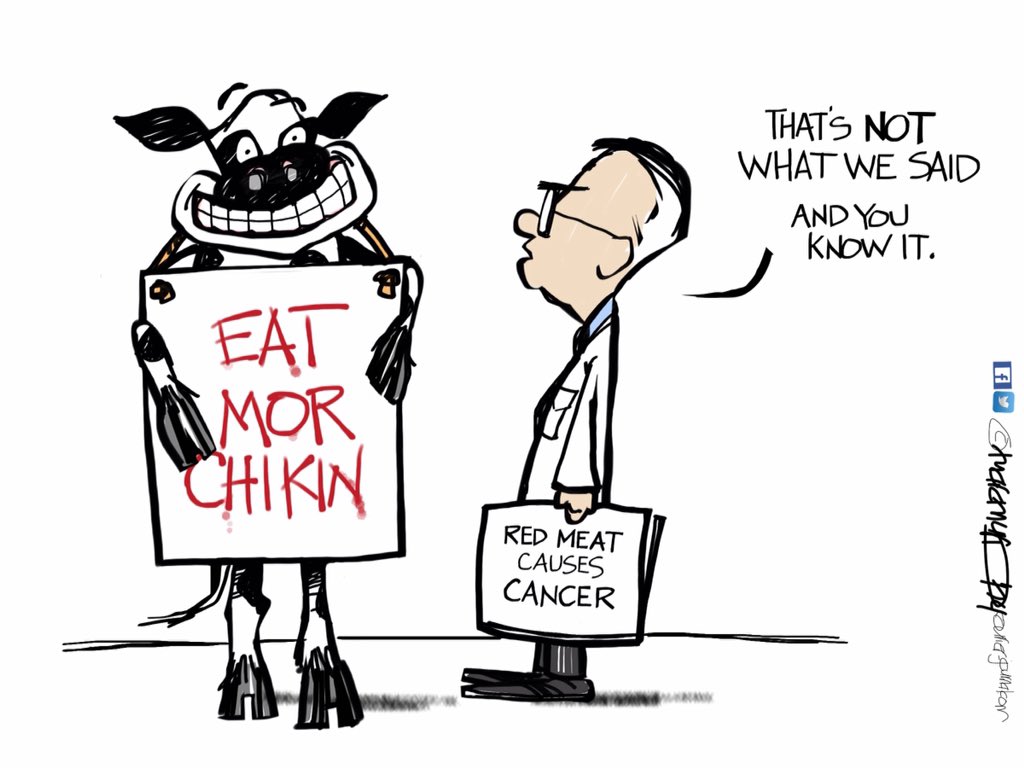
Yes, this really is a review of a calendar. If you haven't encountered the Chick-fil-A cows, they are a family of bovines with decidedly human lifestyles, and atrociously poor spelling. As I write this, I sit in my favorite writing corner of the local Chick-fil-A restaurant, savoring my breakfast of hot chicken tortilla soup underneath a poster of a cow who has just chewed the signature motto "Eat Mor Chiken" out of the leaves on a wall covered with foliage.

In the 2017 calendar, the cow family sweats their way to fitness in a variety of athletic endeavors: cycling, running, working out and otherwise exercising those muscles we rarely think about cows possessing. Probably the cutest image is "Mommy and Moo" with the mama cow exercising her calves in a sweet Pilates lift.

And while the humorous images make it a good calendar to hang on the wall, the real value in this $7 item is the card on the back. You register the card online, and once a month, it is good for a menu item from the Chick-fil-A list. Each month has its designated freebie. In January 2017 you can choose between the "Hearty Breast of Chicken Soup" or the "Chicken Tortilla Soup." Half of the year's worth of offers are a mystery, and half are listed items.

The key is that even the six listed items for 2017 will provide you with up to $20.56 in benefits, almost three times the cost of the calendar. To compare, from the 2016 Cow Calendar, the maximum total benefit for the $7 price turned out to be $43.85, over six times the initial cost.

Here's the way to parlay this into really major savings: buy calendars for Christmas gifts, but remove the cards and register them to yourself! I'm not too chicken to admit I do this, but only for friends and relatives who live nowhere near a Chick-fil-A.

The savings—like the chicken tortilla soup—are just too good to pass up!

Saturday, November 19, 2016

Fault vs. Responsibility: Dangerous Ideas for Our Time

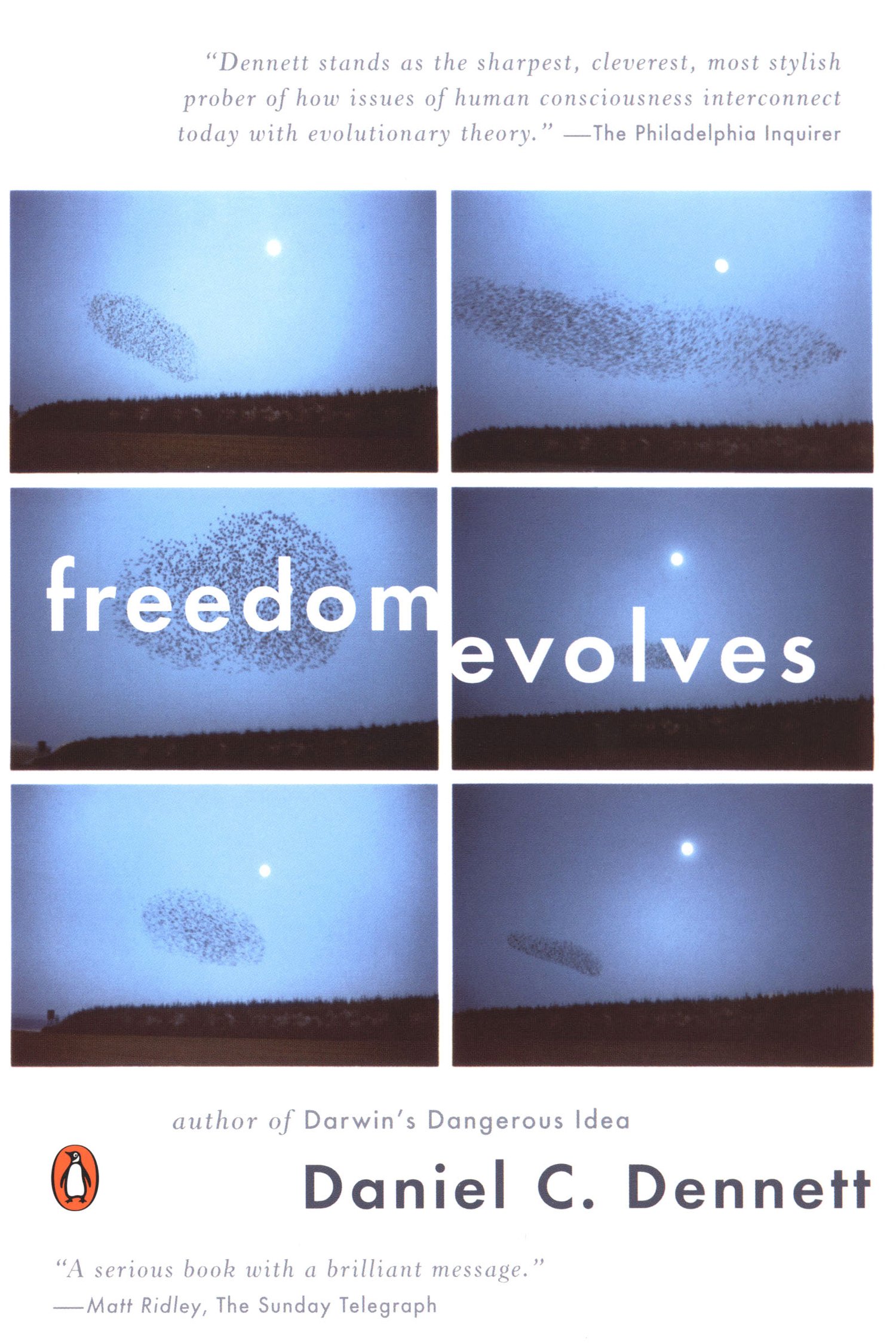
Review: Freedom Evolves by Daniel Dennet


Daniel Dennett is my favorite philosopher, for many reasons. One trivial reason: he writes to communicate, not obfuscate. On second thought, that's not trivial at all. His works on paper include web links, for another, and he chooses accessible illustrations to make his points. 

In the first section of Freedom Evolves, Dennett is discussing whether determinism—the idea that all outcomes/choices/decisions are set by the initial conditions, that "everything's fixed, and you can't change it," as 
Andrew Lloyd Webber's Judas complains to Jesusmeans that no one is responsible for their choices in life. 

To illustrate that 
whether or not you believe in it, determinism cannot affect guilt, Dennett tells the story of the French Foreign Legionnaire who is hated by all at the fort. Tom, knowing that he will be sent on patrol the next morning, poisons the water in his canteen. Dick, unaware of Tom's actions, empties the Legionnaire's canteen and fills it with dry sand. Harry, also unaware of the previous interventions, pokes a small hole in the canteen so its contents will trickle away as the hated fellow marches out in the morning. When the Legionnaire does march off into the desert with his adulterated canteen, and eventually perishes of the lack of potable water, which man is responsible for his death? 

Dennett has said of Freedom Evolves, "If I accomplish one thing in this book, I want to break the bad habit of putting determinism and inevitability together. Inevitability means unavoidability, and if you think about what avoiding means, then you realize that in a deterministic world there’s lots of avoidance. The capacity to avoid has been evolving for billions of years. There are very good avoiders now. There’s no conflict between being an avoider and living in a deterministic world. There’s been a veritable explosion of evitability on this planet, and it’s all independent of determinism." [Emphasis mine, Dennet quote from a 2004 interview in ReasonOnline

Exercise for the reader: Was the Legionnaire's death by dehydration avoidable?*

This review is a brief visit because this is not a book to be grasped in a quick scan; that's the main reason I like Dennett's work. I read several pages, then sit back, stunned by the light of reason. Aha! And I must go reread this article, or that book, or even turn back to reread a few pages in Dennett, in the light of that new understanding. 

"Inevitable" is a word I'm hearing a lot these days. So is "guilt," and "blame." Dennet helps put them all into perspective for me.


Liner Notes:

My involvement with Dennett pre-dates this blog by decades; Darwin's Dangerous Idea was the my first encounter. I enjoyed the philosophical exploration of this scientific revolution, with its the pro-and-con arguments from Darwin's time and ours so much that I went Dennett-hunting. Consciousness Explained was next. I found this the toughest to read, because I was also reading Stephen Pinker's How the Mind Works at the time, and many of Dennett's thoughts on Thought run counter to Pinker's. Then I got Elbow Room: The Varieties of Free Will Worth Wanting, and had to reread both of those books in the light of what I learned. All, including Freedom Evolves, are now available on Kindle.

Other writings by Dennett are available on the Web: The Bright Stuff and Two Brights Side-by-Side are on The Brights web site. Kelby Mason does a good job of boiling down the naturalistic world view in Thoughts as Tools: The Meme in Daniel Dennett's Work
Google "naturalistic" or "determinist" plus "Daniel Dennett" for more. You may also be interested in the TED Talk: Dangerous Memes.

*And the Legionnaire's "inevitable" death? There was a fourth man involved with his canteen, the only one who ultimately needed to rely on its contents, whose responsibility it was to make sure the canteen was functional, and filled with clean water. A fourth man, who might, had he thought about it, have suspected that the canteen might have been tampered with. So while his death in the desert was not his fault—I'm not blaming the victimit certainly was avoidable.