Thursday, October 13, 2016

Who is Most Evil: Yul Brynner or Ed Harris?

Review: Westworld (HBO Series) with Evan Rachel Wood, Ed Harris, Anthony Hopkins, James Marsden —vs— Westworld (1973 MGM Film) with Yul Brynner, Richard Benjamin, James Brolin


Based on the novel of the same name by Michael Crickton, the 1973 Westworld film (directed by Crichton) featured a loose-jowled, black-clad Yul Brynner as the cold-eyed gunman robot in a theme park designed to thrill guests with gun-fights, saloon-girls, high-stakes gambling, and outlaw-hunting. Brynner's robot was programmed to be threatening, but unable to kill any human. It was designed to lose in the end to any guest who challenged him.

It isn't until that programming "goes wrong" that robots begin to kill the human guests.


In the HBO series, the gunman who loses is still a "host" (this version's name for the robots), and the shooter is still a human. But this time, the black hat and dead-soul stare over the gunsights belong to the human, Ed Harris. And what an evil fellow he is, too! This nameless guest is determined to find a way to stay in the park, killing with abandon, and indulging all the base appetites a man can possess.

Others have commented about the rich world-building of the HBO production, and the casting of star-class film actors Anthony Hopkins, Ed Harris and James Marsden, plus small-screen stars like Evan Rachel Wood, Jeffrey Wright, and Luke Hemsworth. If we've seen the 1973 film, we have a general idea of the storyline and its destination. So I'd rather focus on why Ed Harris' gunman is so much more sinister than Brynner's was.


I think the first reason is simple. A robot is amoral by nature; its motivations and goals are not its own. They come from its programming, which is, in the end, a human product. Any "evil by design" host in the HBO series came from the workshop with that vileness built in.

Harris, on the other hand, has chosen to be vile. He can have a dead-soul stare because he had a soul to kill in the first place; he has stepped onto the path to hell of his own free will. As a robot, Brynner had no free will to make a choice. Even his "evil" actions are the result of human error, not his own.

In addition to the philosophic difference, the truth is that the Westworld of the HBO series is darker than the one we saw in the 70s. Even the "white-hat" guests are encouraged to indulge vices. None of them are expected to be saints, and the park is designed to offer darker and darker "narratives" to accomodate their slide from virtue. Thus, the evil espoused by Harris needs to be crueler, more heartless, than the ordinary sinners who pay to live out dark fantasies for a few days.

Finally, Harris is tall and lean, sharp-cut, a steel knife of a figure. He is physically more menacing than Brynner could be in this role. Coupled with the human evil he represents, the dire threat offered by the gunman in black is as obvious and bone-chilling as a rattler's warning. 

Or perhaps more so, in this playground where rattlenakes are mere scenery, and "only man is vile."


Liner Notes:

  1. Listening to the the player-piano music in Episode 1, I was surprised to hear the classic "Black Hole Sun" by Soundgarden (one of my favorite pieces of music), followed by the Stone's "Paint It Black." By Episode 2, I was listening intently during all the saloon scenes, and was rewarded with Radiohead's "No Surprises." 
  2. It was nice to see actor Jimmi Simpson in Episode 2, playing the nebbish part he has done so well in multiple TV shows before this. He seems more balanced in it than the similar role played by Richard Benjamin in the MGM movie version.
  3. Keep an eye on the young boy character who has shown up several times now. Is he a human guest? Or a memory of Anthony Hopkin's character, made flesh?


Wednesday, October 12, 2016

Typical Tepper: Excellent Enigmas

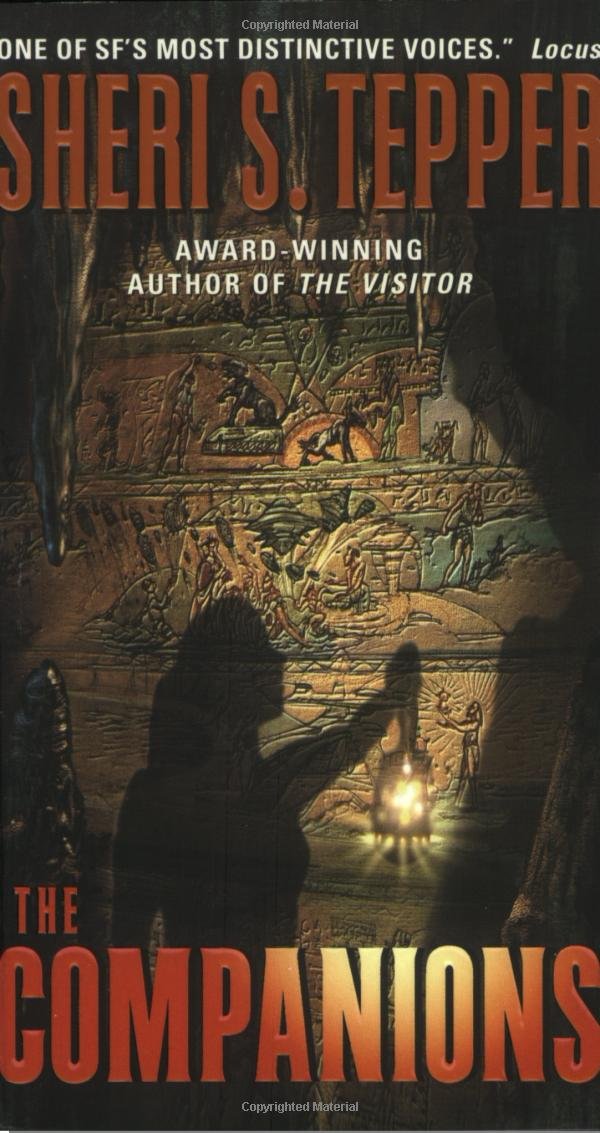
Review: The Companions by Sheri S. Tepper


I sometimes feel that every review of a Sheri Tepper novel should be subtitled, "Dances With Words." Even though I rarely agree with the writer's philosophy, the astoundingly graceful way in which she spins words into story is seductive, and subliminally persuasive:

The moss world... was a Victorian parlor of a planet, everywhere padded and bolstered, its cliffs hung with garlands, its crevices studded with cushions, every cranny silk-woven, every surface napped into velvet. Here were peridot parklands where moss piled itself into caverned outcrops of sapphire shade. There were violet valleys, veiled in lavender and wine, across a mat of miniscule, multi-colored moss beads...


I first read this book as soon as it was released in paperback, in September 2004. In addition to Moss, another mono-cultured world like Grass, which I reviewed in 2014, Tepper has introduced conquering canines, vat-cultured concs (concubines), a burkha-clad populace on Earth trying desperately to stay sane in the crowded conditions, and the siren comfort of the world of Moss, a pillowed and bolstered place that may (or may not) have inhabitants.

The most wonderful characters in the book are the six talking dogs rescued from Earth by the linguist Jewell. Together Jewell and her companions Scramble, Behemoth, Dapple, Titan, Wolf and Vigilant contact the intelligent life of Moss, and are "dognapped" to a world where canine-forms rule (and where Jewel is reduced to pet-status while her companions are lauded). Together they must solve the ultimate mystery posed by Moss and a dozen other worlds: where have the ancient races gone? 

You need not subscribe to the eco-crisis, feminist vision of Tepper to thoroughly enjoy the disturbing pleasure of her writing. Like scarlet moss, it carries the reader to ever-higher transports of delight. And if a Tepper novel does not exactly provide a happy ending, at least, like a well-composed fugue, it will always provide closure.

Big Fun in Little China

Review: Big Trouble in Little China with Kurt Russell, Kim Catrall, James Hong


Traditional wuxia, films in a martial arts fantasy genre that originated in Hong Kong, feature melodramatic acting and slapstick humor, along with silly story lines interspersed with elaborate fight scenes in which the combatants can literally fly, or pause midair in slo-mo. John Carpenter took these crucial elements of Chinese film-style, coupled them with a goofy American hero (Kurt Russell), an abrasive and clumsy activist lawyer (Kim Catrall), staged it in San Francisco's Chinatown, and had an American hit on his hands.
Is this gonna get ugly? I hope not cause I thought what we were, racial differences notwithstandin', was all friends here, all Californians.

The interesting thing is, this movie came out in 1986, 14 years before the critical cross-over success of Crouching Tiger, Hidden Dragon, and 13 years before the state-of-the-art special-effects blockbuster, The Matrix.

Little China has all the necessary components for wuxia: magicians and ghosts, monsters and flying sword fights, gods of storm and lightning, virtuous maidens and their heroic lovers, and wise old-men teachers masquerading as peasants. Chinatown provides a colorful venue for these adventures, with white-slavery rings, gambling, tongs and tea parlors as extra spice.

Even at its age, the movie is hardly dated, mostly because it is actually set in the romantic past. The era that informs Little China is the 40s, a time when the "yellow peril" could be discussed without any snickering or PC outrage. (In fact, a radio talk show in the background over the opening credits features a caller arguing that "Chinese immigration" imperils the American worker.) This, despite Russell's Jack Burton character, who seems hardly to notice the ethnic of his gambling buddy Wang Chi.

While hardly as athletic as a Jackie Chan movie, or as beautifully scripted as Jet Li's Hero, Little China is one of the few movies of its kind that I can watch over and over again. This is an underrated classic
even in its adopted genrewhich continues to succeed because, despite the wild action and fantastical plot, the main characters are likeable and we can identify with them.
You just listen to the ol' Pork Chop Express an' take his advice on a dark and stormy night when some wild-eyed eight-foot tall maniac grabs your neck an' taps the back of your favorite head up against a barroom wall. An' when he looks you straight in the eyes and asks you have you paid your dues? Well you just stare that big sucker right back in the eyes and you remember what ol’ Jack Burton always says at a time like this. "Have you paid your dues Jack?" "Yessir, I have, the check's in the mail."

Wednesday, October 5, 2016

Ebola, Marburg and HIV-AIDS

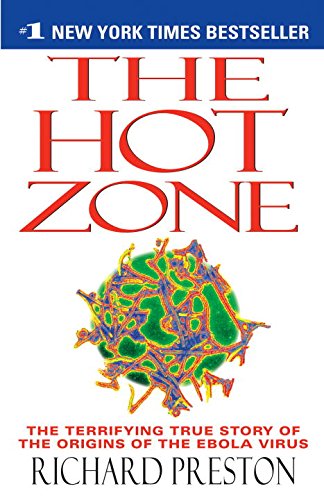
Review: The Hot Zone by Richard Preston


A classic NCIS episode1 I watched again this week focused on an anthrax attack that took down two of the agents. Marburg deaths have been slowly increasing in Angola over the past decade and AIDS statistics on the continent continue to amplify. Whether news or fiction, virulent infections capture our attention.

The fear of plague is deeply rooted in us. The thought of a disease that wipes out one in five, one in three, or nine of ten panics us, even when the infection is happening in a remote part of the world and is nominally under control. 

How much more terrifying is the realization that there is no part of the world remote enough to contain contagion? That these agents enter our borders daily, taking up residence in our population centers, smoldering unrecognized?

The chilling tale in Preston's book is a true story, lightly fictionalized in its details, and vastly amplified in the disturbing coincidences it presents. It opens with the description of a death in western Kenya, a horrifying account of how the Marburg virus kills. We meet Charles Monet, who dies in a gruesome fashion in a hospital in Nairobi. We meet the physicians and nurses who contract the disease from him. 

More horrifying, we learn that Marburg is the least lethal filovirus of three related agents. Ebola Sudan, which surfaced in the war zone of southern Sudan, kills half of those infected. Ebola Zaire kills eight to nine of ten infected. In this context, Marburg is relatively safe, killing "only" an average of one in two infected. (Unfortunately, one current strain in Angola is much more virulent; in May 20052, for example, the WHO reported that 276 of 316 reported Marburg cases were fatal. That's 87%, beginning to rival Ebola Zaire!)

I first read Hot Zone in 1999, when bioterror was a collegium topic rather than a keyword in current events. The tale of the discovery of a fourth filovirus—Ebola Reston—in a monkey house on the outskirts of Washington, D.C. was an eye-opener for all. Preston's dry, matter-of-fact style gives the already-chilling tale a liquid-helium twist. See, he says on more than one page, we dodged the bullet this time. Next time, we might not be so lucky. The tale of the discovery, containment and disinfection of the building is interspersed with equally factual tales of the devastation wrought by Ebola and Marburg in Africa.

We are already seeing the slow spread of a much more lethal agent, HIV-AIDS3, through the human race. AIDS is more successful than Marburg or Ebola, Preston argues, because it doesn't kill so swiftly and nastily. The virus has much more time to transmit itself. As horrifying as death from AIDS can be, the early stages of the disease may actually make the victim more capable of infecting others, especially in cultures where a slender physique is considered attractive.

Even so, the plague Preston details in this book is terrifying enough, an Ebola-like infection that travels through the air like the common cold, killing 100% of the non-human primates who are exposed to it. This particular game of Russian Roulette turned out to land on an unloaded chamber for the human race.

Do we really want to keep playing?


Liner Notes

  1. It was NCIS Season 2, Episode 22, "SWAK." Tony got the anthrax-laden letter.
  2. The most recent Ebola outbreak was brought under nominal control in June of 2016.
  3. In July 2016, WHO warned of growing HIV-AIDS drug resistance.

Grist for Google+, Fuel for Facebook, Talking-Points for Twitter

Review: The Complete Monty Python's Flying Circus: All the Words Volume 1 and Volume 2


Whether you post your opinions at a site that allows comments, or read social media posts, sooner or later you may be puzzled by references to the legendary walking tree of Dahomey1, or  E. Henry Thripshaw's Disease2.


Maybe it's simply a snide aside about "Mrs. Betty Teal and her lover in Boulton." Actually, it probably wouldn't be them; Mrs. Teal paid the requested £15, so the name of her lover in Boulton was kept secret. But it might be one of the other hapless victims of BLACKMAIL, a Pythonesque parody of a Candid Camera-style game-show.
PRESENTER: Hello, sir, hello, yes. No sir, no. I'm sure you didn't. No, it's all right sir, we don't morally censure, we just want the money... Yes, and here's the address to send it to:
(caption read in voice over)
BLACKMAIL
BEHIND THE HOT WATER PIPES
THIRD WASHROOM ALONG
VICTORIA STATION

Perhaps you see a plea for the words to "The Lumberjack Song", but by the time you've fired up your VCR, fast-forwarded through the wrong 18 episodes to find it, transcribed the words and got back to your computer, six other people have already answered.

Dear Sir, I wish to complain in the strongest possible terms about the song which you have just broadcast, about the lumberjack who wears women's clothes. Many of my best friends are lumberjacks and only a few of them are transvestites. Yours faithfully,
Brigadier Sir Charles Arthur Strong (Mrs).
P.S. I have never kissed the editor of the Radio Times.


Help is here in the two volumes of The Complete Monty Python's Flying Circus: All The Words. Here is the complete dialog of the "Parrot Sketch", the entire menu recitation that sets off the Vikings in the "Spam Sketch", the five Bruces of the "Philosophy Department of the University of Woolahmooloo".

Fourth Bruce: No. Right, well, gentlemen, I'll just remind you of the faculty rules. Rule one—no pooftahs. Rule two—no member of the faculty is to mistreat the Abbos in any way whatsoever if there's anyone watching. Rule three—no pooftahs. Rule four—I don't want to catch anyone not drinking in their room after lights out. Rule five—no pooftahs. Rule six—there is no... rule six. Rule seven—no pooftahs.

Both books include a complete cross-referenced index; items from the other volume appear in italics in the index of each book. What isn't in these volumes is the brilliant cartoonery and illustration of Terry Gilliam, nor the bizarre credits that sometimes reflected the insanity that went before. (Some of Gilliam's graphics are described, where they are essential to the story or critical to the joke.) An insert of photos from the well-known episodes is also included in each volume.
Cardinal Ximenez: Nobody expects the Spanish Inquisition!

I've been enjoying these volumes for years, and find them essential to my reputation as a Python-quoter. I recommend them for any Flying Circus debater who wishes to reach the next level.


Liner Notes:

  1. Nicholas Parsons, for whom the Pythons named the walking oak, is a long-time (long-running?) British game-show host and radio personality, seen in the US on The Benny Hill Show. To my astonishment, the 92-year-old Parsons still lives near London.
  2. I actually purchased an E. Henry Thripshaw's Disease t-shirt, and wore it often in the 1980s. Alas, it no longer fits.
  3. My favorite bit is The Poet Ewan McTeagle, with its allusions to pompously-hammy Shakespeare sonnet readers and the real Scottish doggerel poet William McGonnagall.

Monday, October 3, 2016

Short-cut to the Library

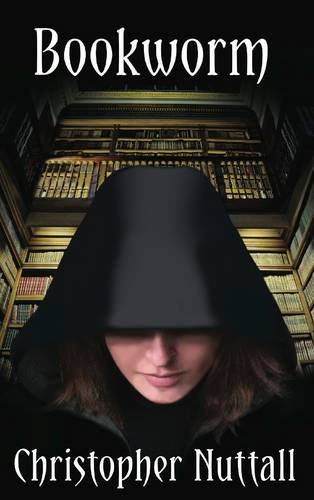
Review: Bookworm by Christopher Nuttall


Legions of schoolboys would love to believe that they could fall asleep on a pile of schoolbooks, and wake having absorbed all the required reading within. But for Elaine, who loves to read, a curse has handed her this result. Not for her schoolbooks, but for the entire contents of the Empire's Library, a repository of magical tomes—some of which are banned.

Elaine became a Librarian because her level of power for practicing magic was quite low. Without any more power, she now has a deep and complete understanding of magic, as well as the Empire's history, and secrets that have lain hidden in the Library's Black Vault. 

This series follows by several centuries the tale of Emily, who brought physical, chemical science to this world from Earth, as told in Nuttall's 10-volume Schooled In Magic series. This later Empire is still linked by Emily's steam-engine trains, but the old tension between "town and gown" remains. In this world, however, "gown" is the garb of the magic-user, while the "town" is filled with "mundanes" who possess no magical powers.

To make matters worse, the capital city has entered into a time of chaos between the death of one ruling Grand Sorcerer and the selection of the next. The Inquisitors who would normally answer to this ruler are now free to enforce the regulations without oversight—and it is strictly illegal for Elaine to have the knowledge the curse has planted in her mind!

Nuttall has crafted another delicious story of a world where magic follows strict rules, just like any other "science," and where people do not become superhuman just because they possess powers we do not. If anything, most of Nuttall's magic users are surpassingly petty and unempathetic. 

Not excluding the heroine Elaine. 

In fact, the tale's most empathetic and thoughtful characters may be the ominous Inquisitor Dread, whose task it seems to be to catch Elaine in a crime, and the socially active Daria, her roommate and friend, who has assigned herself the role of matchmaker for the socially awkward, shy Elaine.

I look forward with great anticipation to the next three books in the series. If they are as intensely engrossing as this first, I will be finished reading them shortly!


Liner Notes:


  • Inappropriate for younger readers. This novel contains several graphic sexual scenes and multiple comments about diverse sexual practices. While not totally gratuitous, these scenes can easily be skipped if your taste, like mine, is for less detail in such matters.
  • Some character's names (and backstories) are obvious nods to other novels. One contender for the Grand Sorceror title comes from a kingdom named "Gor," for example, where "women are expected to remain silent and obedient." His name is (snicker) "Vlad Deferens."
  • The author uses the British term "revise" where American English users would write "review." Since the opening scenes of the novel portray anxious students cramming (swotting) for exams, a jarring multiple occurrence of the term finally sent me to the Kindle dictionary. After, unfortunately, I had already marked it twice as a typo. 

Ida in Escherland

Review: Monument Valley from USTWO Games Ltd


This charming video game hides a secret: you can't solve its puzzles unless you are willing to let go of your preconceptions.

In multiple levels and three different titles (Monument Valley, Forgotten Shores, and Ida's Dream), you guide the silent princess on her path through the various mazes and walkways. Mystical music and airy scenarios surround her quest for the right spot to return her stolen loot. Yes, the silent princess in her conical white hat is trying to return lost "sacred geometries" to their monuments.

Princess Ida is not the only one who treads these convoluted passages. A turbaned mystic waits to chide her for her theft, and warn her that other thieves will cross her road ahead. And flocks of bullying crows block her way; it will take a clever path-finder to outwit them and reach her goal.

To my delight, the eye rules in this interesting puzzle game. You can create a new way ahead simply by changing your perspective. Music and occasional sound effects are pleasant, but you don't miss any clues by playing the game on mute. And the princess is so obedient! I sent her walking back and forth for 10 minutes at a stretch, climbing ladders and stairs, as I tried to spot the next legitimate move for the Nocturne maze. She wasn't even breathing hard!

The folks at USTWO have done an amazing job of creating multiple mobile puzzles that are difficult, but not ultimately unsolvable. Each time I thought I had walked Ida and her buddies into a permanent dead-end, the way opened up at last for her to move onward. 

And the final wonderful thing about the three Monument Valley games? All of them were free—really truly free—for my Kindle Fire tablet.