Showing posts with label TV. Show all posts

Monday, October 2, 2017

Galaxy Quest It's Not—And That's Good!

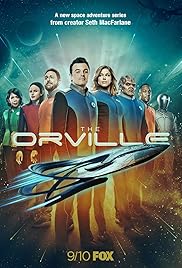
Review: The Orville, Fox TV, Initial Episodes with Seth McFarlane, Adrianne Palicki, and—Liam Neeson!?


Touted as a comedy, set in the "hallowed" Star Trek universe—sort of—and helmed by its writer/producer, and often, director Seth McFarlane (Family Guy, but also Ted and Ted2), The Orville on Fox Thursdays was not on on my watch schedule. I have a favorite comedic space-opera movie in Galaxy Quest, and sincerely doubted this TV show could match it.

Then I got a nudge from a friend on Gab, and went to Fox OnDemand to catch Episode 1. I wound up watching four episodes in a row.

Surprise! I don't know who was blowing air up whose skirts, but whether with intention or not, this is no comedy. Oh, it has its light-hearted moments. With McFarlane as its principal writer, of course it has plenty of puerile humor. (The "best helmsman in the Fleet" has been beached for "drawing penises on pretty much everything.") The zany mix of aliens in the Fleet are weirder than otherwise expected, including a mucusoid green blob that keeps propositioning the Doctor, finally settling for an evening alone, "just me and my toothpaste."

But the stories are classic Star Trek serious. Episode 1 has Captain Ed Mercer (McFarlane again) battling his XO ex-wife (Palicki) publicly on the bridge, and privately sniping back and forth whenever the opportunity arises. Everyone in the ship, it becomes obvious, is in on the issue, casually debatingor bettingon the outcome of their spats. Others have criticized the marital squabbling and the crew's absorption in it; I found it contributed to the realism. What people anywhere, anytime don't gossip about such things? 

Can you spell Kardashian?

A screamingly funny bit in fact literally brought in the Kardashians as a solution to a kidnapping. Helmsman Lt. Gordon Malloy (Scott Grimes) defeats an enemy ship by "humping the donkey", then wonders why his CO didn't ask where the egg produced by alien Lt. Commander Bortus (Peter Macon in a Worf-like appliance) came from, complaining, "How is that not the first thing you ask?"

So there's comedy in this "comedy-drama," just a whole lot more drama. And if it's a bit (or even a lot) strained, I'm willing to stick with it a while longer. I'll give McFarlane and the other writers a chance to grow into the drama-writing.

You see, I remember the initial episodes of Star Trek TOS. 

Monday, June 5, 2017

The All-Time Winner At Losing: Brockmire

Review: Brockmire with Hank Azaria, Amanda Peet, Tyrell Jackson Williams


Jim Brockmire, the incredibly-layered baseball boothcaster character created by Hank Azaria, is world-renowned for one thing: his disastrous on-air meltdown a dozen years back, following his discovery that his wife was cheating on him with a friend.

Fair warning: neither the wife's activities as discovered in flagrante delicto by her husband, nor Brockmire's subsequent vulgar commentary upon it, are politically, morally, or even grammatically correct. Brockmire has a huge Loser's Trophy, always on display.

Nothing—absolutely nothing—is held back as Brockmire's continual crisis of coping crashes headlong into the promise of a new life. In baseball. With a lover. With a young friend whose admiration for Brockmire is actually based on his renown for losing.

Brockmire's woes may have begun with the actions of his wife, but every downward step following that event, every stumble and fall afterward, is a direct result of his own actions. We wouldn't care about Brockmire if he were only a plaid-jacket-clad, inner-dialogue-out-loud jerk bent on making the world pay for his errors. What gives the character pathos is the same thing that makes him hilarious: he knows he is a failure. He accepts it. He has quit dreaming of overcoming that monumental mistake and the dozen intervening years of self-torture.

But life has more to offer Jim Brockmire. All he has to do is reliquish his trophy and embrace its opposite to win at this game.

Note: 

If you dislike foul language and blatant—even gymnastic—sexuality, avoid this program. The locker-room humor is not shyly hidden, it is celebrated. Even the commercials are risqué.

But redemption is always available, even for the self-damned. And that prospect of redemption is what makes this series rise above its foul-mouthed, gutter-hugging characters to be worthwhile to watch. 

Thursday, October 13, 2016

Who is Most Evil: Yul Brynner or Ed Harris?

Review: Westworld (HBO Series) with Evan Rachel Wood, Ed Harris, Anthony Hopkins, James Marsden —vs— Westworld (1973 MGM Film) with Yul Brynner, Richard Benjamin, James Brolin


Based on the novel of the same name by Michael Crickton, the 1973 Westworld film (directed by Crichton) featured a loose-jowled, black-clad Yul Brynner as the cold-eyed gunman robot in a theme park designed to thrill guests with gun-fights, saloon-girls, high-stakes gambling, and outlaw-hunting. Brynner's robot was programmed to be threatening, but unable to kill any human. It was designed to lose in the end to any guest who challenged him.

It isn't until that programming "goes wrong" that robots begin to kill the human guests.


In the HBO series, the gunman who loses is still a "host" (this version's name for the robots), and the shooter is still a human. But this time, the black hat and dead-soul stare over the gunsights belong to the human, Ed Harris. And what an evil fellow he is, too! This nameless guest is determined to find a way to stay in the park, killing with abandon, and indulging all the base appetites a man can possess.

Others have commented about the rich world-building of the HBO production, and the casting of star-class film actors Anthony Hopkins, Ed Harris and James Marsden, plus small-screen stars like Evan Rachel Wood, Jeffrey Wright, and Luke Hemsworth. If we've seen the 1973 film, we have a general idea of the storyline and its destination. So I'd rather focus on why Ed Harris' gunman is so much more sinister than Brynner's was.


I think the first reason is simple. A robot is amoral by nature; its motivations and goals are not its own. They come from its programming, which is, in the end, a human product. Any "evil by design" host in the HBO series came from the workshop with that vileness built in.

Harris, on the other hand, has chosen to be vile. He can have a dead-soul stare because he had a soul to kill in the first place; he has stepped onto the path to hell of his own free will. As a robot, Brynner had no free will to make a choice. Even his "evil" actions are the result of human error, not his own.

In addition to the philosophic difference, the truth is that the Westworld of the HBO series is darker than the one we saw in the 70s. Even the "white-hat" guests are encouraged to indulge vices. None of them are expected to be saints, and the park is designed to offer darker and darker "narratives" to accomodate their slide from virtue. Thus, the evil espoused by Harris needs to be crueler, more heartless, than the ordinary sinners who pay to live out dark fantasies for a few days.

Finally, Harris is tall and lean, sharp-cut, a steel knife of a figure. He is physically more menacing than Brynner could be in this role. Coupled with the human evil he represents, the dire threat offered by the gunman in black is as obvious and bone-chilling as a rattler's warning. 

Or perhaps more so, in this playground where rattlenakes are mere scenery, and "only man is vile."


Liner Notes:

  1. Listening to the the player-piano music in Episode 1, I was surprised to hear the classic "Black Hole Sun" by Soundgarden (one of my favorite pieces of music), followed by the Stone's "Paint It Black." By Episode 2, I was listening intently during all the saloon scenes, and was rewarded with Radiohead's "No Surprises." 
  2. It was nice to see actor Jimmi Simpson in Episode 2, playing the nebbish part he has done so well in multiple TV shows before this. He seems more balanced in it than the similar role played by Richard Benjamin in the MGM movie version.
  3. Keep an eye on the young boy character who has shown up several times now. Is he a human guest? Or a memory of Anthony Hopkin's character, made flesh?


Friday, June 10, 2016

Bloody Intellectual

Review: Wire in the Blood, BBC America series (orig. aired 2002-08), with Robson Green


Advertising hype usually arouses nothing but resistance in me, so I was a long time coming to watch BBC America's Wire in the Blood, the "most intense two hours on television." At the time it aired, I just wasn't ready for yet another semi-autistic savant leading investigations; in those days, I had standing appointments with Gil Grissom of CSI and Dr. Gregory House, and had rejected Numb3rs for much the same reason.

Resolutions are made to be broken. After reading a different book by series writer Val McDermid, I finally turned it on—and I was hooked. 


Robson Green's Dr. Tony Hill makes his mental efforts totally transparent, and he's less a mental magician than an obsessed compulsive completer. If you had my training and access to the police data, his manner says, you could solve these crimes, too. The character also has a rational relationship with DSI Carol Jordan, ably played by Hermione Norris, who heads the crime probes he's assisting.

Dr. Hill's assistance comes from his ability to enter the mind of a serial killer (and sometimes, his victims), sorting clues and juggling evidence until a pattern becomes clear. Clear to Dr. Hill, anyway. Wire's process involves some false starts and mistaken diagnoses before the real answer comes clear, when Dr. Hill's solutions are finally couched in ordinary, understandable language.

One episode that originally aired shortly after October 2002 had a chilling echo of that year's Beltway sniper attacks by John Allen Muhammad and Lee Malvo. In Wire's version, Hill and Jordan are faced with a series of seemingly unconnected deaths, in each of which a single playing card is found at the sniper's firing point. Dr. Hill struggles to find a pattern in the killings, even while he deals with the discovery that he has a brain tumor that may or may not be malignant.

Based on the pattern Hill has put together, the police arrest a man who is connected to each of the victims. They seem sure they have the right man, especially when they discover a cache of rifles hidden in the man's home. But as Tony Hill is consulting with a local minister, the man is shot in front of the church, literally inches away from Dr. Hill. The sniper is still at large, and Hill's pattern falls apart.

The phrase "the wire in the blood" comes from T.S. Eliot's Four Quartets:
The trilling wire in the blood
sings below inveterate scars
appeasing long-forgotten wars.

In an interview, Robson Green said the phrase was taken to mean a genetic kink, something impure and unusual in the blood, that might lead to the kind of psychosis Hill deals with. Val McDermid, author of the Dr. Hill and DSI Jordan mysteries, agreed. "Who knows what Eliot really meant by that line? Robson's explanation is as good as any. For myself, I've always taken it to be a metaphor for the thrill of adrenaline surging through the bloodstream. But we'll never know for sure."

This is a well-written drama. If there are stereotypes here, at least they come from British assumptions, and seem less expectable to American eyes. The result is a thoroughly enjoyable, and (I hate to admit) intense experience. 


Liner Note:

The "other book" I alluded to is Val McDermid's non-fiction, Forensics: What Bugs, Burns, Prints, DNA and More Tell Us About Crime, finally out on Kindle.

Wednesday, May 11, 2016

Grim, Dirty, Corrupt, and Real

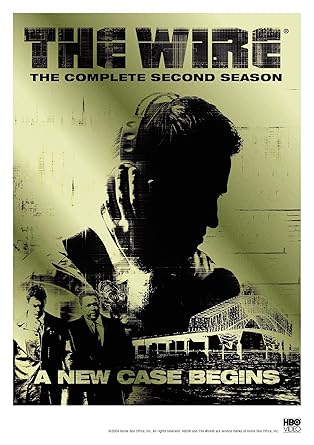
Brief Review: TV Series The Wire starring Dominic West, Sonja Sohn and Lance Reddick


One of the wonders of cable and webcast TV viewing is that occasionally, you can stumble into an entire amazing series you missed when it was originally broadcast. For me, this was The Wire, a series from 2002-2008, set in ghetto-and-dockyard Baltimore. After it was recommended during a recent "Watchathon" by multiple writers whom I trust, I began with Episode 1, Season 1, and watched it in its entirety over the course of a couple of weeks. In this environment, the story proved to be complex, well-written, with interesting characters who developed over the seasons into people I cared about, at least enough to curse at!

As the name might imply, the plot gimmick is telephone surveillance, run by the Baltimore Police Department (BPD) against the drug trade. Each season focuses on a new investigation, and explores it with a slightly different kind of wire. The series' continuing characters (both in BPD and on the streets) are, with just a few exceptions, criminal, dishonest, or corrupt—or all of the above!

The starring character, Detective Jimmy McNulty (Dominic West), is no exception: a self-destructive alcoholic locked in an adversarial relationship with his employer, Baltimore PD, he finds new focus with the initiation of a clever wire-tap equivalent as a task force of losers is assembled to investigate the street-corner drug trade in Baltimore's project housing. Over the course of 13 episodes in Season 1, the wire-tap crew comes together as an effective force arrayed against a criminal organization headed by Avon Barksdale (Wood Harris) and Stringer Bell (Idris Elba).

In this crowd of conniving police and murderous criminals, the few incorrupt individuals shine. Det. Kima Greggs (Sonja Sohn) is a competent cop side-lined by her gender and sexuality. Det. Lester Freamon (Clarke Peters) was shunted into a position as evidence clerk when he took a principled position against a superior 13 years before. Lieutenant Cedric Daniels (Lance Reddick) struggles to work within his framework as the department supervisor, but his effort is hamstrung from the beginning by department politics, budget limitations, and the misfit crew assigned to him. 

There are lots of questionable cops as well. Just to name a few, Det. Hauck (Domenick Lombardozzi) comes across as a bigoted thug. He and his partner, Det. Carver (Seth Gilliam), a wise-cracking sneak, are always looking for a way to skim. Under-reported drug money, bribes, theft of evidence property, and a few other scams send a trickle of graft to their pockets. Among the other losers detailed to the investigation unit is the clueless Det. "Prez" Pryzbylewski, son-in-law of the district commander, who manages to shoot a wall while showing off his "hair-trigger" personal sidearm in the first episodes. 

My short comments cannot possibly show all the ways the criminal Baltimore ghetto, the corrupt Baltimore political machine, and the crooked cops interact to undo any honest efforts to straighten out the mess. In each season, my initial response is glee at the clever twist on surveillance that promises to bring down the drug conspiracy. This segues into suspense as the venality of everyone, both sides against the middle, brings the investigation to naught. The final feeling is always frustration, as I realize the mirror that is held by The Wire reflects anti-crime activities everywhere, not just Baltimore.

I'll add only one thing. If you have the opportunity, hold your nose and brave the vile language. The Wire is worth wading in the muck, fighting the frustration, and rueing the political shenanigans. It's an action thriller that horrifies because it cuts a little too close to the bone, a little too close to home.