Monday, June 13, 2016

Undiscovered America

Review: The Lost Continent by Bill Bryson


WELCOME TO DES MOINES. 
THIS IS WHAT DEATH IS LIKE.

As a pre-teen boy growing up in Iowa, Bill Bryson read National Geographics and yearned to be a European boy, to travel, to be someplace else. Small-town America was just so rural. 

And in many books (In a Sunburned Country, Neither Here Nor There, Notes from a Small Island, Bill Bryson's African Diary), Bryson has done exactly that. Even better, his witty travelogues invite us to join him for good times and bad.

In Britain it had been a year without summer. Wet spring had merged imperceptibly into bleak autumn. For months the sky had remained a depthless gray. Sometimes it rained, but mostly it was just dull, a land without shadows. It was like living inside Tupperware.

The Lost Continent brings Bryson back to America, back to the rural scenery he once despised. He plans to travel a route across the mid-west in homage to his father. Along the twisted secondary-highway route, Bryson reconnects with the country of his birth, as manifested in the small towns, parks, and wayside stops he visits. His road trip expands to cover the whole American scene, from the largest city to the grubbiest desert cafe-grocery store-gas station. This is Bill Bryson, after all—we visit the pits as often as the heights.
In the morning I awoke early and experienced that sinking sensation that overcomes you when you first open your eyes and realize that instead of a normal day ahead of you, with its scattering of simple gratifications, you are going to have a day without even the tiniest of pleasures; you are going to drive across Ohio.

A Bryson travelogue is a series of poignant or pithy vignettes, stirred together into a potage of unique flavor. It will never be too sweet. New York: "Next door a store sold pornographic videos, right there on Fifth Avenue. My favorite was Yiddish Erotica, Volume 2. What could this possibly consist of...?" 

Wells, NV, had: "absolutely, in my opinion, the worst food I have ever had in America, at any time, under any circumstances..."; Savannah, GA: a Hyatt Regency: "from the F-ck You school of architecture..." 

But then he praises Detroit's Henry Ford Museum: "Grudgingly I paid the admission charge and went in. But almost from the moment I passed through the portals I was enthralled." And Charleston, SC: "I walked away the afternoon, up and down the peaceful streets, secretly admiring all these impossibly happy and good-looking people and their wonderful homes and rich, perfect lives."

Bryson's decades living in England make so much about America appear fresh to him, from TV commercials to the "chichi" signs on a shop door. Like many readers, I watched to see if Bryson would visit my hometown, and then waited with bated breath to see if it would receive that rare sweet comment, or strike a sour note. Even Bryson himself is not immune; he detoured from his planned route to visit Bryson City, and found himself regretting he did not have a crowbar to remove a souvenir sign.

I particularly fancied having the Bryson City Church of Christ sign beside my front gate in England and being able to put up different messages each week like REPENT NOW, LIMEYS.

I like Bill Bryson's books; I've been to many of the places he describes—or I feel that I have, after reading them. It's the way he has of taking us along, like passengers in the back seat of the family car. We may not pick the itinerary, but there we are, enjoying and suffering by turns as Bryson drives.

Are we there yet?

Saturday, June 11, 2016

Lemon 3D Printer: A "Life" Lesson

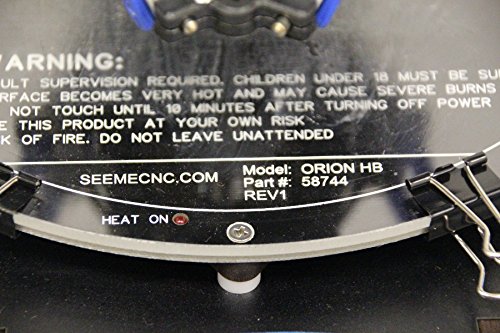
It should say: "WARNING! LEMON!"

Review: Orion Delta 3D Printer from SeeMeCNC


Our Bukito 3D printer reached its end-of-life after a yeoman performance that ran somewhere around 3500 printing hours, over the course of a year and a half. It included lots of transport and "waving" the printer during operation, since the Bukito is designed for portability. 

We knew the Orion Delta, purchased with a MatterControl Touch controller through Amazon, would not match the portability of the Bukito, but we certainly expected a longer life than 75-100 printing hours.

Yes, that's the total. Out of the box, it worked well, and we began to climb the learning curve of the new controller with its dedicated slicing and rendering software. We had just over a month of using the new Delta printer at around half the printing hours per week as the Bukito. Then we began to have heating problems with the unit. 

First to appear were odd blobs of plastic studded on otherwise-smooth objects. Then extrusion began halting mid-output, with models "printing air." The extruder nozzle was still moving above the half-finished object, but no plastic was coming out. Observing conditions when this happened, we noticed the temperature was reading low. Something was wrong with the equipment: either the sensor was misreading, or the extruder was not heating sufficiently. 

We researched the problem online, and discovered many complaints about failure of the heating resistors for this model. One user told of his experience in following the recommended repair of his self-assembled printer: after the resistors were replaced, he had a fire that torched the printer and his workbench.

We don't have to worry, I assured my partner. We bought the unit fully assembled. But no, this is the response we got from SeeMeCNC support on the matter:
It sounds like the issue that you have is with the heating resistors. They have simply come to the end of their life and will need to be replaced. I have attached a PDF that shows where the heating resistors are located on the hot end. [emphasis mine]

The support email concluded with instructions about how to test this diagnosis with a multi-meter and where to obtain parts and a guide to replacing them in the printer.

We told them we were uncomfortable trying this repair at home, and asked for a different option, perhaps a modular replacement that could be plugged in. We got a support ticket number and a promise of followup "within a few days". That was May 30th.

On June 6th, my partner sent a reminder ("Seven days is a few, right?") 

Crickets.

Yesterday, still having heard nothing after 12 days of waiting, we sent an urgent request for an immediate response: "On May 30th, you told us that we would have a reply in a few days. Seven days later, having heard nothing more from you, I sent a reminder, to which we have still had no reply... I don't want to call 'lemon' on this equipment, but saying that we need to essentially rebuild the equipment we purchased from you via Amazon after such a short use is not a reasonable support response."

Still no response. It's a pity, and a waste of the $1200+ we spent to acquire it fully assembled with the dedicated controller. The controller works well, and we can put it to use with our next 3D printer, when we scrape together enough extra funds to purchase one.

But the printer itself is a lemon.

Friday, June 10, 2016

Engineer's Choices: Complexity, Reliability and Politics

Review: Beyond Engineering by Robert Pool


Robert Pool, author of the controversial look at the biological basis of gender, Eve’s Rib, and longtime contributor to several distinguished science and technical journals, did not realize what a complex topic he had chosen when he began this book. Originally, he intended to write “a straight-forward treatment of the commercial nuclear industry—its history, its problems, and its potential for the future.” Instead, he discovered a Byzantine maze of inter-connected choices, society shaping technology, rather than the opposite. Beyond Engineering completes the circle, reflecting what he discovered back to the general, non-technical, public in very accessible terms.

History and Momentum begins this journey into complexity with a look at how society has shaped the choices made in providing electricity to the user. Edison, Westinghouse, and Tesla; Szilard, Einstein and Rickover—choices made by these men before 1950 determined the economy of future decisions in the power industry. Pool then looks at The Power of Ideas, giving us a background on the concept of paradigm shift in molding scientific inquiry, before exploring how the “endless power source” paradigm shifted irretrievably to an “evil destructive nuclear polluter” view of nuclear power.

These shifts in choice, decision, and viewpoint are reflected in the book itself, Pool tells us in his Introduction:
This is a very different book from the one I began writing four years ago… In 1991, the Alfred P. Sloan Foundation provided grants to some two dozen writers to create a series of books on technology. Because [technology has shaped the modern world so profoundly], Sloan wanted to give the general, non-technical reader some place to go in order to learn about the invention of television or X-rays or the development of birth control pills. This would be it. Sloan asked that each book in the series… be accessible to readers with no background in science or engineering…

I took nuclear power…

A chapter on Business looks at the rise of giants like GE, IBM, Apple and Xerox, in the background of the growing industrial demand for power; one on Complexity examines the history of steam power, the growth of the US automobile and airline industries and airplane manufacturers like McDonnell, before presenting information about nuclear generation of electric power. By doing this, Pool gives his reader a stronger base to judge the value of the information he presents.

Choices and Risk then take us into the heart of Pool’s contention that society shapes technology. In delineating the choices available in nuclear power, Pool first introduces the concept by discussing previous choices: internal combustion vs. steam; QWERTY vs. the Dvorak keyboard; VHS vs. Betamax. To illustrate how risk assessments should and do guide such choices, he uses a discussion of recombinant bovine growth hormone, rBGH, and the controversy its use stirred up:
…The system of cows, humans and bacteria was simply too complex to analyze in any but the crudest detail. The calculation of risk could only be an approximation. In such cases, where there is no clear right or wrong answer, people tend to rely on their instincts, biases and gut feelings about how the world works…

Finally, Pool looks at control and reliability in a section titled Managing the Faustian Bargain. The chapter on control investigates the legal system that has grown up around the power industry, by telling the story of how a former church secretary named Juanita Ellis fought the giant Texas Utilities to a standstill—for nearly a decade—over the building of the Comanche Peak nuclear power plant. In looking at reliability, Pool examines once-reliable entities such as NASA, and what happens when that reputation is allowed to substitute for acting in reliable ways. The description of an exemplary “highly-reliable organization” (a Nimitz-class carrier, written by a naval carrier officer) is notable:
So you want to understand an aircraft carrier? Well, just imagine that it’s a busy day, and you shrink San Francisco Airport to only one short runway and one ramp and gate. Make planes take off and land at the same time, at half the present time interval, rock the runway from side to side, and require that everyone who leaves in the morning returns that same day. Then turn the radar off to avoid detection, impose strict controls on radio, fuel the aircraft in place with their engines running, put an enemy in the air, and scatter live bombs and rockets around. Now wet the whole thing down with salt water and oil, and man it with 20-year-olds, half of whom have never seen an airplane close up. Oh, and by the way, try not to kill anyone.

In this increasingly technological age, the complexity of technology has grown to the point where no one person can know everything about even a very restricted discipline, at the same time that more and more of societal attention is focused on how these complex systems interact. Pool’s book is a good first step on the road to the re-engineering of engineering itself, and an excellent argument that such a sweeping change is essential.

Liner Note:

Beyond Engineering is available for Kindle, Eve’s Rib is not.

Bloody Intellectual

Review: Wire in the Blood, BBC America series (orig. aired 2002-08), with Robson Green


Advertising hype usually arouses nothing but resistance in me, so I was a long time coming to watch BBC America's Wire in the Blood, the "most intense two hours on television." At the time it aired, I just wasn't ready for yet another semi-autistic savant leading investigations; in those days, I had standing appointments with Gil Grissom of CSI and Dr. Gregory House, and had rejected Numb3rs for much the same reason.

Resolutions are made to be broken. After reading a different book by series writer Val McDermid, I finally turned it on—and I was hooked. 


Robson Green's Dr. Tony Hill makes his mental efforts totally transparent, and he's less a mental magician than an obsessed compulsive completer. If you had my training and access to the police data, his manner says, you could solve these crimes, too. The character also has a rational relationship with DSI Carol Jordan, ably played by Hermione Norris, who heads the crime probes he's assisting.

Dr. Hill's assistance comes from his ability to enter the mind of a serial killer (and sometimes, his victims), sorting clues and juggling evidence until a pattern becomes clear. Clear to Dr. Hill, anyway. Wire's process involves some false starts and mistaken diagnoses before the real answer comes clear, when Dr. Hill's solutions are finally couched in ordinary, understandable language.

One episode that originally aired shortly after October 2002 had a chilling echo of that year's Beltway sniper attacks by John Allen Muhammad and Lee Malvo. In Wire's version, Hill and Jordan are faced with a series of seemingly unconnected deaths, in each of which a single playing card is found at the sniper's firing point. Dr. Hill struggles to find a pattern in the killings, even while he deals with the discovery that he has a brain tumor that may or may not be malignant.

Based on the pattern Hill has put together, the police arrest a man who is connected to each of the victims. They seem sure they have the right man, especially when they discover a cache of rifles hidden in the man's home. But as Tony Hill is consulting with a local minister, the man is shot in front of the church, literally inches away from Dr. Hill. The sniper is still at large, and Hill's pattern falls apart.

The phrase "the wire in the blood" comes from T.S. Eliot's Four Quartets:
The trilling wire in the blood
sings below inveterate scars
appeasing long-forgotten wars.

In an interview, Robson Green said the phrase was taken to mean a genetic kink, something impure and unusual in the blood, that might lead to the kind of psychosis Hill deals with. Val McDermid, author of the Dr. Hill and DSI Jordan mysteries, agreed. "Who knows what Eliot really meant by that line? Robson's explanation is as good as any. For myself, I've always taken it to be a metaphor for the thrill of adrenaline surging through the bloodstream. But we'll never know for sure."

This is a well-written drama. If there are stereotypes here, at least they come from British assumptions, and seem less expectable to American eyes. The result is a thoroughly enjoyable, and (I hate to admit) intense experience. 


Liner Note:

The "other book" I alluded to is Val McDermid's non-fiction, Forensics: What Bugs, Burns, Prints, DNA and More Tell Us About Crime, finally out on Kindle.

Thursday, June 9, 2016

Growth of Mind and Consciousness

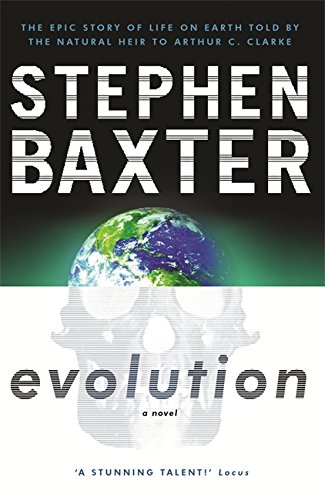
Review: Evolution by Stephen Baxter


In a sweeping story, Baxter has chosen to tell the tale of human evolution, from our earliest mammal ancestor through present day and into a post-human future. Bringing together factual elements to paint a picture of what it might have really been like to live in these "geologically interesting" times, Baxter begins with a mass-extinction event, the comet-fall that spelled the end of the reign of dinosaurs.

Baxter's story begins with individuals in the line ancestral to humans. Through them he traces the rise of human thought and consciousness, the coming of religious beliefs, human societies and nations, the practice of war, and extinctions. Especially extinctions.

Characterizing the developing minds he follows as actors in understandable dramas of survival helps Baxter present deep concepts without being pompous or preachy, and set the stage for what might really come next. For example, at the Cretaceous-Tertiary boundary, ~65 million years ago [mya] and just after the comet-fall: 
...here and there living things moved in the ash: insects like ants and cockroaches and beetles, snails, frogs, salamanders, turtles, lizards, crocodiles - creatures that had been able to hide in mud or deep water - and many, many mammals... It was as if the world ran with rats. 

In this time also, proto-primates already have brains "large and complex enough to require self-referential cleansing...", and so they dream.

An arboreal primate in the arctic jungles of ~51 mya is threatened by his own reflection:
From inside the water two primates were looking out at him... He could not smell the male, could not tell if he was kin or stranger... [He] could recognize others of his species [but]... could not recognize himself, for his mind did not contain the ability to look inward.

About 5 mya, proto-hominid "Capo" leads his ape-troop on the coast of North Africa with guile born of nascent consciousness:
He sat under a tree, dropped his hammer stone, picked up a stick and began to work methodically to clean out the spaces between his toes. He knew if he made a dash for his palm nuts the others would get there first and pilfer them... This new ability had even made him self-aware, in a new way. The best way to model the contents of another's mind was to be able to study your own. If... I believed what she does, what would I do? It was an inward look, a reflection: the birth of consciousness. If Capo had been shown his face in a mirror, he would have known it was him... 

I enjoyed the book thoroughly, even without necessarily agreeing with Baxter's rather grim projection beyond the present. Then again, if fiction isn't speculative, it just isn't science fiction!

Liner Note:

I found this novel strongly reminiscent of Michener's The Source, in the way both authors use fictional characters to make the history more approachable. The publisher echoes this thought in the cover text, which was the reason I decided to buy this book.

Wednesday, June 8, 2016

Shoddabags and Esteefee

Review: Little Fuzzy by H. Beam Piper


H. Beam Piper's output of science fiction includes three highly successful series, and two well-beloved novels: Lord Kalvan of Otherwhen and Little Fuzzy. Piper himself, however, believed he was a failure; he committed suicide barely 14 years into his writing career.

Little Fuzzy is the tale of an endearing creature encountered on a mining planet by Jack Holloway, a somewhat reclusive sunstone miner. Holloway recognises the intelligence of this little guy, especially when he happens to slow down a recording of the "Yeek!" noises that Little Fuzzy makes. 

That's how Holloway discovers there are discrete words in that high-pitched yeek—and "Pappy Jack" sets out to learn Fuzzy speech, as Little Fuzzy begins to learn English.

Navy emergency rations (ST3) are a big hit with Little Fuzzy, so much that he brings a few fuzzy friends to get them from Pappy Jack. All the Fuzzies want shoddabag (shoulder-bags made from old cartridge cases) and esteefee (the "wonderful food," as they refer to the Navy rat-bars.)

When more new Fuzzies show up with a wealth of sunstones to store in their new shoddabags, Holloway has a mystery to solve. Are the Fuzzies thieves? Even if they are, are they competent enough to be charged uder the law? Holloway's investigation pits him squarely against Victor Grego's Zarathustra Sunstone Mining Company, which has a monopoly charter to buy sunstones on the planet.

Holloway realizes that the Fuzzies' presence on the planet may mark the end of Zarathustra Company's charter, and that someone in the Company may be trying to eradicate all the Fuzzies before that can happen. The thrilling climax of the story pits Pappy Jack and Little Fuzzy against Grego and the Company in a court of law.

The story is charming, sweet enough that we do not notice how many serious themes are being presented. Guns and hunting, "appropriate technology," merchantile monopoly, faginy and the "legitimate" exploitation of minors, self-rule, and the rule of law are all tackled as Little Fuzzy and his champions establish Fuzzy sapience. You can thus read Little Fuzzy as a tale about cute little smart beings or as an allegory for conservative values.

Either way, Little Fuzzy is a book that ought to be on the shelf of any self-respecting science-fiction reader. 

Liner Notes:

  • I recommend it in the printed collection, The Complete Fuzzy, which includes the other two Piper Fuzzy novels, Fuzzy Sapiens and Fuzzies and Other People. 
  • A new version by John Scalzi (author of the Old Man's War series), Fuzzy Nation, retells the story of Pappy Jack and the Fuzzies. Piper's original may be a bit too saccharin and simplistic for modern tastes; Scalzi's Fuzzy has more kick and conflict. Perhaps both should be in your library.
  • Available for Kindle: Little Fuzzy, Fuzzy Sapiens (Piper); Fuzzy Nation (Scalzi)
  • Not on Kindle: The Complete Fuzzy, Fuzzies and Other People

Tuesday, June 7, 2016

Life on the Edge... of Elfhome

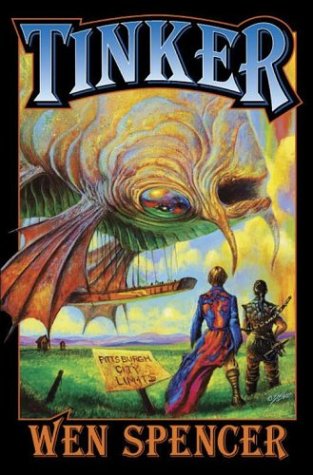
Review: Tinker by Wen Spencer


I'm not usually a reader of sword-and-sorcery fantasy. Maybe I don't have the D&D gene, or perhaps I just miss the internal consistency of reality-based fiction. This novel is an exception.

Start with the accidental translation of a chunk of American city into a parallel universe. For 20-plus years, part of Pittsburgh has been rotating for 29 days out of every 30 into Elfhome, where passenger pigeons exist side-by-side with leg-chomping wargs and flesh-eating willows.

Add in the Elfin Interdimensional Agency, charged with insuring that only adult residents of Pittsburgh and their dependents may remain in the city as it returns to Elfhome. Toss in two minors, Tinker and Oilcan (not their real names, of course), orphans who have held on to their home despite the death of their grandfather. Stir in a soupçon of elven politics, and a dash of nasty orc-ish oni villains, and the stew is bubbling.

Did I say Tinker is a girl, a genius who owns a scrapyard? Anyone with that much cold iron is a force to reckon with in fairyland. And Tinker has the opportunity to save the life of an elven lord fleeing a pack of wargs when he runs into her scrapyard. Tinker teeters from rescue to rescue, managing to set the entire Elfhome world on its ear as she goes.

Like Tinker the genius girl, Tinker the novel is consistently delightful, and internally consistent as well—you won't learn anything special from this book, but it is a lot of fun.