Wednesday, July 27, 2016

A Sideways Look at God

Review: Raising the Stones by Sheri S. Tepper


A recurring theme in Sheri Tepper’s work is the urge toward God, and the ways in which that urge motivates personal and cultural choice. This theme is blatantly obvious in Raising the Stones, Tepper’s 1990 novel in the Arbai Gates sequence.
Beside the ruined temple north of Settlement One, shallow in the soil lay Birrabat Shum. Shallow he lay, with fragments of roots and crumbs of leaves on his eyes…

Like Grass, which preceded it, and which I reviewed in December 2014, this novel is set on a human-settled world which already hosts a native life-form. The Owlbrit are already declining when humans arrive, and they soon die out, leaving behind their curiously shaped temples, one of which still boasts a sparkling, stony Owlbrit “god”. Some time after this, after the human settlements are already well-established, this remnant of Owlbrit life mysteriously dies.
Shallow under the soil, near the temple at Settlement One, straight fibers ramified into feathers, and the feather into lace, which reached beneath the houses and the storage yards, beneath the settlement buildings, beneath the old temples, out toward open country in a tenuous cottony web which enclosed in its fibrous reticulation all the land from the temples north of the community to the fields in the south…

Sam Girat, the Topman of Settlement One, is a genially efficient manager, capable and brave, but he’s not prepared for what happens next. The children of Settlement One set out to restore an older temple in the Owlbrit style, not as a religious practice, but “as a way, a convenience, a kindness.” Mysteriously, they acquire a new god to raise in the restored temple. Like his predecessor, the god Birrabat is a hard fibrous mass with evanescent sparkles running along just under the surface. Perhaps this god-stone is blasphemous, but Settlement One is suddenly running very well indeed, so the adults decide to let it go.

And the children prove to be very apt missionaries for their fibrous god. Elderly settlers, near death, are recruited to “lie shallow under the soil,” to be resurrected as helpful, intrusive Hobb’s Land gods. Gradually, this beneficently quiet infection spreads to fill the world. Everywhere the god-stones are raised, people are kinder to each other, readier to help, more attuned to each other’s needs.

But the infection has been noticed—unfortunately, by the Baidee, a culture that is obsessively opposed to “letting anyone mess with their heads.” This ukase from the mysterious Prophetess1 Morgori Oestrydingh, who arrived on their world through the long-inactive Arbai Gate, has been variously interpreted to mean “don’t cut your hair,” "never accept psychiatric help," and “don’t allow anyone to change your mind.”

Sam Girat, meanwhile, has himself begun to obsess about fatherhood, a concept that is not much honored in Hobb’s Land. In seeking his own father, he has raised a stone that hides a poisonous insect. Sam becomes ensnared by the life-negating Voorstoders2, a slave-owning group on another world, Ahabar, who assert their control over the pagan Gharm. Soon it is the Gharm, one or two at a time, who lie buried “shallow beneath the soil,” ready to provide a source on Ahabar for these very helpful gods. We encounter the slimy Porsa of Ninfadel (who scarcely qualify as sapient), bubbling and offensive, like physical manifestations of the Voorstoders’ hatred.

Tepper weaves these disparate cultures together to create an astounding tapestry of choice. The Baidee speak of preserving choice, but only for themselves; they act to quarantine the infected worlds, with disastrous unintended consequences. The Voorstoders preach choice, but only once; they believe their ancient contract with the Gharm has sway on a new world, and the Gharm may not chose again. The settlers on Hobb’s Land did not chose their gods, but would not chose to let them go now. Sam Girat chose his own myths and heroes in his father’s people, and now must make a better choice.
“What will you do without your books?” she asked again, worried about him… “Write new ones, China Wilm,” he told her… “Listen to the God and write new ones.”

Whenever I read this novel, I am reminded of a quote (I believe it is Spider Robinson’s, but I apologize if I am mistaken) to the effect that “cultural imperialism means you have a tasty culture in which others would like to partake.” When politics become contentious, when people get nasty, and progress is obstructed by the Baidee and Voorstoders of our own world, I wonder if, given the choice, we would accept the Hobb’s Land gods.

I must admit, the prospect entices. When my time comes, I would volunteer to lie shallow under the soil. It would be a way, a convenience, a kindness.


Liner Notes:

  1. It took me a long while after my first reading to translate the name of the mysterious Prophetess: Marjorie Westriding, the protagonist of Grass. Many characters in the Arbai Gate novels appear in wide-spread times and places due to the transportative powers of the Gates, which play a central part in this novel. 
  2. The Voorstoders are obviously meant (in name and culture) to invoke the Afrikaaner Voortrekkers. 


Patrick Henry's Choice: Liberty or Death

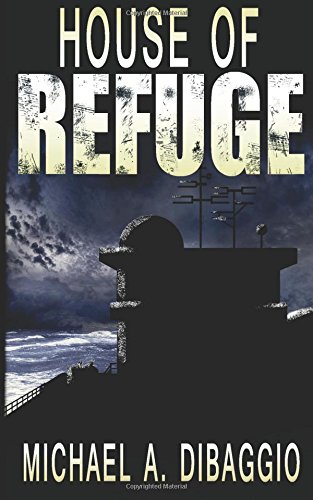
Quick Review of a Short Story: House of Refuge by Michael DiBaggio, Illustrated by Shell DiBaggio


The action and suspense of this tale of maritime rescue do not require the science-fiction details of the Plata Raft, seasteads, clades and states, or indeed the houses of refuge.You do not need to be familiar with the world of Ascension Epoch novels in which the house of refuge is placed.

DiBaggio has given us all we need in the opening paragraphs: a lifeboat beached on the deck of an armed and armored raft manned by a single rescue worker, Justin Agnarsson. This is South Atlantic House of Refuge #49.

Agnarsson's sole task is to be ready to signal his employers when refugees arrive from the nearby mainland of Argentina, or to assist nearby seasteads when they are damaged by storms or battles with other seasteaders. The Plata Raft of local boats housing people who live at sea is presented, but not explained. It doesn't need to be, because this story concerns Agnarsson and the two refugees from the lifeboat, father and daughter, who may not be victims, but combatants in the war on the mainland.
To violate a house of refuge was a grave crime under both treaties and customary law. It was an act of piracy, rendering one a hostis humani generis—an enemy of humanity—and inviting the most severe retribution that no flag or writ would shield one from.

The Argentine gunboat Furibundo—Furious, or quite literally, "rage-filled"—that approaches with a demand for the surrender of these two "war criminals" poses a challenge Agnarsson thus did not expect, and he must decide how to respond. His choice is valiant and deeply principled:
This isn't just about the here and now! It's about every man, woman, and child who will ever set foot on a refuge, every innocent huddled in a camp or hiding in their home! This is about civilization itself. I won't give that away, not in the face of all the bombs and guns on the planet!

At 66 pages, the illustrated version is an easy purchase at 99¢. It's a wonderful story that made me hungry to read more of the Ascension Epoch novels.

Full Disclosure: 

I read this short story in an anthology titled Imagining Liberty, after I learned the Kindle book was free on Amazon. House of Refuge was the second-place winner in this contest collection from the 2014 Libertarian Fiction Authors/Students for Liberty Short Fiction Contest. While it doesn't have the illustrations Shell did for the stand-alone version, Imagining Liberty does include nine other stories of liberty and free choice.

Of Cults, Koolaid, and Post-Apocalypse Communities

Review: New Charity Blues by Camille Griep


This novel opens on a post-apocalyptic City where SpaghettiOs and canned tuna are eaten cold in the dark—or by the light of a candle—and where books are just easy fuel for a fireplace. A world where 90% of the city's populace has perished from a plague. One in which people routinely die from simpler infections that might have been cured had the medicines survived the death of refrigeration.

But this is also a world in which a nearby rural community, New Charity, has most of the region's water impounded behind their dam. They have plenty of electric power and a suspicious immunity to the plague.

Griep has added a potpourri of extrasensory talents to her tale of two communities dealing with the plague. Dwellers in New Charity routinely call music from the air, push plows and build dams with earth magic, cast fire from nothing, or boost the speed of racehorses by lending them air magic. At least they once did, before Cressyda left for the city to attend ballet school. Now, she would be barred from returning to the power-rich New Charity, except that she does have immunity, and she inherits a ranch from her late father, who had remained behind.

Cressyda (Syd) takes her late mother's Cressida (Toyota) back to the town above the dam, determined to release the water and power for the benefit of the city. But when she arrives, she finds a community that has surrendered power to its religious leader, and a dam and power station that is carefully guarded against seizure or diversion. She is drawn into the community like a Trojan Horse, holding the seeds of its destruction within her.

Speaking of which, if you're not prepared for it, the growing resemblances to the tale of the siege of Troy can be disturbing. Names that are given as nicknames early in the story are revealed as short versions of the Greek and Trojan names we are familiar with. By the time you get to a famous sculpture being dragged within the gates of the besieged community, well... 

I almost put the book down when I reached that point. I'm glad now that I didn't. There is a less-distant echo from history in this tale, one that tastes slightly of grape Koolaid, and smells of a Guyanese jungle—and ever so faintly, of cyanide.


Liner Notes:

Another novel that drew, obviously and openly, from the tale of the Greek siege of Troy in Homer's Iliad, is Sherri Tepper's The Gate to Women's Country. This was one of the first books I bought in Kindle format, because I re-read it at least once a year. Where Griep's novel is focused on the actions of the soldiers in this war between communities, Tepper's concentrates on the women who raise such soldiers, and their reluctance (mild word!) to surrender their son's lives to be wasted on the battlefield.

Tuesday, July 26, 2016

Gender-Fight at the OK Corral

Review: Last Woman Standing by Thelma Adams


I recently watched again the Kevin Costner depiction of the young Wyatt Earp, backed up by Randy Quaid as the alcoholic Doc Holliday. 

There's Kurt Russell's offering of the remorselessly-ethical lawman in Tombstone—although I thought he and Val Kilmer as Doc Holliday were miscast in each other's roles. 

I also think of Burt Lancaster's seminal portrayal of Earp and Kirk Douglas' nuanced Doc Holliday in Gunfight at the OK Corral. (For the younger viewers, that's the version with Star Trek's "Bones," DeForrest Kelly, as Wyatt's brother Morgan.)

But all those popular outings of the Earp-versus-Clanton shoot-out that famously left Wyatt Earp "the last man standing" are focused on the men. Josephine Marcus, the mail-order bride of Sheriff John Behan who wound up as the mistress, and then the wife, of Wyatt Earp instead, barely appears in Tombstone, the single film of the three that includes her.

Thelma Adams sets the record to rights with this wonderful novelization of the famous gunfight from the point of view of Wyatt Earp's second wife. 

She begins with Josephine Sarah Marcus as the wild-child daughter of a Jewish baker in San Francisco, waiting impatiently for the summons to join her fiance John Behan in Arizona. She had met the handsome fellow while touring with the Florodora-like Pinafore dance troupe the previous year. The teenage runaway fell in love with the face and charm of Behan, hired to escort the ladies and protect them from their unruly audiences.

Behan persuaded her to return home until he sent for her, promising her that he would do so as soon as he secured the position of Sheriff in Tombstone. Josephine was thrilled by her fantasy Western lawman, and eager to escape from the fate of a good Jewish daughter, to marry as her parents direct. Her mother was, if not resigned to the match, at least reassured by the bride-groom's prestigious position in a Western city.

Little did Josephine or her mother know; Tombstone at the time she met Behan was little more than tents and wild miners, a camp still divided between Blue and Grey five years after the close of Civil War hostilities in the civilized East. Josephine does not know for certain, but comes to suspect during the three-day trip from the city to Tombstone, that her chaperone from San Francisco, Kitty, may have once been her fiance's mistress. Further, her erstwhile groom is having second thoughts about marriage, and sees his Sheriff's position as a golden ticket to bribes and kickbacks. 

And as Josephine steps out of the stage in Tombstone just twelve months before the shoot-out, she will encounter the real deal: an upright straight-shooting fellow (in both senses of the phrase) who will capture her heart.

Adams' novel gives us a real sense of the West, and a concept of the hard lives of its women. Marcus herself is shown as a courageous and inventive person, willing to risk everything—twice—for the desire of her heart. She is also shown to be a worthy partner to the legendary Earp. In this, Wyatt Earp's own words might well serve for his wife of fifty years:
"We know the truth, but we believe in the legend." —Wyatt Earp, My Fight at O.K. Corral

Sometimes Cause Is More Important than Effect

Review: Why Things Break by Mark Eberhart

In this delightful treatise, materials theorist Eberhart explores the whys of the ways in which materials fail. This is not like the engineering question, "what cross-sectional area of substance x is required to sustain stresses of force y for a time period of z, under given environmental conditions." Eberhart explains:
...I usually say, "I am a quantum chemist"...  [T]o have fun, however, I say, "My research is concerned with the study of why things break." Usually a look of satisfaction appears on the questioner's eyes as he says, "Oh, so you are a mechanical engineer...." Now the fun begins, as I say, "No, I study why things break, not when."

Eberhart's decision to go into the field of quantum chemistry rose out of a childhood fascination with cracks and fractures in his marble collection. Why, he wondered, were the marbles that actually entered play so ugly and pitted? Why was the beautifully crazed baked marble (a fad when he was a child) so fragile? At college in Colorado, Eberhart lost his skis to a fracture and his Kevlar kayak to disastrous delamination in a single season, and this solidified his decision to change schools.
Did you know—
It took more than an iceberg to sink the Titanic.
The Challenger disaster was predicted.
Unbreakable glass dinnerware had its origin in railroad lanterns.
A football team cannot lose momentum.
Mercury thermometers are prohibited on airplanes for a crucial reason.
Kryptonite bicycle locks are easily broken.—from the publisher's product description.

At MIT, Eberhart would delve into the basic causes for fracture, working with Nobel-level luminaries in the new field of quantum chemistry—because we know more about what happens after materials break than we do about what happens just before they fracture. These studies would examine such disparate topics as why beating bronze and copper hardens them, why Japanese samurai swords could be hard on the edge and flexible in the shaft, what adding carbon to iron does that makes steel both harder and less brittle than wrought iron, and why the Titanic failed despite a design that should have made her able to stay afloat after the collision.
Graphite is made from carbon atoms tightly bound together into two-dimensional sheets; these sheets are then loosely bound together to form a two-dimensional crystal... graphite is said to be anisotropic, meaning it has very different properties depending on the direction in which it is "cut." When pulled in a direction that lies in the carbon sheets, graphite is very strong, making it an ideal substance from which to make tennis rackets, golf clubs and bicycles. At the other extreme, graphite is used as a lubricant because the weakly-bound sheets of atoms shear so easily.

Mark Eberhart also explores the toughness of materials, looking at where the energy of fracture goes when something breaks, at the historical quest for tougher, more-resilient materials, and the way entire scientific philosophies have grown around (and been broken by) discoveries of tougher substances. Along the way, he explains several puzzling catastrophes (the Challenger disaster and the in-flight fracture of an Aloha Airlines plane among them), and gives us some solid cause for worry whenever a man-made structure is used in a new or radically-extended way (as with hundreds-of-miles-long oil pipelines or bungee-jumping stunts.)

Eberhart makes this exploration almost painless, except the winces we share as we read of someone else's painful discovery. (The tale of a five-man bungee jump that drastically overloaded the tensile strength of the cable comes to mind.) Ranging from atomic-physics concepts to the studied attempt to break a Corelle dinner plate, this book is delightful, enlightening, and very intriguing.

Friday, July 22, 2016

The Fish that Changed the World

Review: Cod by Mark Kurlansky


Cod in Viking Greenland and Imperial Rome and Basque Nova Scotia. Fishing for cod and gutting cod and salting cod and cooking cod. Eggs and hatchlings and adult cod. Cod and slavery; cod and the Spanish Armada; cod and the decline of the Grand Banks fisheries. 

Once again, as with Salt, Mark Kurlansky has written a tightly-focused history of a single commodity, revealing the whole world through this fish-eye lens. He begins with the mysterious medieval source of the codfish, from fishing vessels of an equally mysterious people, the Basque. 

Cod was sometimes caught closer to the Continent, but never in such vast numbers as the Basque supplied.
Catholicism gave the Basques their great opportunity. The medieval church imposed fast days in which sexual intercourse and the eating of flesh were forbidden, but eating "cold foods" was permitted... In total, meat was forbidden for almost half the days of the year, and those lean days became salt cod days...The Basques were getting richer every Friday. But where was all this cod coming from? The Basques, who had never even said where they came from, kept their secret.

To follow the Basque to their secret source of cod became a goal of money-seeking adventurers. In 1475, following the successful attempt by the Hanseatic League to cut Bristol off from Icelandic cod, Thomas Croft went into partnership with John Jay to find the island in the Atlantic called Hy-Brasil, believed to be the source of Basque cod. They found enough (although they never revealed where) to leave them uninterested when the Hanseatics tried to negotiate to reopen the Iceland trade with Bristol in 1490. Interestingly, their cod
...arrived in Bristol dried, and drying cannot be done on a ship deck.... a letter has recently been discovered...sent to Christopher Columbus, a decade after the Croft affair in Bristol... [The letter] alleged that [Columbus] knew perfectly well they had been to America already... Fishermen were keeping their secrets, while explorers were telling the world.

Not to miss this point, Kurlansky cites two other explorers who "claimed" shores in the New World for various governments. John Cabot (nee Giovanni Caboto, of Genoa), claimed "New Found Land" for Henry VII, and reported as part of its wealth rocky coastlines suitable for drying the cod that teamed in its waters. When Jacques Cartier "discovered" the mouth of the St. Lawrence and claimed the Gaspé Peninsula for France, he found 1000 Basque fishing vessels already there.
But the Basques, wanting to keep a good secret, had never claimed it for anyone.

In the second part of the book, Limits, Kurlansky explores how the population of this fish, once so teeming that its supply was thought to be inexhaustible, could have collapsed so drastically. In 1873, Alexandre Dumas could write: "It has been calculated that if no accident prevented the hatching of the eggs and each egg reached maturity, it would take only three years to fill the sea so that you could walk across the Atlantic dryshod on the backs of cod." Cod were known to be amazing prolific. A female codfish of "middling size" (which in the mid-1800s would be over two feet long) might contain 8 or 9 million eggs. How could such a numerous, prolific animal fail to sustain its numbers?

Interspersed throughout the text are recipes for cod, from Roman and Old English times to present-day. An entire section, The Cook's Tale, contains "Six Centuries of Cod Recipes". Kurlansky finishes well, with an extensive bibliography and index.

This is a fascinating look at a world history driven by cod. I recommend it for a cold winter evening by the fire, with a glass of port and a dish of Jamaican Stomp-and-Go close to hand.

Mix 1 pound flour with water until it is thin
Add 1/2 pound soaked, broiled and crumbled salt cod.
Beat in 2 eggs.
Add a little baking powder, sautéed onions, scallion, thyme.
Mix together
Drop spoonsful in hot oil.
—Alphonso MacLean, Terra Nova Hotel, Kingston

Religious Regimes, Repression, and Revolt (The Alteration)

Review: The Alteration by Kingsley Amis


Possibly the most disturbing in my recent trio of religious-tyranny-themed science-fiction novels, Amis' novel of an English choirboy faced with castration to preserve his soprano voice shows the expertise he developed writing earlier works like Lucky Jim, That Uncertain Feeling, The Anti-Death League, and The Green Man.

His alternate-history scenario has as its diversion-point the elevation of a certain German cleric to the See of Rome: Martin Luther became Pope Germanian I, and the Protestant Reformation never happened. Amis doesn't tell us, he slips it into a conversation between two agents of the English Inquisition's Holy Office: Monsignors Henricus and Laurentius.

Or, to give them their childhood names, Heinrich Himmler and Lavrentiy Beria.

As in Keith Robert's Pavane, the result is a Catholic Church with a potent reach over almost the entire Western world, and a 1970s English culture that feels strangely medieval. A "heretical" reformation that happened in the American colonies 125 years before is a distant and taboo topic of whispers among the Chapel music students, shared after lights-out in the dormitory with the same guilty pleasure as rumors of "science" (another taboo), and their "Counterfeit World" and "Time Romance" (science fiction and alternate history) novels.

Hubert and his family struggle with the prospect of his "invitation" to join the ranks of castrati. Counseling him to decline are his school chums, his mother, his composing teacher, and an intriguing American family at that country's embassy in London. An altered man they meet in Rome tries to convince Hubert's father to withhold permission. But the appeal of the change is strong; as an altered singer, Hubert can expect to command great fortune and temporal power to replace his manhood.

The strongest voice against the change comes from within Hubert himself. A growing attraction to the American ambassador's unruly daughter, and a chance observation of a stable-hand's encounter with a serving girl give him a new perspective on the cost of future fame.

Gripping action, subtle humor and a keen eye for the persistence of human faults in any society give this tale extra strength. There's a reason it won the John W. Campbell Memorial Award for Best Science-Fiction Novel in 1977.


Liner Notes:

  1. I was pleased to find a couple of "TR" novels named in the schoolboys' illicit library: The Man in the High Castle by Philip K. Dick, and a Keith Roberts novel named Galliard. The Dick story is not the one we know about a Nazi victory in WWII (which conflict never happened in the world of The Alteration), but instead is a strangely-real account of an England in which "the Holy Victory never happened," and thus Henry VIII's reign eventually produced a culture with science, electrical devices and flying cars. "There are always flying cars," scoffs one of Hubert's school chums.
  2. My advice: skip the Introduction by William Gibson to avoid spoilers, but read it after you finish the novel. Gibson makes some excellent points about the more-disturbing elements of Amis' counter-factual world.
  3. Amis richly lards his novel with details: Mozart survived to write well into middle-age, as did Shelley and Blake. Shakespeare's works were suppressed, but some of the stories survived, notably Hamlet.(as "The Spanish Tragedy" by Kyd). Well-known politicians and philosophers of 1970s English life have cameos, often in wildly ironic roles.  
  4. Watch for the moment when Hubert's feelings about America change. It's shattering.