Friday, May 13, 2016

How to Derail Your Life (New Cat #1)

Sisu on the stair-rail in 2014
The sadness of losing a cat companion—our Sisu was put to sleep following sudden renal failure on Saturday, May 7th—has only one cure. It's not a replacement cat, either, but an entirely new, different challenge of cat rescue.

We called Sisu our "sofa cushion kitty." Long before he reached cat maturity, he wanted to sleep more than any other cat we've had, preferably somewhere near us. My spouse's lap was his favorite, but absent that preferred site, he would drape himself across the back of the sofa behind me, stretch out a long foreleg, and rest one paw delicately against my neck. His illness came on lightning-fast, and by the time I realized it, he was gone.

Of our trio of aging cats, this left only Pounce, our three-legged, formerly-feral cat. While she mostly ignored "the boys" when they were living, as they vanished she was obviously missing them. When Nimitz died last year, she called through the house for him for several days, and hissed at Sisu whenever he answered. She was looking for Nimitz. This last week, Pounce has been "grieving" in a similar way for Sisu. I know she doesn't quite know what is missing, but she does know something in her world has changed. And cats hate change!

After several days of Pounce's increasing neediness, we began to discuss a new cat. What did we want? We only knew what we did not want: neither a kitten, nor an older cat that would be leaving us too soon.

Sherbet has white mask and legs.
Yesterday, we made the rounds of the cat shelters. At the Sonoma Humane Society, we found a match: "Honey Girl" is a 2-year-old female who had already been returned to the shelter by a previous adopter. 

We knew she would be a challenge, and very different from our sedate cushion-kitty. She "needs" to be outside; our area has predators, including mountain lions, that make it very dangerous for outdoor cats. She needs lots of stimulation and "enhancement." This we can provide with a large house that she will have the run of, with lots of vertical spaces to climb and explore.

And she bites.

Yes, we took on a second kitty with over-stimulation issues. Pounce's feral behaviors have finally (mostly) disappeared, perhaps because we have learned her body language, figured out the clues that over-stimulation is imminent. I hope this new kitty, renamed "Sherbet" (or as my spouse calls her, soar-BEY), becomes more transparent to us over time, as we get to know her, and she settles in with us.


Liner Notes:

Yes, it is not "Sherbert"—that is a misspelling of the word. 

Wednesday, May 11, 2016

Grim, Dirty, Corrupt, and Real

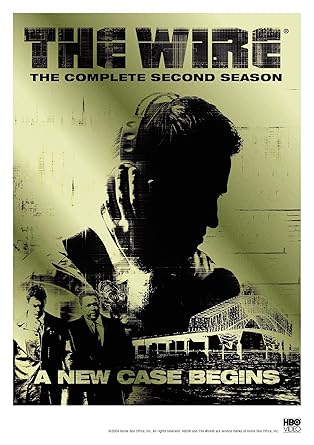
Brief Review: TV Series The Wire starring Dominic West, Sonja Sohn and Lance Reddick


One of the wonders of cable and webcast TV viewing is that occasionally, you can stumble into an entire amazing series you missed when it was originally broadcast. For me, this was The Wire, a series from 2002-2008, set in ghetto-and-dockyard Baltimore. After it was recommended during a recent "Watchathon" by multiple writers whom I trust, I began with Episode 1, Season 1, and watched it in its entirety over the course of a couple of weeks. In this environment, the story proved to be complex, well-written, with interesting characters who developed over the seasons into people I cared about, at least enough to curse at!

As the name might imply, the plot gimmick is telephone surveillance, run by the Baltimore Police Department (BPD) against the drug trade. Each season focuses on a new investigation, and explores it with a slightly different kind of wire. The series' continuing characters (both in BPD and on the streets) are, with just a few exceptions, criminal, dishonest, or corrupt—or all of the above!

The starring character, Detective Jimmy McNulty (Dominic West), is no exception: a self-destructive alcoholic locked in an adversarial relationship with his employer, Baltimore PD, he finds new focus with the initiation of a clever wire-tap equivalent as a task force of losers is assembled to investigate the street-corner drug trade in Baltimore's project housing. Over the course of 13 episodes in Season 1, the wire-tap crew comes together as an effective force arrayed against a criminal organization headed by Avon Barksdale (Wood Harris) and Stringer Bell (Idris Elba).

In this crowd of conniving police and murderous criminals, the few incorrupt individuals shine. Det. Kima Greggs (Sonja Sohn) is a competent cop side-lined by her gender and sexuality. Det. Lester Freamon (Clarke Peters) was shunted into a position as evidence clerk when he took a principled position against a superior 13 years before. Lieutenant Cedric Daniels (Lance Reddick) struggles to work within his framework as the department supervisor, but his effort is hamstrung from the beginning by department politics, budget limitations, and the misfit crew assigned to him. 

There are lots of questionable cops as well. Just to name a few, Det. Hauck (Domenick Lombardozzi) comes across as a bigoted thug. He and his partner, Det. Carver (Seth Gilliam), a wise-cracking sneak, are always looking for a way to skim. Under-reported drug money, bribes, theft of evidence property, and a few other scams send a trickle of graft to their pockets. Among the other losers detailed to the investigation unit is the clueless Det. "Prez" Pryzbylewski, son-in-law of the district commander, who manages to shoot a wall while showing off his "hair-trigger" personal sidearm in the first episodes. 

My short comments cannot possibly show all the ways the criminal Baltimore ghetto, the corrupt Baltimore political machine, and the crooked cops interact to undo any honest efforts to straighten out the mess. In each season, my initial response is glee at the clever twist on surveillance that promises to bring down the drug conspiracy. This segues into suspense as the venality of everyone, both sides against the middle, brings the investigation to naught. The final feeling is always frustration, as I realize the mirror that is held by The Wire reflects anti-crime activities everywhere, not just Baltimore.

I'll add only one thing. If you have the opportunity, hold your nose and brave the vile language. The Wire is worth wading in the muck, fighting the frustration, and rueing the political shenanigans. It's an action thriller that horrifies because it cuts a little too close to the bone, a little too close to home.

A Dragon Sleeps in Our Genes

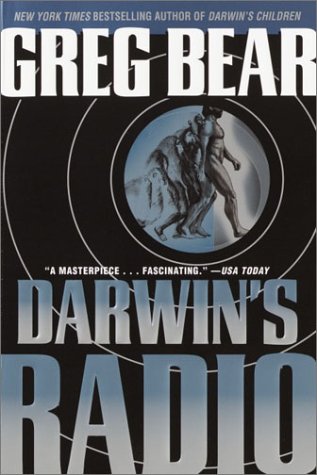
Review: Darwin's Radio by Greg Bear

In evolutionary debate, the question of Intelligent Design is a hot button; if life-forms are evolving to a particular design, one must presuppose a designer.

We also need a mechanism to communicate the design, one that matches observed phenomena better than Darwinian selection, and can carry design instructions forward through generations of forms that do not express it. 
For example, if a design is responsible for an air-breather's lungs, there must be some way for a genetic instruction for lungs to reside in the gill-breathing precursor—and that instruction must stay unexpressed through aeons of gill-breathers.

Greg Bear has proposed such a mechanism in Darwin's Radio. Biologist Kyle Lang is investigating the possibility that an ancient disease may be coiled "like a sleeping dragon" in the remnants of endogenous retroviruses, the so-called "junk DNA" in the human genome. As her research begins to bear fruit, a pandemic is growing. If she does not act, soon there may not be any humans left to use the knowledge she has gained.

Bear has taken a fact: the existence of gene "phages" that lie unexpressed in the genetic code until environmental stress causes them to express, and which can lie dormant for generations until they find the right conditions to express. From that fact, Bear has taken a giant "what if" leap: What if a similar DNA sequence lies unexpressed in human DNA, waiting to drive all of us in the next evolutionary step forward?

Even though there is a potential mechanism for communicating a genetic design forward through time, unaddressed in this novel or its sequel Darwin's Children is the question of Intelligent Design itself. In fact, the second book seems to imply the opposite, that the "radio" which is telegraphing messages forward is merely genetic selection at the level of the individual gene. 


So although the books are thrilling, and chock-full of information about human DNA research skillfully used to drive the story, for me, there is that nagging question still waiting to be asked.

Monday, May 9, 2016

Rearranging Lifestyles and Bodyfat

Review: Bridget Jones: The Edge of Reason by Helen Fielding (and the movie with Renée Zellweger)


No one can claim that Bridget Jones lacks focus. In her diary, she is totally focused on three things: Keeping Mark Darcy, Losing Weight, and Giving Good Advice. But even with that with all that focus, things seem to go awry on her.

For one thing, it's hard to be receptive to a good snuggle while you're trying to hide the fact that you're wearing "really scary underpants." Bridget's undergarment 
struggles, begun in the first Diary (Daniel Cleaver was strangely aroused by her "giant" beige knickers), continue as she conceals her tummy bulge with corsetry.

Cannot help but wonder if was free to rearrange own fat according to choice, would I still wish to reduce amount? Think would have huge big breasts and hips and tiny waist...

The movie substitutes a near-triumph in Trivial Pursuit by Bridget at Mark's swanky Law Dinner party for her hilarious précis of Labour vs. Tory politics in the book. (Perhaps the movie producers thought the political discussion would be inaccessible—or worse, not funny—to US audiences.) Either way, Bridget's careening, almost-there headlong style is always capped by the final humiliating "oops!" ending, faithfully recorded in her diary under the daily record of weight, cigarettes smoked, and lies told about her diet and smoking.

Despite her obsessive focus on her Relationship With Mark Darcy, Bridget has time to obsess about other people's relationship issues, too. Her mother is off again, this time to Kenya, and Bridget believes her father's "stiff upper lip" reaction is hiding a broken heart. Her buddy Jude is starting to worry about her biological clock, but not enough to want the baby-belly and cabbage-bra issues of Magda, their "Smug Married" friend. And Sharon, or "Shaz," has abandoned her feminism for a troubling proclivity to watch soccer with the boys.

Bridget is battling work relationship issues, too. Her boss gives her assignments ("locate two Middle-England voters who are pro") and waits for her to screw them up. Meanwhile, he will put her on camera only in situations where she can display her complete incompetence (and her undergarments). Mark's office has him paired with Rebecca, who obviously has designs on him. (For some reason, the movie invents a whole other character to be the "jellyfish," whose every encounter with Bridget results in her delivering multiple verbal stings; "Bridge, how's it going with Mark? You must be really pleased to get a boyfriend at last.")

In an effort to escape the snarled cares of her life, Bridget agrees to visit Thailand with Shaz, "and NO MEN!" In fact, she gets her wish, as she winds up in a Thai women's prison. Fortunately Bridget's blithe take on life, and her thorough grounding in the religion of self-help (and Mark Darcy) come to her rescue.

Despite the substitutions and amendments noted above, the movie captures the breezy voice of Bridget Jones' diary entries perfectly. Casting is wonderfully apt; Colin Firth as Mark Darcy is especially appropriate, considering Bridget's and her girlfriends' sovereign remedy for the blues is a viewing of Pride and Prejudice starring Firth as Jane Austen's mannered hero Lord Darcy. Excellent reprises by Gemma Jones as Bridget's Mom, and Jim Broadbent as her Dad also shine. Hugh Grant shows up to reveal Daniel Cleaver's middle-aged angst, and to let Mark Darcy settle his hash.

In the end, though, it is Bridget Jones herself, with Renée Zellweger plumping up for the role again, who carries the story. You just have to love a woman who can look at herself honestly in the mirror, and still proclaim,
"I truly believe that happiness is possible... even when you're thirty-three and have a bottom the size of two bowling balls."

Before Flash Fiction, There Was Feghoot

Review: The Compleat Feghoot by Reginald Bretnor (writing as Grendel Briarton)


Have you heard the one about the guy who planted kitchen herbs in his creek to make it run uphill, because "dill waters run steep"? 

No? How about the news headline announcing the court's judgement re: a thief who had waited out the statute of limitations period for his crime in a time bubble: "A niche in time saves Stein." 

Or a vulture carrying two dead raccoons, turned away by the stewardess as he goes to board the plane, because "only one carrion is permitted per passenger."

These are classic "Feghoots," a genre of super-short (science-)fiction story—today we would call it flash fiction—that usually featured space-and-time traveler Ferdinand Feghoot, and always ended with a terrible pun. They appeared in many of the early science fiction magazines. Reading the name of the main character, Feghoot, was enough to provoke an anticipatory groan for the pun we knew was coming.

Most of these stories were written by Reginald Bretnor under his anagrammatic pseudonym, but the ideas for them were often suggested by other sci-fi writers of the time. Isaac Asimov wrote one on his own (the "niche in time" cited above). Thomas Pynchon included a Feghoot-less incident in Gravity's Rainbow. It ended with "For DeMille, young fur-henchmen can't be rowing!" (Forty million Frenchmen can't be wrong.)

Have a good groan today: read a Feghoot and celebrate the endless ways we twist clever words to make a story come out "right."

Liner Notes:

  • There are several Feghoots included in the The First Reginald Bretnor Megapack if you cannot find The Compleat Feghoot in your second-hand bookstore.
  • The Second Reginald Bretnor Megapack not only includes another Feghoot, but also the Papa Schimmelhorn stories and the classic Gnurrs Come From the Voodvork Out.
  • My own copy of The Compleat Feghoot resides in the john, where it is available to enliven those "idle moments."

Saturday, May 7, 2016

Surveying Skeeters (Carrot Ranch Flash Fiction Challenge)

For most of us, disasters are rarities. Rather, we build our positive or negative memories upon mounds of tiny successes or clouds of nagging defeats. We go camping, and take home a bright image of a tasty fish caught and grilled for supper, or we recall only the battle to defend our ankles from the bite of ticks and chiggers.

I recall one spring, when we were searching for an appropriate place to hold a human-powered vehicle speed challenge in the Western Rockies. Our two-man team went out to survey roads in Colorado. We were hunting a paved surface with a specific slope (0.66%), 200 meters for the timed stretch, with a gentle catenary curve leading down to it, and as few bumps as possible. How hard could it be, after all?

It would have been a pleasant outing, with wonderful scenery, and purposeful work to survey our candidate roads—except for the biting insects. Deer flies, gnats, and the never-sufficiently-to-be-damned mosquitoes were out in force, and I was the best buffet they had available. 

In the prompt this week for the Carrot Ranch Flash Fiction Challenge, Charli Mills asks us to include insects in a story. Yet these pests need no invitation; they show up for dinner, and, if we let them, ruin the party!

May 4, 2016 prompt: In 99 words (no more, no less) include insects in a story. Periwinkles, bees laden with pollen, ants building hills. What can insects add to a story? Do they foreshadow, set a tone, provide a scientific point of interest or a mystical element? Let you inner periwinkles fly!

In the end, if you are wondering, we did find a downhill run that met our parameters, and the four-cyclist engine powered their Pininfarina-designed vehicle to just short of a record. Nowadays, these runs are made in Nevada. I fortunately have no idea what pests wait for surveyors in that dry environment!

_______________________________________

Surveying Skeeters

A spring somewhere uphill feeds a soggy ditch paralleling the road. Every road we've surveyed seems to have its own mosquito bog. I squint downhill through the transit to the rod my partner holds, and, jotting the numbers, spot the blood-sucker on my hand. 

Whap! My notebook serves a second function as a skeeter-swat. I turn the transit to the back-line and spot the previously-sited stake. Wiping my sweaty forehead, I dislodge a team of gnats. My hand comes away adorned with another mosquito.

That night, doing calculations from my surveyor's notes, I find more dead mosquitoes than numbers.

Real Torture, Deprivation, and Life Triumphant

Review: The Long Walk by Slavomir Rawicz

In 1939, 25-year-old Polish cavalry officer Slavomir Rawicz was sentenced to twenty-five years of hard labor in Siberia following a torture-induced “confession” in Moscow. In 1956, he was living peacefully in England with his English wife. The years between are detailed in The Long Walk, the classic tale of Rawicz’ trek with seven others to freedom.

Rawicz tells his story from the calm, relaxed vantage of a decade’s separation from the events. If anything, this detached approach lends additional power to the tale. He spends less than a chapter detailing his torture at the hands of the NKVD “specialists” in Kharkov prison, almost passively detailing his weeks-long confinement in a upright-coffin-sized kishka cell standing in his own bodily wastes, his racking and the burning of his hands with hot tar, the systematic beatings and subtler tortures. Rawicz can even praise the kishka of Lublyanka prison where he is incarcerated during his show trial, because “…this kishka was clean, and the periods I was forced to spend in it were much shorter.”

Sentenced to serve in a labor camp in Siberia, Rawicz must first get there from Moscow. This trip takes him 3000 miles by train across wintry Russia, still barefoot in the button-less cotton blouse and belt-less pants which he wore in the Kharkov. He reports the death of numerous prisoners in his cattle-car, whose bodies were dumped alongside the track after being stripped of their prison garb. “Father Stalin only loaned the poor bastard his clothes for the duration of his stay in the USSR…”

When the caravan reached the southern tip of Lake Baikal, the men were chained by twos to the end of a dozen trucks, and marched to their camp. Although they were issued warmer clothes and rubber boots, 10 to 15 percent of the prisoners died on that final march.

At Camp 303, Rawicz decides to escape. He is aided in this plan by the bored wife of the Soviet commandant, who asks only that he wait until her husband is away and the camp is nominally under the command of the political officer. Rawicz chooses six other prisoners—one of whom, they discover to their surprise, is an American mining engineer who was arrested after a year’s work on the Moscow subway tunnels. “Mr. Smith” is strangely fluent in Russian, and may in fact be a spy, but the other five men are Polish, Latvian and Lithuanian prisoners. They collect supplies of dried bread, steal deer, sable and rabbit skins from the guards, and manage to create warmer clothing, shoes and other tools for survival before leaving the camp in mid-April, 1941.

The seven men, and an escaped Polish teen, Kristina, whom they meet on the east side of the half-frozen Lena River, had before them a daunting trek. They would need to walk more than 3000 miles south through Siberia’s spring blizzards and icy rivers, Mongolia’s Gobi Desert and the Tibetan Himalayas, in order to “surrender” to a British lieutenant in southern Nepal. Along the way, Rawicz lists their changing numbers almost diffidently in chapter titles: “Seven Cross the Lena River”, “Eight Enter Mongolia”, “Six Enter Tibet”, “Five By-Pass Lhasa.”

Concealed within this off-hand report of group size is nine months of gruelling travel, including nearly sixty days of suffering in the Gobi Desert. “We sweated it out for about three hours in throbbing discomfort, mouths open, gasping in the warm desert air over enlarged, dust-covered tongues.” And, “After a while he closed his eyes and I thought he had gone, but he was still breathing quietly… There was no spasm, no tremor, no outward sign to show that life had departed the body.” And, “The heat enveloped us, sucking the moisture from our bodies, putting ankle-irons of lethargy about our legs.”

This is no calm, beautiful serenity that surrounds the travelers, but a rasping deprivation they fight with every ounce of their strength. Rawicz and three of his companions would live through this self-imposed torment to reach India and freedom. Throughout their trip, all eight of the escaped prisoners fought grimly to stay alive. Why, during a period of history when millions were dying in a second World War and a dire Holocaust, would we celebrate the triumph of four souls over death?

Today, when the “right to die” is viciously debated in our forums, and moral outrage over "torture" is extended to discomforts that pale in comparison, The Long Walk is a refreshing celebration of the will to live. Whether you read it as a moral fable or a true account of escape from Siberia, its focus on life is a useful contrast to the discussions of the day.
I hope The Long Walk will remain as a memorial to all those who live and die for freedom, and for all those who for many reasons could not speak for themselves. I had to tell my story as a warning to the living, and as a moral judgment for the greater good.  Slavomir Rawicz, 1993 Introduction to The Long Walk