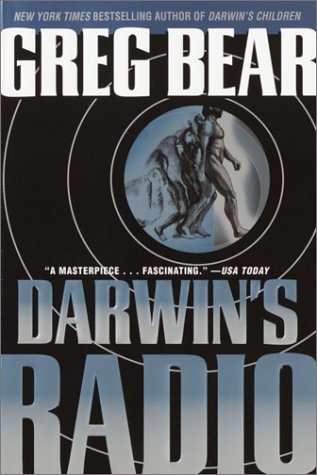
Review: Darwin's Radio by Greg Bear
In evolutionary debate, the question of Intelligent Design is a hot button; if life-forms are evolving to a particular design, one must presuppose a designer.
We also need a mechanism to communicate the design, one that matches observed phenomena better than Darwinian selection, and can carry design instructions forward through generations of forms that do not express it. For example, if a design is responsible for an air-breather's lungs, there must be some way for a genetic instruction for lungs to reside in the gill-breathing precursor—and that instruction must stay unexpressed through aeons of gill-breathers.
Greg Bear has proposed such a mechanism in Darwin's Radio. Biologist Kyle Lang is investigating the possibility that an ancient disease may be coiled "like a sleeping dragon" in the remnants of endogenous retroviruses, the so-called "junk DNA" in the human genome. As her research begins to bear fruit, a pandemic is growing. If she does not act, soon there may not be any humans left to use the knowledge she has gained.
Bear has taken a fact: the existence of gene "phages" that lie unexpressed in the genetic code until environmental stress causes them to express, and which can lie dormant for generations until they find the right conditions to express. From that fact, Bear has taken a giant "what if" leap: What if a similar DNA sequence lies unexpressed in human DNA, waiting to drive all of us in the next evolutionary step forward?
Even though there is a potential mechanism for communicating a genetic design forward through time, unaddressed in this novel or its sequel Darwin's Children is the question of Intelligent Design itself. In fact, the second book seems to imply the opposite, that the "radio" which is telegraphing messages forward is merely genetic selection at the level of the individual gene.
So although the books are thrilling, and chock-full of information about human DNA research skillfully used to drive the story, for me, there is that nagging question still waiting to be asked.
Wednesday, May 11, 2016
Monday, May 9, 2016
Rearranging Lifestyles and Bodyfat
Review: Bridget Jones: The Edge of Reason by Helen Fielding (and the movie with Renée Zellweger)
No one can claim that Bridget Jones lacks focus. In her diary, she is totally focused on three things: Keeping Mark Darcy, Losing Weight, and Giving Good Advice. But even with that with all that focus, things seem to go awry on her.
For one thing, it's hard to be receptive to a good snuggle while you're trying to hide the fact that you're wearing "really scary underpants." Bridget's undergarment struggles, begun in the first Diary (Daniel Cleaver was strangely aroused by her "giant" beige knickers), continue as she conceals her tummy bulge with corsetry.
Cannot help but wonder if was free to rearrange own fat according to choice, would I still wish to reduce amount? Think would have huge big breasts and hips and tiny waist...
The movie substitutes a near-triumph in Trivial Pursuit by Bridget at Mark's swanky Law Dinner party for her hilarious précis of Labour vs. Tory politics in the book. (Perhaps the movie producers thought the political discussion would be inaccessible—or worse, not funny—to US audiences.) Either way, Bridget's careening, almost-there headlong style is always capped by the final humiliating "oops!" ending, faithfully recorded in her diary under the daily record of weight, cigarettes smoked, and lies told about her diet and smoking.
Despite her obsessive focus on her Relationship With Mark Darcy, Bridget has time to obsess about other people's relationship issues, too. Her mother is off again, this time to Kenya, and Bridget believes her father's "stiff upper lip" reaction is hiding a broken heart. Her buddy Jude is starting to worry about her biological clock, but not enough to want the baby-belly and cabbage-bra issues of Magda, their "Smug Married" friend. And Sharon, or "Shaz," has abandoned her feminism for a troubling proclivity to watch soccer with the boys.
Bridget is battling work relationship issues, too. Her boss gives her assignments ("locate two Middle-England voters who are pro") and waits for her to screw them up. Meanwhile, he will put her on camera only in situations where she can display her complete incompetence (and her undergarments). Mark's office has him paired with Rebecca, who obviously has designs on him. (For some reason, the movie invents a whole other character to be the "jellyfish," whose every encounter with Bridget results in her delivering multiple verbal stings; "Bridge, how's it going with Mark? You must be really pleased to get a boyfriend at last.")
In an effort to escape the snarled cares of her life, Bridget agrees to visit Thailand with Shaz, "and NO MEN!" In fact, she gets her wish, as she winds up in a Thai women's prison. Fortunately Bridget's blithe take on life, and her thorough grounding in the religion of self-help (and Mark Darcy) come to her rescue.
Despite the substitutions and amendments noted above, the movie captures the breezy voice of Bridget Jones' diary entries perfectly. Casting is wonderfully apt; Colin Firth as Mark Darcy is especially appropriate, considering Bridget's and her girlfriends' sovereign remedy for the blues is a viewing of Pride and Prejudice starring Firth as Jane Austen's mannered hero Lord Darcy. Excellent reprises by Gemma Jones as Bridget's Mom, and Jim Broadbent as her Dad also shine. Hugh Grant shows up to reveal Daniel Cleaver's middle-aged angst, and to let Mark Darcy settle his hash.
In the end, though, it is Bridget Jones herself, with Renée Zellweger plumping up for the role again, who carries the story. You just have to love a woman who can look at herself honestly in the mirror, and still proclaim,
"I truly believe that happiness is possible... even when you're thirty-three and have a bottom the size of two bowling balls."
Before Flash Fiction, There Was Feghoot
Review: The Compleat Feghoot by Reginald Bretnor (writing as Grendel Briarton)
Have you heard the one about the guy who planted kitchen herbs in his creek to make it run uphill, because "dill waters run steep"?
No? How about the news headline announcing the court's judgement re: a thief who had waited out the statute of limitations period for his crime in a time bubble: "A niche in time saves Stein."
Or a vulture carrying two dead raccoons, turned away by the stewardess as he goes to board the plane, because "only one carrion is permitted per passenger."
These are classic "Feghoots," a genre of super-short (science-)fiction story—today we would call it flash fiction—that usually featured space-and-time traveler Ferdinand Feghoot, and always ended with a terrible pun. They appeared in many of the early science fiction magazines. Reading the name of the main character, Feghoot, was enough to provoke an anticipatory groan for the pun we knew was coming.
Most of these stories were written by Reginald Bretnor under his anagrammatic pseudonym, but the ideas for them were often suggested by other sci-fi writers of the time. Isaac Asimov wrote one on his own (the "niche in time" cited above). Thomas Pynchon included a Feghoot-less incident in Gravity's Rainbow. It ended with "For DeMille, young fur-henchmen can't be rowing!" (Forty million Frenchmen can't be wrong.)
Have a good groan today: read a Feghoot and celebrate the endless ways we twist clever words to make a story come out "right."
Liner Notes:
- There are several Feghoots included in the The First Reginald Bretnor Megapack if you cannot find The Compleat Feghoot in your second-hand bookstore.
- The Second Reginald Bretnor Megapack not only includes another Feghoot, but also the Papa Schimmelhorn stories and the classic Gnurrs Come From the Voodvork Out.
- My own copy of The Compleat Feghoot resides in the john, where it is available to enliven those "idle moments."
Saturday, May 7, 2016
Surveying Skeeters (Carrot Ranch Flash Fiction Challenge)
For most of us, disasters are rarities. Rather, we build our positive or negative memories upon mounds of tiny successes or clouds of nagging defeats. We go camping, and take home a bright image of a tasty fish caught and grilled for supper, or we recall only the battle to defend our ankles from the bite of ticks and chiggers.
I recall one spring, when we were searching for an appropriate place to hold a human-powered vehicle speed challenge in the Western Rockies. Our two-man team went out to survey roads in Colorado. We were hunting a paved surface with a specific slope (0.66%), 200 meters for the timed stretch, with a gentle catenary curve leading down to it, and as few bumps as possible. How hard could it be, after all?
It would have been a pleasant outing, with wonderful scenery, and purposeful work to survey our candidate roads—except for the biting insects. Deer flies, gnats, and the never-sufficiently-to-be-damned mosquitoes were out in force, and I was the best buffet they had available.
In the prompt this week for the Carrot Ranch Flash Fiction Challenge, Charli Mills asks us to include insects in a story. Yet these pests need no invitation; they show up for dinner, and, if we let them, ruin the party!
May 4, 2016 prompt: In 99 words (no more, no less) include insects in a story. Periwinkles, bees laden with pollen, ants building hills. What can insects add to a story? Do they foreshadow, set a tone, provide a scientific point of interest or a mystical element? Let you inner periwinkles fly!
In the end, if you are wondering, we did find a downhill run that met our parameters, and the four-cyclist engine powered their Pininfarina-designed vehicle to just short of a record. Nowadays, these runs are made in Nevada. I fortunately have no idea what pests wait for surveyors in that dry environment!
_______________________________________
Whap! My notebook serves a second function as a skeeter-swat. I turn the transit to the back-line and spot the previously-sited stake. Wiping my sweaty forehead, I dislodge a team of gnats. My hand comes away adorned with another mosquito.
That night, doing calculations from my surveyor's notes, I find more dead mosquitoes than numbers.
I recall one spring, when we were searching for an appropriate place to hold a human-powered vehicle speed challenge in the Western Rockies. Our two-man team went out to survey roads in Colorado. We were hunting a paved surface with a specific slope (0.66%), 200 meters for the timed stretch, with a gentle catenary curve leading down to it, and as few bumps as possible. How hard could it be, after all?
It would have been a pleasant outing, with wonderful scenery, and purposeful work to survey our candidate roads—except for the biting insects. Deer flies, gnats, and the never-sufficiently-to-be-damned mosquitoes were out in force, and I was the best buffet they had available.
In the prompt this week for the Carrot Ranch Flash Fiction Challenge, Charli Mills asks us to include insects in a story. Yet these pests need no invitation; they show up for dinner, and, if we let them, ruin the party!
May 4, 2016 prompt: In 99 words (no more, no less) include insects in a story. Periwinkles, bees laden with pollen, ants building hills. What can insects add to a story? Do they foreshadow, set a tone, provide a scientific point of interest or a mystical element? Let you inner periwinkles fly!
In the end, if you are wondering, we did find a downhill run that met our parameters, and the four-cyclist engine powered their Pininfarina-designed vehicle to just short of a record. Nowadays, these runs are made in Nevada. I fortunately have no idea what pests wait for surveyors in that dry environment!
_______________________________________
Surveying Skeeters
A spring somewhere uphill feeds a soggy ditch paralleling the road. Every road we've surveyed seems to have its own mosquito bog. I squint downhill through the transit to the rod my partner holds, and, jotting the numbers, spot the blood-sucker on my hand.Whap! My notebook serves a second function as a skeeter-swat. I turn the transit to the back-line and spot the previously-sited stake. Wiping my sweaty forehead, I dislodge a team of gnats. My hand comes away adorned with another mosquito.
That night, doing calculations from my surveyor's notes, I find more dead mosquitoes than numbers.
Real Torture, Deprivation, and Life Triumphant
Review: The Long Walk by Slavomir Rawicz
In 1939, 25-year-old Polish cavalry officer Slavomir Rawicz was sentenced to twenty-five years of hard labor in Siberia following a torture-induced “confession” in Moscow. In 1956, he was living peacefully in England with his English wife. The years between are detailed in The Long Walk, the classic tale of Rawicz’ trek with seven others to freedom.
Rawicz tells his story from the calm, relaxed vantage of a decade’s separation from the events. If anything, this detached approach lends additional power to the tale. He spends less than a chapter detailing his torture at the hands of the NKVD “specialists” in Kharkov prison, almost passively detailing his weeks-long confinement in a upright-coffin-sized kishka cell standing in his own bodily wastes, his racking and the burning of his hands with hot tar, the systematic beatings and subtler tortures. Rawicz can even praise the kishka of Lublyanka prison where he is incarcerated during his show trial, because “…this kishka was clean, and the periods I was forced to spend in it were much shorter.”
Sentenced to serve in a labor camp in Siberia, Rawicz must first get there from Moscow. This trip takes him 3000 miles by train across wintry Russia, still barefoot in the button-less cotton blouse and belt-less pants which he wore in the Kharkov. He reports the death of numerous prisoners in his cattle-car, whose bodies were dumped alongside the track after being stripped of their prison garb. “Father Stalin only loaned the poor bastard his clothes for the duration of his stay in the USSR…”
When the caravan reached the southern tip of Lake Baikal, the men were chained by twos to the end of a dozen trucks, and marched to their camp. Although they were issued warmer clothes and rubber boots, 10 to 15 percent of the prisoners died on that final march.
At Camp 303, Rawicz decides to escape. He is aided in this plan by the bored wife of the Soviet commandant, who asks only that he wait until her husband is away and the camp is nominally under the command of the political officer. Rawicz chooses six other prisoners—one of whom, they discover to their surprise, is an American mining engineer who was arrested after a year’s work on the Moscow subway tunnels. “Mr. Smith” is strangely fluent in Russian, and may in fact be a spy, but the other five men are Polish, Latvian and Lithuanian prisoners. They collect supplies of dried bread, steal deer, sable and rabbit skins from the guards, and manage to create warmer clothing, shoes and other tools for survival before leaving the camp in mid-April, 1941.
The seven men, and an escaped Polish teen, Kristina, whom they meet on the east side of the half-frozen Lena River, had before them a daunting trek. They would need to walk more than 3000 miles south through Siberia’s spring blizzards and icy rivers, Mongolia’s Gobi Desert and the Tibetan Himalayas, in order to “surrender” to a British lieutenant in southern Nepal. Along the way, Rawicz lists their changing numbers almost diffidently in chapter titles: “Seven Cross the Lena River”, “Eight Enter Mongolia”, “Six Enter Tibet”, “Five By-Pass Lhasa.”
Concealed within this off-hand report of group size is nine months of gruelling travel, including nearly sixty days of suffering in the Gobi Desert. “We sweated it out for about three hours in throbbing discomfort, mouths open, gasping in the warm desert air over enlarged, dust-covered tongues.” And, “After a while he closed his eyes and I thought he had gone, but he was still breathing quietly… There was no spasm, no tremor, no outward sign to show that life had departed the body.” And, “The heat enveloped us, sucking the moisture from our bodies, putting ankle-irons of lethargy about our legs.”
This is no calm, beautiful serenity that surrounds the travelers, but a rasping deprivation they fight with every ounce of their strength. Rawicz and three of his companions would live through this self-imposed torment to reach India and freedom. Throughout their trip, all eight of the escaped prisoners fought grimly to stay alive. Why, during a period of history when millions were dying in a second World War and a dire Holocaust, would we celebrate the triumph of four souls over death?
Today, when the “right to die” is viciously debated in our forums, and moral outrage over "torture" is extended to discomforts that pale in comparison, The Long Walk is a refreshing celebration of the will to live. Whether you read it as a moral fable or a true account of escape from Siberia, its focus on life is a useful contrast to the discussions of the day.
I hope The Long Walk will remain as a memorial to all those who live and die for freedom, and for all those who for many reasons could not speak for themselves. I had to tell my story as a warning to the living, and as a moral judgment for the greater good. Slavomir Rawicz, 1993 Introduction to The Long Walk
Seeking Glorious Death
Review: The Dark Lady by Michael Resnick
Michael Resnick’s “romance of the far future,” The Dark Lady, is an exploration of man’s attraction to the myth of glorious death. Told from the point of view of the alien “Leonardo,” the story examines heroism, self-sacrifice and the submission of artists to their art.
Leonardo himself is a a non-human male Bjornn, a kind of remittance-man from a species whose males are always sent away from the nest. His assignment to the service of art gallery owner Tai Chong (whom he refers to as “Great Lady”) is perfect for this creature who takes his species' obedience to females to the point of adulation.
While researching art for his Great Lady's gallery, Leonardo uncovers the recurring likeness of a single sad-eyed, dark-haired woman whose portrait has been rendered by artists across seven thousand years of human history. He is gradually drawn into obsession over her.
The Dark Lady of the title has been painted by dozens of relatively unknown artists. For many of them, it is the only such painting they have ever produced, often shortly after they have faced death. What do they all have in common, Leonardo wonders. Could this be some mythic war goddess? But not all the artists have been warriors. What draws men (always human, always male) to paint the portrait of this woman who never smiles?
Leonardo is not the only one obsessed with her. Malcolm Abercrombie, the “man who had it all,” is a bitter, self-absorbed collector who hates humans and non-humans with equal passion. His obsession is to complete his collection of portraits of the Dark Lady. On learning that Leonardo has a verifiable ability to find paintings not yet in his collection, Abercrombie hires the alien, and inadvertently feeds Leonardo’s growing interest.
Valentine Heath, the “man who stole it all,” contacts Leonardo to sell him a purloined portrait of the Lady. Between them, they decide to locate the actual woman who is the model. Although her first appearance in human art is certainly over 7,000 years old, she has been photographed and documented as a living woman, right up to the current day. They actually have her on their ship, when she vanishes in the midst of space!
Leonardo’s growing obsession with the woman is only increased when he begins to dream about her, and tries to sketch her image. Reuben Venzia, the “man who wanted it all,” also dreams of the Dark Lady, and the three males conspire to determine to whom the Dark Lady will appear next.
The poignant ending of the tale with the “man who got it all” is purely Resnick, and absolutely wonderful. Leonardo is just alien enough to carry the detachment his character needs to make the other men’s obsession plain—yet he is also male in a very basic way, and that, too, is why he comes to obsess over the Dark Lady.
Although some standard Resnick characters (the gunfighter, the remittance man, the high-rolling gambler, the elegant thief) make appearances in the story, they are not central. The Dark Lady’s attraction is no stronger for Resnick than for Leonardo, for she also stands for that obsession that lets artists (and writers) endure great privation, alienate friends and family, and cast all other efforts aside, in pursuit of their art.
And that, perhaps, is why Mona Lisa smiles.
Liner Notes:
- The French translation of this novel, la Belle ténébreuse, was the 2000 Prix Tour Eiffel Winner.
- William Shakespeare referred to a “Dark Lady” in a number of sonnets, and dedicated sonnets 127 to 154 to her.
Monday, May 2, 2016
Dining With the Devil
Review: The Editor and Del Webster by Vincent B. Moneymaker
Some things are inevitable. Death and taxes complete the usual list, but I submit another: when one sups with the Devil, a long spoon is required. Even then, some sort of short end on the deal that is finally dished up is to be expected.
Demon dinner-guests have sat down with attorneys and politicians, surgeons and money-lenders, and in one notable instance (Robert Sheckley's The Accountant), with a fellow in a green eye-shade. Moneymaker here offers a tale of a different supper with a red-eyed chap wearing a green eye-shade, this time in an editorial role.
At 9 pages, this is a short story with the cleverness and twist appropriate for dealing with a devil. Writers have their reasons to attribute demonic tendencies to editors, and I doubt Moneymaker is different. His tale might well be autobiographical.
The story is well written, and has a satisfying open end that Faust would approve. Several typos brought down the rating a bit, but the writing chops are there. I'll be looking for more from Mr. Moneymaker.
If he lives that long...
Liner Notes:
- Sheckley's story The Accountant can be read on Kindle in Store of the Worlds: The Short Stories of Robert B. Sheckley.
- The reviewed story does not appear to be available in other than eBook format.
Subscribe to:
Posts (Atom)